
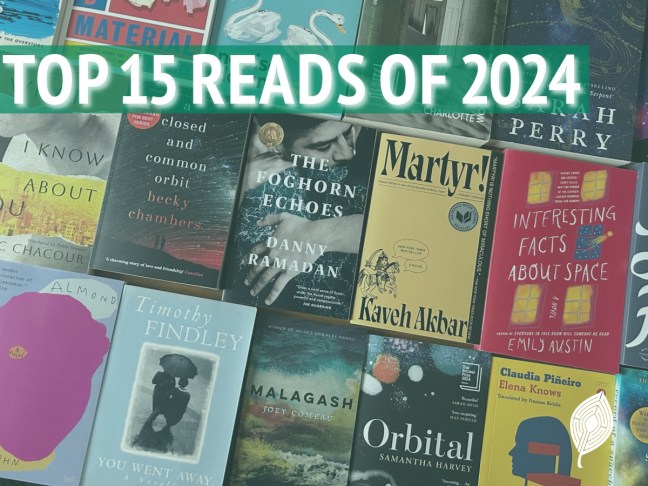
An annual ‘best of’ my reading year post has become a tradition here since 2017. Where 2023 was an absolute banner year for my reading life — by the second week of January, I’d already read two books I knew were not just going to be best-of-the-year picks, but new all-time favourites — 2024 was a slower burn, and didn’t quite hit the same heights. But not every year can be the best, and it was still a great reading year. Without further ado, here are the cream of this year’s crop.
15. Peacocks of Instagram, by Deepa Rajagopalan (2024 🇨🇦)
I adored this Giller short-listed collection of short stories about life in the Keralan diaspora (with most of the stories taking place in the United States or Canada). These are not just short stories in genre only — they average less than twenty pages per story, yet each was compelling, with strong point-of-view characters, and well-earned development. They never felt incomplete, but full, tight, narratives. Standouts in the collection for me were “A Thing with Many Legs,” “The Many Homes of Kanmani,” and the title story, “Peacocks of Instagram.”
14. In Winter I Get Up at Night, by Jane Urquhart (2024 🇨🇦)
Stories of settler life on the Prairie are a mainstay of Canadian literature, but fit increasingly uncomfortably in this time when we are just beginning to come to grips with the less savoury aspects of our national history, and struggling to find new and more truthful ways of telling that story. This recent release by Can-Lit icon Jane Urquhart, which was long-listed for the 2024 Giller Prize, is, I think, a helpful step in that process of reassessing our national mythology. It is still very much a story of proud and brave, and isolated, pioneer life, but it’s also a story of the tension between Canadian nation-building policies and those settlers who came seeking safety for their unique ways of life and had no interest in being assimilated into Anglo-Canadian society. As such, the country’s forced removal and assimilation of Indigenous peoples stands throughout the novel as an ominous and stark warning of the possibilities of cultural erasure. The fact that the story is mostly told from the protagonist’s childhood reflections — and so the reader understands far more than she does for quite a while — only heightens the foreboding atmosphere, particularly as she befriends children from many of the threatened communities. This is stellar.
13. The Bright Sword, by Lev Grossman (2024)
One of the most fascinating aspects of the Arthurian story cycle is its incredible ability to be reimagined in every succeeding generation — even its most ‘canonical’ elements are a bizarre amalgam of late Roman, early Medieval, and High Medieval European politics and culture. And so it should come as no surprise that this latest contribution to the Aurthurian universe is able to engage with contemporary themes and concerns — sexuality, gender identity, decolonization, and the anxieties of witnessing the end of an era of established norms — while feeling completely appropriate and natural to the world of these legends. This isn’t to say that it’s not also a rollicking good time, with plenty of action and adventure, mystery and magic — because it’s all those things too. And for all those reasons, it makes my list of top reads of the year.
12. Elena Knows, by Claudia Piñeiro (2007, transl 2021)
This is one of those rare books that transcends the ways we think and talk about books. It’s criminal it took fourteen years for this to be translated into English. While the book is framed in terms of a mother’s quest for justice for her daughter, this is ultimately about the never-ending challenges and indignities of living with a chronic degenerative disorder, and the difference between knowing something in our mind and knowing them in our core. This is simply a stunning, heartbreaking, and challenging piece of art. It is profound, empathetic, insightful, informative, and in a lot of ways far more terrifying than any horror story I read this year.
11. You Went Away, by Timothy Findley (1996 🇨🇦)
For me, Timothy Findley is one of those authors whose work either hits big or misses hard, and this was a huge hit for me. Make no mistake, this story of a Toronto family that slowly falls apart amidst the gloom of the WWII homefront is a very sad book, and the grief and loss are palpable on pretty much every page. At the hands of a lesser author, it would have felt manipulative, but with Findley at the helm, everything felt earned and just beautiful. Both of the main protagonists, Matthew, a boy struggling with a distant father and the transitions of adolescence, and his mother, who is trying to hold her family together in spite of her husband’s alcoholism and surprise enlistment, are all-time memorable characters for me. And the writing is absolutely superb. This is Can Lit at its best. (As a strange bookish coincidence I can’t help but mention, the opening scene of the novel takes place in my neighborhood!)
10. A Closed and Common Orbit (Wayfarers 2), by Becky Chambers (2016)
A Closed and Common Orbit, the second book in Becky Chambers’ Wayfarers series, is a great example of a sequel that builds off the first book but also excels in doing its own thing. This story about an artificial intelligence that finds itself in a humanoid body after years controlling the functions of a spaceship is indisputably one of the best science fiction books I’ve ever read. And with the rapid advances in AI technology over the past eight years since this was published, the ethical themes it engages with are all the more relevant and compelling. Thought-provoking, challenging, and one step ahead of where we’re at, this is a perfect example of why science fiction exists as a genre, and why it’s important.
9. Good Material, by Dolly Alderton (2024)
From the reviews I’ve seen, this is a very polarizing novel. And it seems that whether you love it or hate it depends on the extent to which you’re able to sympathize with the main character, Andy, a stand-up comedian of waning popularity who is struggling to accept the end of a relationship. While there are aspects of his story that are problematic — and we’re never meant to think otherwise — for the most part I found him to be lovable and sympathetic, even as I couldn’t wait for him to get it together. What was so refreshing about this for me was how opposite it is to the stories we normally get. Our dominant pop cultural narratives champion the person who is brave enough to end the ‘good-enough’ relationship to go after a bigger life. And that’s a good and needful story to be sure. But that’s only half the story — for every person wanting something bigger, there’s the person who loved the life-together that the other found so constricting, and so it felt a bit subversive to spend some time in this side of that story of unequal love. And that’s the real truth at the heart of this: Romance is inherently unfair; the one who is the least invested ultimately holds all the power. That isn’t ‘right’ or ‘wrong’, but just the reality. That Dolly Alderton was able to make a book engaging these hard truths winsome, charming, and laugh-out-loud funny is a tremendous credit to her.
8. Martyr!, by Kaveh Akbar (2024)
This is a strange but brilliant book that defies summary or explanation. But rest assured, this is a profound and powerful novel, well-deserving of all the praise it received upon its release. It follows the story of a troubled queer, Persian-American poet who, haunted by a cultural obsession with death, a family legacy of loss, and his own history of addiction, becomes obsessed with the concept of martyrdom and what makes death meaningful. Dealing with the deepest possible themes — loss, grief, identity, love, creativity, and meaning — Martyr! is full of the kind of wisdom that doesn’t offer easy answers but puts life’s big questions in a new and sparkling light. This is one that will stick with me for a long time.
7. Table for Two, by Amor Towles (2024)
Amor Towles is without a doubt one of our greatest living authors. And so, as much as I’d have loved for him to have released a novel, I was more than happy to get this incredible collection of stories instead. The first half of the book is comprised of six insightful and gently satirical tales set at least partially in New York City. (They are all excellent, but my standouts are “The Line”, about a Russian peasant who stumbles into individual success (and into the United States) under Communism, and “I Will Survive”, about a the surprising consequences of a harmless secret.) The second half is taken up by a novella (though, at over 200 pages with a robust set of characters, it’s hard not to call it a novel!) set in Los Angeles: an expanded version of the previously KU-release Eve in Hollywood, which is a sequel to his Rules of Civility (2011). Despite an ambitious plot, this provided a lot of space for Eve to breathe as a character; as much as I enjoyed her in Rules, she felt a little confined there, and I was glad to see her shine here in California. In all of these stories, Towles demonstrates again and again his impeccable writing and grasp of place and character: No one can get me invested in a new situation as quickly or as deeply. Really, my only complaint was in the lop-sided structure of the collection. I think these would have been better served by being two 225-page books instead of one 450-page one. But this does nothing to diminish the brilliance of what’s inside.
6. What I Know about You, by Éric Chacour (2023, transl. 2024 🇨🇦)
This Giller-short-listed title, about the consequences of an Egyptian man’s illicit affair, won several major awards in Quebec for its original French-language publication, and was receiving a lot of buzz in the lead-up to its English-language release this Summer. And so I was thrilled to discover that all of the praise was absolutely warranted. This is a spectacular novel. The plotting is amazing, especially in the first half of the book, where we see an innocent situation slowly become something different, and the noose slowly close around the main character’s neck. I’ll also note that I’ve rarely seen a second-person narrative voice — something I normally don’t enjoy — used to as good effect as it is here.
5. Stone Yard Devotional, by Charlotte Wood (2023)
This was among the more whispered about books on this year’s Booker lists — not just because of its limited release (I picked up a copy in Europe, as its North American release isn’t scheduled until 2025), but also because its still small voice didn’t resonate with some readers. This story about a burned out environmental activist who goes to a convent to recover deals with classic questions of human Wisdom traditions: faith and doubt, hope and despair, contemplation and action — questions all the more pressing in these times when not only the future of civilization but life on earth itself seems to hang in the balance. And yet it does not seek to answer these questions. It’s really about one woman’s search for acceptance of the life and times that have been given to her: her sorrows, her failings, her successes, her anxieties for the future and exhaustion from wrestling with all of these for so long. I understand this won’t work for everyone, but make no mistake: it’s a masterpiece.
4. The Art of Fielding, by Chard Harbach (2011)
There’s a cliche about authors (especially white male authors) trying to write ‘the Great American Novel.’ But Chad Harbach may actually have done it with this novel about the big consequences of a freak accident on the baseball diamond of a small liberal arts college. It’s kind of a perfect novel, from start to finish. The sentence-level writing is gorgeous (even if the author shows far too much love for the word ‘ecru’), the characters and relationships vivid and realistic, the character journeys earned, the plotting tight, and the themes expansive and universal, while remaining deeply personal. The worst I can say about it is that its perfection is grounded in a precision and control that can edge on sterility in moments. (I often feel this way about books by authors with MFAs.) But that’s a minor complaint, if it’s even a complaint at all. This was just fantastic.
3. Dayspring, by Anthony Oliveira (2024)
This is one of the most original, strange, controversial, and wonderful books I’ve ever read. Its basic premise, which puts Jesus into a sexual relationship with a man, will make it a non-starter for many readers — scandalized either by the explicit homosexual content, or by just how incredibly Jesus-y it is. It’s a big risk and one that could easily have gone sideways quickly. But nothing here is designed to titillate or shock, but rather to make profound and beautiful theological points. Jesus is a sexual being here in the same way that he makes fart bubbles in the bath: because he delights in his embodied existence. In other words, this poetic, unabashedly queer, novel is one of the most profound reflections on the Incarnation I’ve encountered: “And the Word became flesh: coarse hair, crooked smile, the taste of salt on his clavicle.” This is God not just becoming human but becoming a man. And part of that involves the sticky, smelly, pleasurable, and painful realities of having a body many ‘good religious folk’ would rather not think about. The Gospel narrative is mostly left unchanged here, and the creative reworkings Oliveira does undertake are really thoughtful ways of ironing out some wrinkles in the stories, and they also smartly play on historical traditions about them. Interspersed throughout the narrative are quotations from mystics throughout the centuries who have described their relationship with Christ in erotic terms. This is really effective because it again pushes back against the dualist suggestion that desire and pleasure are bad things, while also leaning into the personal charisma this figure Jesus had not only in his earthly life but to the present day. All this said, this will absolutely not be for everyone, but it’s absolutely something beautiful and very special: a profoundly theological, mystical and poetic work that leans into the Incarnation and teachings of Jesus with as much wonder, joy, and beauty as it can.
2. My Friends, by Hisham Matar (2024)
This novel, reflecting on the realities of life in exile through the eyes of a London man unable to return to his native Libya, is absolutely brilliant. I was shocked, and even outraged, that this didn’t make the cut from the Booker long list to the short list. It’s literary without being pretentious, and the writing drew me in from the first page. It also perfectly bridges the gap between the particular — a very specific story of political exile — and the universal — the longing for a place to call home. While the story covers some very difficult territory, it never felt like it was piling on the trauma and in fact always remained hopeful. This novel is a gift and not only is it among my top reads of the year, it’s also now among my all-time favourites.
1. Glorious Exploits, by Ferdia Lennon (2024)
This is one of those books that was so good, so unexpected, and so charming, that I wanted to hug it and squeeze it and never let it go. The specific and unique setting — the Sicilian city of Syracuse during the Peloponnesian War — works really well, the characters are memorable, the pacing is perfect, and it features one of the strongest narrative voices I’ve ever encountered. (The author’s decision to write this story set in ancient Sicily in his native Irish patter was an incredible choice in this regard (If you’re an audiobook reader, I highly recommend this format here, as the author performs the audiobook and it elevates every interaction and comedy beat.).) And while, yes, it’s funny and delightful, it also has important things to say, about the arts, about the possibility of genuine connection in the midst of conflict, and the human spirit.


One thought on “Top 15 Reads of 2024”