
Over all of the many years I’ve been keeping this blog, my various projects and series have consistently brought me back to the opening chapters of Genesis. Do we need to reassess our relationship with creation? Turn to Genesis. Do we need to question common understandings of sin? Turn to Genesis. Are we exploring what it means to be human? Turn to Genesis. Are we wondering what our Scriptures really have to say about gender and sex? Turn to Genesis. Indeed, for Christians, there have been few chapters more important for our basic understanding of the world and ourselves than the opening chapters of Genesis. But this significance is not necessarily obvious; these texts are far less important in Judaism, for example, which of course shares them and has a longer history of reflecting on them (Sarna 9, ACCS 6).* So, we have to ask ourselves why and how these texts have come to have the outsized influence on Christianity they’ve had, and how they’ve been interpreted, misinterpreted, and reinterpreted over the centuries. It’s hard for us as readers today to come to them ‘clean’, to not just see in them what we expect to see. And that makes them ripe for a more intentional study.
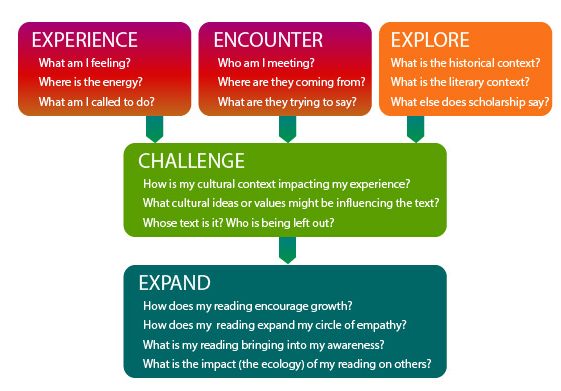
Over the next few weeks, I’ll be applying my Integral hermeneutic method to Genesis 1-11, which covers biblical primordial prehistory, from creation until just before the call of Abram. As a reminder this methodology involves five steps: 1. The reader’s experience of reading the text; 2. Who the reader encounters in the text; 3. What insights the reader might gain from literary, rhetorical, textual, and historical analysis and study; 4. What insights the reader might gain from the perspectives of those whose story the isn’t telling, or who have historically been marginalized by its interpretation; and 5. Putting all the pieces together to leave with an interpretation that is informed and life-giving:
But to begin, today I’ll be going over some introductory questions about Genesis itself, including authorship, dating, form, and importance.
Authorship & Dating
The short answer is that we have no idea who wrote Genesis, or when. There are few internal clues, if any, and one’s presuppositions will go a long way in determining how one interprets them.
That said, ancient tradition considered Moses as the primary author for the first five books of the Bible, known as the Pentateuch in biblical scholarship. But there are no internal suggestions this is the case within Genesis, and it seems very likely this tradition arose out of a misunderstanding of common ways of talking about books, where something called, say, the ‘book of Dwayne’ could just as easily be about Dwayne as written by Dwayne. And there’s no question that Moses is the star of the other four books in the Pentateuch. This combined with the long tradition of pseudepigrapha in Second Temple Judaism, in which writers would assign authorship of their books to ancient figures, makes it easy to see how a confusion could have arisen.
But the main argument against Moses’s authorship of Genesis that it seems clearly to be a heavily-edited, composite text. This stands to reason since the book brings together a diverse set of stories, most likely originating as oral traditions that were written down only much, much later.
Talk of ancient sources lying behind the Biblical text can be controversial, but it really shouldn’t be. The Old Testament makes explicit reference to roughly twenty sources that no longer exist, including The Book of the Wars of the LORD (Numbers 21:14) and the Book of Jashar (Joshua 10.3, 2 Samuel 1.18). Moreover, as we will see over the coming weeks, Genesis contains doubles of certain stories, including the major two stories at the heart of these introductory chapters: Creation and the Flood. These aren’t simply cases of an author looping back to elaborate on certain details; the details, and the narrative aims of the stories, are themselves different. (For example, in the first creation story, God creates the animals before humanity (1.20-26), but in the second story, God creates the animals only after seeing Adam’s loneliness (2.18-20).) Other evidence that the authors or editors of Genesis were working with pre-existing material comes in the book’s many allusions to Ancient Near Eastern (ANE) mythology. We’ll get into this in greater detail in future posts, but no matter what else we believe about the Bible, we must agree with Jewish biblical scholar Nahum Sarna’s assessment that “The Bible does not constitute an ideological monolith. … [I]t is clear that the Bible reflects different notions current in [Ancient] Israel, some of which awaken memories of ancient Near Eastern mythologies” (Sarna 1). Again it needs to be pointed out that Genesis’ dependence on earlier sources says nothing about its own quality or creativity:
A comparison with Near Eastern [creation myths] shows the degree of indebtedness of the Israelite version to literary precedent, even as Shakespeare was greatly obligated to his predecessors. Yet, at the same time, the materials used have been transformed so as to become the vehicle for the transmission of completely new ideas. (Sarna 4; cf Brueggemann)
Much has been written over the past two hundred years about who the final editors of Genesis may have been. Suffice it to say that this is still an open debate, and one that is most certainly unsolvable. At this point, the most widespread scholarly opinion places the more or less final edition of Genesis in priestly circles during the Babylonian Exile in the 6th century BCE (see Smith 41ff for a good summary supporting this dating). This relatively late date is suggested by details fitting a mid-first-millennium BCE context rather than a second-, such as references to Israel’s political composition (including the monarchy itself (49.10), which was not part of God’s plan for Israel!), references to people groups that only arose or arrived in the area in the first millennium (such as the Philistines (21:32, 34) and Chaldeans (11:28, 31; 15:7)), and themes of possession and dispossession of the Land of Promise, which would have been particularly poignant in an Exilic context.
While, again, we’ll likely never know when the text took its present form, at the very least it seems certain that it could not have been before the eighth century BCE and likely not later than the fifth. And, this editing job seems to have been well received, since the differences between the different textual traditions for Genesis are minor compared to some other parts of the Old Testament canon. (For example, most of the differences in Genesis lie in different approaches to solving difficulties in the timelines, whereas a book like Daniel has entirely different stories in it in different textual traditions. For more on the recensions, see Carr 5f.)
Form
Those last two paragraphs essentially skip over two hundred years of biblical scholarship. For a long time, scholars thought that the best way to really understand what was happening in the text was to understand the various texts underlying it. But I’m far more sympathetic to the line of thought that emerged in the second half of the twentieth century (led by Brevard Childs and carried forward by people like Walter Brueggemann), that irrespective of any sources, what’s really important for us in understanding the Bible is the finished product. As Brueggemann put the matter in his wonderful commentary on Genesis:
The matter of canonical authority is not something peripheral or extraneous to our exposition. Nor is it a matter of woodenly asserting the “truth” or “validity” of a text. Rather, the canonical character of the material is important in two respects. First, it requires that the texts be taken seriously on the assumption that when we listen faithfully they may yield to us important disclosures about our life and faith. …Second, the canonical character of the text indicates the kinds of expectations we may have and the kinds of questions we may ask. (Brueggemann)
Both of these points are worth unpacking a bit. First, we study the canonical form of the biblical texts because they are the texts that have been carefully crafted, edited, read, and passed on for over 2500 years now. This is the text we’ve been given and entrusted, so this is the text that we read. In and of itself, Genesis as we have it contains many different literary forms, including mythological materials, legends and sagas, geneaologies, blessings and curses, and battle stories, all brought together to form a (more or less) coherent narrative of one people’s origins set against the backdrop of the wider ANE world.
And second, and perhaps more controversially in some quarters, accepting the canonical text also means that we allow the text to determine its own meaning, rather than forcing our own questions upon it. Genesis doesn’t care about any purported conflict between science and religion, nor does it care about twenty-first-century gender and racial politics. We may come to the text with those questions, and they may help us unsay what previous generations have said about the text, but they shouldn’t blind us to what the text itself has been crafted to do and say. In other words, we approach it as story and allow the story to tell us what it’s about as much as possible. As Brueggemann put it, “Story offers nothing that is absolutely certain, either by historical certification or by universal affirmation;” but that doesn’t mean it’s not ‘true’ (Brueggemann).
Importance
This of course requires us to ask the question of what it is that the story of Genesis (and for our purposes, specifically Genesis 1-11) is designed to say and do. But we’re not in a position here at the start of this study to answer this question. But I think it does set up some further questions that can guide the study itself:
- Where there are two or more different versions of a story (whether within the Genesis text or between Genesis and other ANE texts), what do the differences tell us, and why is this (are these) the version(s) that came down to us in canonical form?
- How does each part of the narrative contribute to an overall message?
- And, how might that message echo through the rest of the biblical canon (and beyond)?
This third question is an important one, for as I already mentioned in my introduction, these chapters of Genesis have left rather different legacies in Judaism and Christianity. The basic pattern Christians, from Paul on, have seen, of creation and fall, has not been nearly as central or compelling to Jewish readers. Where Christians have read Genesis 3 as a unique and cataclysmic event with extreme consequences for all humanity, Jews have read it as just one example among many of human failure. This difference in legacy is also worth thinking through in greater detail.
It’s also important to note again that, perhaps because of the importance Christians have placed on these chapters of Genesis, they have over the centuries become a flashpoint for issues outside the concern of the text and its original authors and editors. For example, Genesis 1-11 has been used to justify the Trans-Atlantic slave trade, the perpetuation of patriarchy, and a lack of concern for environmental degradation. While it will be important to let the text speak for itself on these issues, part of letting the text speak will also require us to ‘unsay’ what others have said about it.
This will be a long and probably quite technical project. But I think it will be rewarding one, and a little fun too! So I hope you’ll join me in exploring these foundational texts.
* See the series bibliography for details.


One thought on “In the Beginning: An Integral Study of Genesis 1-11 – Series Introduction”