
[This series explores the way some of my favourite novels engage with spiritual things. As much as I will try to avoid discussing major plot points, I will be using quotes from the novels and be discussing how they fit generally into the story. So please take this as a spoiler warning.]
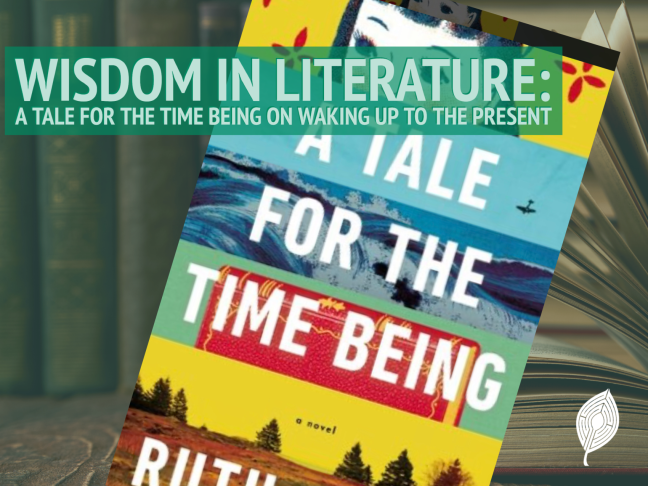
With all due respect to Juliet, who famously said that “That which we call a rose, by any other word would smell as sweet,” sometimes names can tell us everything we need to know. And that’s very true of American-Canadian author Ruth Ozeki’s 2013 novel (which happens to be my very favourite novel), A Tale for the Time Being. First, the title points to the fact that it’s a book very much of the moment. It deals with ever-present anxieties, both big — climate change, ecological disruption, and the ever-present threat of earthquakes and tsunamis along the Pacific Rim — and small — a lost pet, a difficult conversation, high school bullying. But second, the title also deploys a helpful double entendre, as a ‘time being’ is a Buddhist term referring to those creatures who live within time: namely, all of us. And so, this is a book that’s for all of us whose days are filled with the unknown, with ups and downs, joys and devastations, whose days are long but years are short. Reconciling ourselves to all of this, and giving meaning to it, is one of the major purposes of spirituality and wisdom traditions across the world, and this book is a wonderful example of this.
The novel begins in 2012, when one of our main characters, Ruth, is walking along the beach of one of the BC Gulf Islands, and discovers that debris from the previous year’s Japanese tsunami has started to wash up on shore. Among the debris is a sealed plastic bag that contains the diary of a Japanese schoolgirl named Nao. Ruth and her husband Oliver become fascinated by Nao’s life, which they quickly discover was in crisis long before the earthquake and its devastating aftermath. The one bright spot in Nao’s life was her grandmother, who lived as a Buddhist nun and whose wisdom and teaching provide the spine of the novel’s reflections on time and the vicissitudes of life.
As one might expect from a book with such strong Buddhist influences, the constancy of change and the absurdity of fighting it are core themes here. For example, Nao, realizing that her name sounds like the English word ‘now’, reflects: “I whispered Now!…. Now! … Now! … over and over, faster and faster, into the wind as the world whipped by, trying to catch the moment when the word was what it is: when now became NOW. But in the time it takes to say now, now is already over. It’s already then.” Later, Ozeki writes, “Everything in the universe was constantly changing, and nothing stays the same, and we must understand how quickly time flows by if we are to wake up and truly live our lives.” This ever-changing reality of life impacts not just us, but even our memories, as Nao notes in her journal: “But memories are time beings, too, like cherry blossoms or ginkgo leaves; for a while they are beautiful, and then they fade and die.” Similarly, observing the motion of surfer the waves, her grandmother says:
Surfer, wave, same thing. … A wave is born from deep conditions of the ocean. A person is born from deep conditions of the world. A person pokes up from the world and rolls along like a wave, until it is time to sink down again. Up, down. Person, wave.
In the face of this, our response should not be simply to stare into the abyss and weep at the futility of life — which was, to some extent, the approach to this same truth European Existentialists took — but to wake up to the present and live as fully as we can: “Life is fleeting. Don’t waste a single moment of your precious life. Wake up now! And now! And now!” Or again:
Both life and death manifest in every moment of existence. Our human body appears and disappears moment by moment, without cease, and this ceaseless arising and passing away is what we experience as time and being. They are not separate. They are one thing, and in even a fraction of a second, we have the opportunity to choose, and to turn the course of our action either toward the attainment of truth or away from it. Each instant is utterly critical to the whole world.
I’m reminded once again of the ancient Christian teaching about our place in the world, seen in as varied sources as the Cappadocian Fathers (4th C), Julian of Norwich (14th C), and C.S. Lewis (20th C), how we are simultaneously nothing compared to the vastness of the created world and deeply loved and vital to the world. Our smallness, finitude, and ephemoral nature make our action all the more urgent, not less. Life is short. Yet life has the capacity to bear so much meaning and to contribute so much to the world.
“Life is fleeting. Don’t waste a single moment of your precious life. Wake up now! And now! And now!”
 Matthew Root