
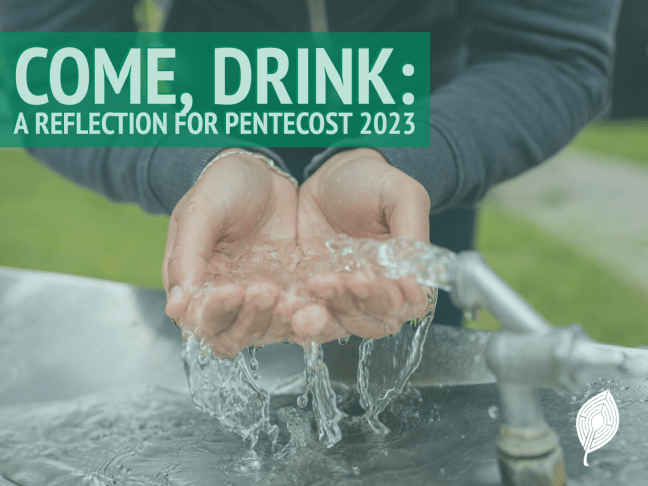
The creation story in Genesis famously imagines the chaos out of which God creates life as being a fathomless ocean. Whatever else we might think about this story, it rightly places water at the centre of the story of life. Life on our planet first developed in the water, and to this day, even the most stubbornly land-loving creatures are born out of a kind of re-creation of this original watery habitat. Poets say we are born out from the ocean of the womb and cry out the ocean in our tears. Our very bodies are likewise surprisingly watery: our hearts and brains are both about three quarters water, and our lungs are about fourth fifth water. Even our very solid-seeming bones are about a third water! Without water, there is no life. Yet, many of us live in a consistent state of dehydration, and even those of us who do get enough water sometimes need to remind ourselves to drink some. This was humorously captured in a meme that was circulating a couple weeks ago, which said, “You’re beautiful and capable, but probably dehydrated.” As true as this is physiologically, it’s also true spiritually and symbolically. So many of us go through our lives feeling dry and parched, as though we lived in a spiritual desert. The normal state for many of us is tired, low-energy, and low-inspiration. The promise of today’s feast of Pentecost, however, is that this doesn’t need to be the case: The living water of the Spirit is all around us, waiting patiently for us to remember to come and drink.
This is the message of today’s Gospel reading, a short passage from the seventh chapter of John. It reads:
On the last day of the festival, the great day, while Jesus was standing there, he cried out, ‘Let anyone who is thirsty come to me, and let the one who has faith in me drink. As the scripture has said, “Out of his belly shall flow rivers of living water.”’ Now he said this about the Spirit, which those who have faith in him were to receive; for as yet there was no Spirit, because Jesus was not yet glorified. (John 7.37-39)
These words are wonderful, beautiful, but also very strange. Their familiarity hides just how strange it really is. Jesus tells the crowd he has water, but then clarifies that it’s a spiritual water he’s talking about, and it’s not for now, but for later. There’s a lot to unpack here.
The first point of strangeness I’d like to address is the last in the passage: What does the explanatory note about how “as yet there was no Spirit” mean? It’s a bizarre turn of phrase and we shouldn’t be tempted to take this literally. The Spirit of God makes its first appearance in the Creation story (Genesis 1.2), and appears throughout the Old Testament in both general and specific ways. On the one hand, as today’s Psalm says, “You [God] send forth your Spirit, and [the animals] are created; and so you renew the face of the earth” (Psalm 104.30). Here, the Holy Spirit is understood to be, as the ancient prayer puts it, “everywhere present and filling all things” — the force working in and through the whole created order. In this sense, the Spirit is generally present everywhere we look. But on the other hand, the Spirit is said to come down upon specific individuals — mostly the charismatic leaders known as ‘judges’, prophets, and kings — in a special to enable them to fulfill the particular calling before them. The prophet Joel prophesied of a time when the Spirit would empower not just kings and prophets but the whole people, a prophecy Christians believe was fulfilled at the day of Pentecost, when the Holy Spirit came in power upon the disciples, sending them out into the streets ecstatically proclaiming the Gospel in other languages. From that time on, the coming of the Holy Spirit was understood to be the mark of genuine Christian faith and baptism. So, John’s turn of phrase “there was no Spirit” is strange. What he had to have meant was a kind of shorthand; writing from long after Pentecost, he is reminding his readers that the intimate experience of the Spirit they knew was not yet available to Jesus’ audience. Something that was obvious to them, and maybe even taken for granted, was yet to happen at the time of the story.
The second point that’s strange is that, while there are many Old Testament passages that use the analogy of water and Spirit, there is not one that matches Jesus’ supposed quote. It’s certainly a biblical idea, but it isn’t a quotation from any Scripture we know of today. The closest parallels are:
- “…until a spirit from on high is poured out on us and the wilderness becomes a fruitful field …” (Isaiah 32:15)
- “For I will pour water on the thirsty land, and streams on the dry ground; I will pour my spirit upon your descendants, and my blessing on your offspring” (Isaiah 44.3)
- “I will never again hide my face from them, when I pour out my spirit upon the house of Israel, says the Lord God” (Ezekiel 39:29)
- “Then afterwards I will pour out my spirit on all flesh; your sons and your daughters shall prophesy …” (Joel 2.28)
So, when Jesus is quoted here as saying “As the Scripture has said…”, it’s verses like these we should have in mind. It’s again the idea that the particular blessing of the Holy Spirit upon leaders of the people will be given to the whole people of God.
But why would Jesus suddenly start yelling about water anyway? The answer is found in the first few words of the passage, even though its significance is lost to most of us: “On the last day of the festival, the great day…” As we know from 7.2, the festival in question is Sukkoth, or Booths. One of the major events of this feast was a ritual drawing of water from the Pool of Siloam, which was believed to have healing properties, to be poured over the altar in the Temple. It was a ceremony symbolizing the renewal of the Temple, of life, and of God’s people, and was apparently a very joyous event. The Mishnah states about this event: “He who has not seen the rejoicing at the Place of the Water-Drawing has never seen rejoicing in his life” (Tractate Sukkah 5:1). So now the pieces of the puzzle about what Jesus is going on about are starting to come together. People have gathered for a joyous ceremony celebrating God’s renewal of Israel (both land and people) through the ritual drawing and pouring out of water. It’s then that he cries out, “Let anyone who is thirsty come to me, and let the one who has faith in me drink. As the scripture has said, “Out of his belly shall flow rivers of living water.’” As bizarre as it would have been to the crowds, Jesus is saying that he is the true well from which the community can be renewed.
The final curiosity about Jesus’ words I’d like to think through today is the ambiguity of the language in the ‘quote’, which is all the stranger since it seems most likely to be a summary of the Prophets’ teaching in his own words. I’ve translated it literally, “Out of his belly …” but the question then becomes whose belly it’s talking about. Grammatically, the clearest antecedent is ‘the one who has faith,’ and many English translations interpret this way (e.g., NRSV “Out of the believer’s heart…”). But this doesn’t really fit the logic of the passage, which suggests that Jesus is the well from which this living water should flow. From this perspective, it would make more sense for the pseudo-quote to be something like, “Out of the Faithful One’s belly…,” referring to God’s particular Servant. At any rate, the good news (and the Good News) is that it doesn’t really matter, because, in the logic of the Gospel, in what I often call ‘God’s economy’, both are true: We come to the Faithful One to receive the living water of the Holy Spirit and then become ourselves wells of life for the world.
And now, at last, I think, we have the rationale for why this passage is assigned for today, this great and holy feast of Pentecost. For it is for us the feast of the empowering of the people to become as Christ to the world. We come to Christ to become christs in the world; we receive the fire of the Holy Spirit to become ‘all flame’, as the wonderful story from the Desert Fathers puts it; we come to the well to drink the refreshing waters of the Spirit to become wells of living water ourselves. We receive in order to give. This is the Good News of God’s salvation for the world. And this is the meaning of Pentecost.
And so today, let anyone who is thirsty come to the well and drink. Amen. Amen. Amen.
 Matthew Root
3 thoughts on “Come, Drink: A Reflection for Pentecost 2023”