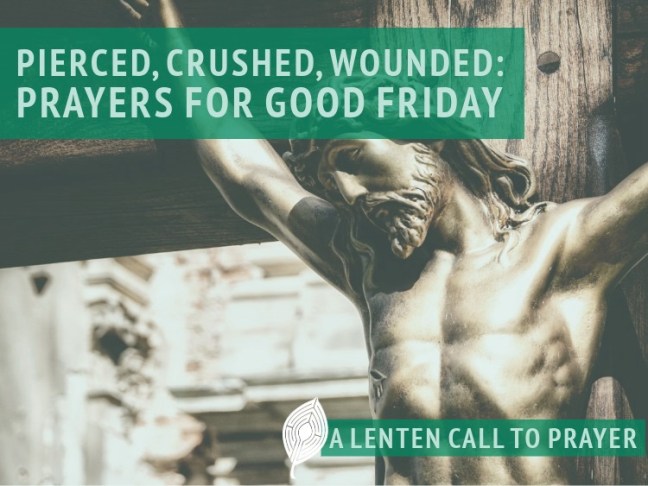
Today is one of the most sacred — and certainly the most solemn — of days on the Christian calendar, the day known in most of the English-speaking world as Good Friday. It’s the day when we commemorate Jesus’s farcical trials, beatings, crucifixion, and death. This is obviously rich theological soil for writing, but it can sometimes feel like soil that’s been depleted from overuse, or perhaps hard to farm because it’s been trod on so many times by so many people — myself included. But throughout this Lent and Holy Week, I’ve been reflecting on liturgical hymns and prayers, and in reading some of the prayers for Good Friday I was struck by a shared focus in both the oldest and the newest texts I came across on Jesus’ body, and how it relates to our own bodies.
The first is the 15th Antiphon of the Matins of Holy Friday in the Eastern Orthodox Rite, known colloquially as “Today He Who Hung the Earth.” It goes like this:
Today He who hung the earth upon the waters is hung upon the Cross.
He who is King of the angels is arrayed in a crown of thorns.
He who wraps the heavens in clouds is wrapped in the purple of mockery.
He who in Jordan set Adam free receives blows upon His face.
The Bridegroom of the Church is transfixed with nails.
The Son of the Virgin is pierced with a spear.
We venerate Thy Passion, O Christ.
Show us also Thy glorious Resurrection.
This hymn, in a common ancient liturgical trope, uses paradox to highlight the mystery of Christian faith. Picking up on poetic imagery from across the Scriptures, it emphasizes the shocking—and, strictly speaking, philosophically and theologically impossible—claim that when Jesus died on the Cross, in a very way God died. But what stuck out to me was how consistently this text focuses his body. His body is hung on the Cross, his forehead scratched by the crown of thorns, his shoulders wrapped in purple, his face struck, his side pierced. But as we remember all this, the prayer reminds us that our hope and prayer is that we will also see and know, and even participate in (Romans 6.3-8) his resurrection.
I was interested to see a similar focus on the body in the collect for the day in Prayers for an Inclusive Church (2009). It reads:
Lord, you are punctured,
no longer divided between inside and out,
knowing in your flesh the sharp violence that kills what it fears:
take us through the narrow door from which an endless river flows
into a new body – wounded but unafraid;
through Jesus Christ, the passion of God.
This prayer too focuses on the push and pull we experience on this day between witnessing Jesus’ suffering and knowing how the story ends, between death and new life, between the battered body and the glorious resurrected body. It viscerally describes Jesus’ wounds as breaking the sacred boundary of “inside and out,” and places the blame for that blasphemy on the scapegoat mechanism (”the sharp violence that kills what it fears”). But, in a surprisingly mystical turn for a twenty-first century text, it then pictures those same wounds, which literally violated Jesus’ physical integrity, as doorways between the old life and the new, and as springs pouring out the “living waters” of the Kingdom.
These are profound mysteries, that turn the ugliness of what we remember today — and we must never forget how ugly it all is — into something beautiful.
Let all mortal flesh keep silent.
 Matthew Root