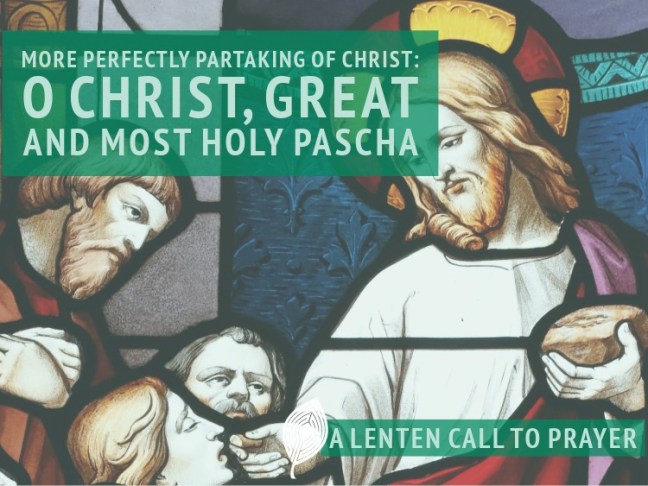
One thing I love about older liturgical traditions is how they’ve had time for through-lines to accumulate, connecting different services, feasts, and readings together across the year. One of my favourites is the praying, in the Byzantine rite, at communion of a part of the Paschal canon, the tradition’s great Easter hymn. Today, as we prepare to wrap up this series tomorrow (ish, as I’ll be taking the same approach for Holy Week this year), I’d like to reflect on the prayer and how it ties together the themes of the Eucharist and Holy Week.
The prayer in question is the troparion for the ninth ode of the Paschal canon, but is also traditionally spoken by the deacon right at communion. (In some local traditions, prayed by the whole congregation). It goes like this:
O Christ, great and most holy Pascha!
O Wisdom, Word, and Power of God!
Grant that we may more perfectly partake of You
in the never-ending day of Your Kingdom!
Pascha is simply the Greek word of Passover (and Easter). The association of Jesus with the Passover dates to the New Testament (1 Corinthians 5.17). Not only do the events of his betrayal, death and resurrection, take place in and around the Passover, but the Passover was also a major way early Christians understood the atonement (that is, what Jesus accomplished for our salvation). The dominant metaphor involved in this perspective is bondage and freedom: Just as the Hebrews were slaves in Egypt and were freed through the Passover, which was an apotropaic (protective) act that saved them from the plague of death, so too were we slaves to sin and death who are freed from their grip and power through Jesus’ “Passover” from death into life. Christ is the “Passover lamb” killed for the sake of our freedom and life, whose body feeds us and whose blood protects us. This is fitting imagery then for both Easter and here at the high point of the Eucharist.
Not only do we address Jesus here as our Passover, but also as the “Wisdom, Word, and Power of God.” These are again ancient titles for Jesus as the second Person of the Trinity. He is God’s Wisdom, God’s Logos (ordering principle, inner reason), and God’s power made manifest in human flesh. We think of these titles primarily in terms of creation, but here we deploy them thinking in terms of the new creation or re-creation.
Then comes the petition itself: We ask that, even as we are partaking in Christ in the sacrament, that we may more perfectly partake of Him in His Kingdom. As much as we believe that in ingesting the blood and wine at Holy Communion we are literally taking Christ into ourselves, to become part of our very flesh and bone, this is only a sign or foretaste of the communion with Him we trust we will experience in the fullness of the life of the Kingdom of God. And that’s our prayer, our ‘last word’ as we receive the bread and wine.
I think this is a beautiful and rich prayer, and these are the words that still come to mind for me whenever I receive communion, even though it’s been a decade and a half now since I last attended an Orthodox Divine Liturgy (Eucharist service). To my mind, it does everything that it could possibly do in and for that moment in just four short lines.
O Christ, great and most holy Pascha!
O Wisdom, Word, and Power of God!
Grant that we may more perfectly partake of You
in the never-ending day of Your Kingdom!
Amen.
 Matthew Root