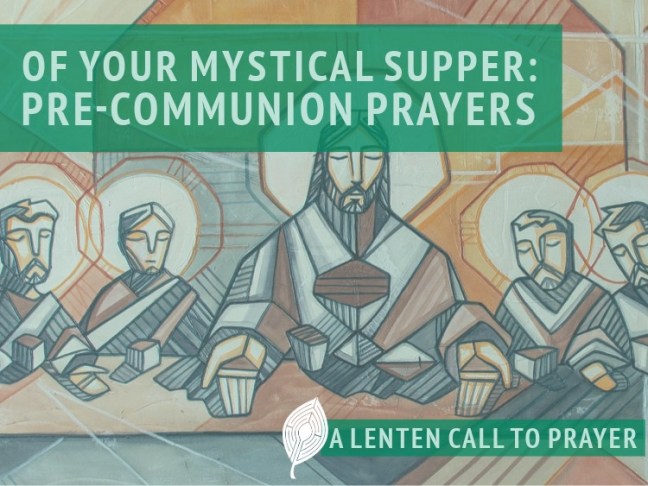
After a two-day hiatus in honour of the Annunciation, today we return to reflecting on pre-Communion prayers. On Monday, we looked at a traditional Anglican prayer prayed right before receiving Communion; today, we’ll turn our attention to prayers of the Christian East.
Before going up to receive communion, the faithful pray three quick prayers in succession. The first confesses both our faith and our sins:
I believe, O Lord, and I confess that You are truly the Christ,
the Son of the Living God,
Who came into the world to save sinners, of whom I am first. I
believe also that this is truly Your own pure Body,
and that this is truly Your own precious Blood.
Therefore I pray You:
Have mercy upon me and forgive my transgressions
both voluntary and involuntary, of word and of deed, of knowledge and of ignorance.
And make me worthy to partake without condemnation of You most pure Mysteries,
for the remission of my sins, and unto life everlasting.
Amen.
The first line brings together Peter’s confession of Jesus as the Messiah with the words of 1 Timothy 1.15 (”Christ Jesus came into the world to save sinners—of whom I am the first.”) The wording here of being the worst of sinners may be jarring and not “literal,” but it’s spiritually true. For all of us are in the same boat before God, in need of grace of forgiveness. There is no room for finger-pointing or judging others in the Christian life. So as far as each of us is concerned, we are all “the first” among sinners.
The prayer then moves on to our belief that the Eucharistic bread and wine become for us in the sacrament Christ’s body and blood. Believing as we do that God is gracious and forgiving, before approaching the Mystery of the sacrament, we ask for forgiveness of our sins, whether they were committed willfully or not, whether in our speech or actions, or whether committed knowingly or not. This fulfills the same role as the General Confession in Western services. Finally, it asks that our participation in the sacrament will be for our spiritual benefit.
The second and third prayers continue in the same vein:
Of Your Mystical Supper, O Son of God, accept me today as a communicant;
for I will not speak of Your Mystery to Your enemies,
neither like Judas will I give You a kiss;
but like the thief will I confess You:
Remember me, O Lord, in Your Kingdom.
May the communion of Your Holy Mysteries be neither to my judgment,
nor to my condemnation, O Lord,
but to the healing of soul and body.
Amen.
These prayers traffic in the more mystical and mysterious approach take to the sacraments. Originating in a culture where secret oaths, revelations, and words were taken very seriously, the prayers affirm that we will not speak of the Gospel truths to those who oppose God (as Jesus put it, not “casting pearls before swine”) or betray Christ like Judas, but rather will act like the faithful thief next to Jesus on the Cross, who asked of him: “Remember me, O Lord, in Your Kingdom!”
In a similar way, the last prayer assumes that if we partake of the sacraments without the proper preparation or attitude, they could actually be to our detriment rather than our benefit. This may sound a bit strange to our sensibilities, but it was a very common idea in the Ancient World. Unlike us, they had no flippancy about mystical experiences, but understood encounters with the transcendent to be genuinely awe-full and therefore as likely to harm as bless the seeker. (One famous Jewish story has only one of four rabbis seeking to encounter God return safely, the others either dying, going insane, or becoming a heretic for their efforts.) So it’s not surprising to see this sensibility here, in the context of this more mystical understanding of the sacrament. Really, the whole set of prayers we’re talking about here is designed to ensure the faithful don’t ‘accidentally’ partake unworthily: we confess our faith and the whole gamut of possible sins, promise not to betray Christ or the sacramental Mystery, and actively pray that our participation will be for our physical and spiritual healing and not to our detriment.
We might look at all this as superstition, but while I’m not sure I think God would ever actively harm someone for approaching mystical experiences with the wrong attitude, I do think we would do well to carry a bit more of this sense of awe with us. I’m reminded of the wonderful scene from C.S. Lewis’s The Lion, the Witch and the Wardrobe in which Susan asks of the great lion Aslan is “safe:”
“Is he-quite safe? I shall feel rather nervous about meeting a lion” …
“Safe?” said Mr. Beaver …”Who said anything about safe? ‘Course he isn’t safe. But he’s good.”
That’s the kind of attitude I think we’d benefit from reclaiming.
Of Your Mystical Supper, O Son of God, accept me today as a communicant;
for I will not speak of Your Mystery to Your enemies,
neither like Judas will I give You a kiss;
but like the thief will I confess You:
Remember me, O Lord, in Your Kingdom.
May the communion of Your Holy Mysteries be neither to my judgment,
nor to my condemnation, O Lord,
but to the healing of soul and body.
Amen.
 Matthew Root