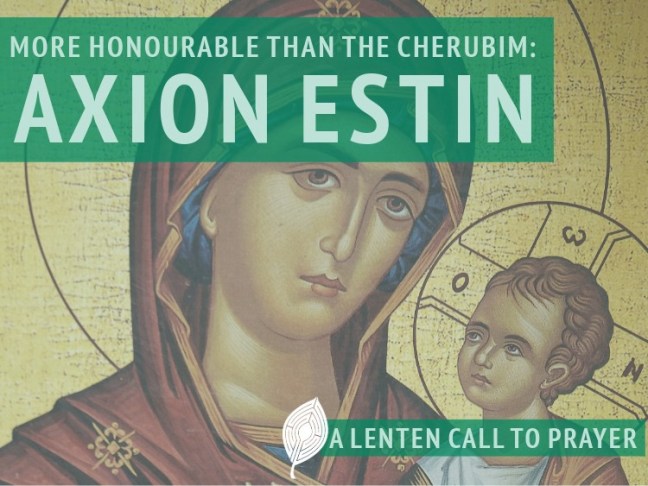
Tomorrow is the feast of the Annunciation, when we remember the Angel Gabriel’s world-changing visit to Mary announcing her pregnancy. And so in preparation for that I thought today was a good moment to step back and reflect on hymns glorifying Mary, which are some of the most cherished in the Eastern and Roman Churches, but which Protestants find both confounding and uncomfortable. Specifically, I’d like to reflect on a common theotokion, that is, hymn to Mary, sung in the East, known as Axion Estin, or ‘It is Truly Right’.
The text goes like this:
Truly it is right to bless you, O Theotokos,
Ever blessed and all-pure and the Mother of our God.
More honourable than the Cherubim, more glorious beyond compare than the Seraphim,
Who undefiled gave birth to God the Word,
True Theotokos, we magnify you.
There’s a lot to unpack here, with some language lost in translation, and some critical pieces of theology that are foreign to a lot of modern readers.
The first word in the Greek is axios, ‘worthy’, often translated as ‘meet’ or ‘right’. It’s the idea we talked about the other day of strong appropriateness that is hard to express in English. It’s saying that the lofty words to follow are worthy of the great mysteries of God revealed to us in and through Jesus.
The greatest of these mysteries discussed in the hymn is that Mary should be called ‘Theotokos,’ which is without a doubt the most common title for the Virgin Mary in the East. It means “One who gave birth to God,” and is the root of a lot of further mariological imagery. As with most odd things emerging from the Ancient Church, its prominence came about as a response to theological controversy. The term itself was used from at least the third century by such important names as Sts. Ephrem the Syrian, Athanasius of Alexandria, Gregory the Theologian, John Chrysostom, and Augustine. It should come as no surprise that all of these are people who were particularly concerned with Trinitarian theology, for as much as we may read it as saying something big about Mary, it’s really saying something about Jesus. Then, as now, some people heard the title and were uncomfortable with it. Even if they believed that Jesus was God, they weren’t comfortable with how the title ‘Theotokos’ framed the incarnation. Things came to a head at the Council of Ephesus in 431, which decreed that the title Theotokos is appropriate because it is impossible to separate Jesus’ divinity and humanity, and so we must be okay with saying that Mary gave birth to God.
The next line calls her “ever blessed and most pure” (literally, ‘all-spotless’), terms which hearken back to the way sacrificial offerings are described in the Old Testament. The image is of Mary offering her life fully and perfectly to God like the perfect sacrifice of praise.
Now the prayer goes into poetic mode, calling Mary “more honourable than the Cherubim” and “more glorious beyond compare than the Seraphim.” Again, this is saying more about Jesus than about Mary: While the angels of heaven worship at God’s throne, she was herself God’s literal dwelling place for nine months, making her worthy of being called more glorious and venerable than the angels.
The prayer then calls Mary “undefiled” in her birth-giving. This is hard to hear and sing. The ancient Mediterranean world unquestionably held the perspective — with all the historical misogyny that went along with it — that virginity in a woman is a kind of purity, and that to lose that virginity ‘defiled’ her in some way. The prayer isn’t trying to make a loaded moral statement about human sexuality here; it’s just the way they talked about sex in that time and place. The point though is that, through the miracle of the conception of Jesus through the power of the Holy Spirit alone, her pregnancy and birth-giving in no way diminished the completeness of her perfect self-offering.
So, this prayer, as foreign as it may be to many of our sensibilities, glorifies Mary, but specifically for her role in the mystery of the Incarnation, and everything that means for her, for God, and for us. It’s a hymn addressed to Mary, but it really is about glorifying the divine mystery.
Truly it is right to bless you, O Theotokos,
Ever blessed and all-pure and the Mother of our God.
More honourable than the Cherubim, more glorious beyond compare than the Seraphim,
Who undefiled gave birth to God the Word,
True Theotokos, we magnify you.
 Matthew Root
One thought on “More Honourable than the Cherubim: Axion Estin”