Today we shift gears from the evening and nighttime prayers to start morning prayers, and specifically the Anglican Morning Prayer tradition, which combined elements of different morning-time prayers of the Hours. One of the strange peculiarities of Anglican worship was that for several centuries, its Sunday morning liturgical life was dominated by Morning Prayer, with the Eucharist / Holy Communion almost completely sidelined. While more a traditional, biblical, and ecclesiastically- and theologically-responsible Eucharistic-centred model had become the norm by the time I was a kid in the ‘80s and ‘90s, I do have strong memories of my dad (serving as a deacon before his ordination to the priesthood) introducing today’s prayer, known as the Venite, whose text is the first seven verses of Psalm 95. This is a common ‘Invitatory’, that is a hymn inviting those gathered to prayer. It goes like this:
Come, let us sing to the Lord;
let us shout for joy to the rock of our salvation.
Let us come before his presence with thanksgiving
and raise a loud shout to him with psalms.
For the Lord is a great God,
and a great king above all gods.
In his hand are the caverns of the earth,
and the heights of the hills are his also.
The sea is his for he made it,
and his hands have moulded the dry land.
Come, let us bow down, and bend the knee,
and kneel before the Lord our maker.
For he is our God, and we are the people of his pasture
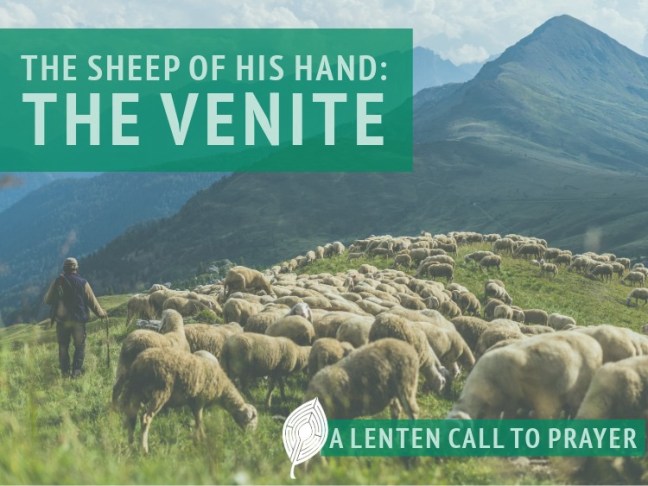
and the sheep of his hand.
Oh, that today you would hearken to his voice! (Psalm 95.1–7)
Much like ‘Come let us worship’, this is a call to communal prayer. And, like ‘Bless the Lord, O My Soul’, it grounds that worship in wonder and awe at God’s wisdom revealed in creation. But what stood out to me as I was praying through the psalm today is the final verse. It pictures the faithful as a flock of sheep being shepherded by God: “we are the people of his pasture and the sheep of his hand. Oh, that today you would hearken to his voice.”
Before Christmas, I had an odd bookish serendipity where I read three books in the span of a week that were all set on sheep farms. In all three, there was a scene in which a character wasn’t able to help look after the flock because they didn’t know his or her voice, and so would not respond to it. In other words, sheep become attuned not to words or speech sounds, but to the specific timbre of the shepherd’s voice: They will follow the voice of their shepherd, but not the shepherd next door. All this is reminiscent of John 10, in which Jesus talks about shepherding:
‘Very truly, I tell you, anyone who does not enter the sheepfold by the gate but climbs in by another way is a thief and a bandit. The one who enters by the gate is the shepherd of the sheep. The gatekeeper opens the gate for him, and the sheep hear his voice. He calls his own sheep by name and leads them out. When he has brought out all his own, he goes ahead of them, and the sheep follow him because they know his voice. They will not follow a stranger, but they will run from him because they do not know the voice of strangers.’ (John 10.1-5)
With this in mind, the the last line of the Venite isn’t just a throwaway line wishing we’d listen to God. Rather, the thought is inextricably linked to the previous one: If we are truly God’s people, our ears should be specifically attuned to hear and follow God’s voice.
And for us as Christians, that voice is that of Jesus, the Good Shepherd:
I am the good shepherd. I know my own and my own know me, just as the Father knows me and I know the Father. And I lay down my life for the sheep. I have other sheep that do not belong to this fold. I must bring them also, and they will listen to my voice. So there will be one flock, one shepherd. (10.14-16)
The point is, we aren’t truly his sheep simply by virtue of being in the sheepfold. As this tells us, he even has many sheepfolds! We are truly his sheep by virtue of doing what he says and following his lead. It’s an evergreen reminder to all of us that our faith isn’t a set of beliefs to accept intellectually, but a way of life to live out as fully as we can.
Come, let us bow down, and bend the knee,
and kneel before the Lord our maker.
For he is our God, and we are the people of his pasture
and the sheep of his hand.
Oh, that today you would hearken to his voice!
 Matthew Root
2 thoughts on “The Sheep of His Hand: The Venite”