
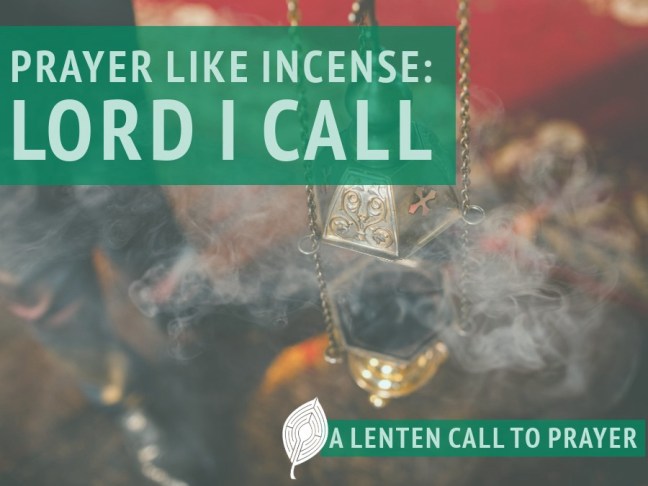
There’s an old saying that when it comes to liturgical prayer, we pray what we believe. That is to say, if you want a sense of a people’s true theology, you don’t turn to theological experts, but to their communal prayers and rituals. I thought of this this morning as I was reflecting on next prayer from Orthodox Vespers, known commonly as “Lord I Call.” It’s really the first two verses of Psalm 141:
Lord, I call upon You: hear me!
Hear me, O Lord!
Lord, I call upon You: hear me!
Receive the voice of my prayer, when I call upon You:
Hear me, O Lord!
Let my prayer arise in your sight as incense
And let the lifting up of my hands be an evening sacrifice:
Hear me, O Lord!
At first glance one might think this prayer suggests that we aren’t sure whether our prayers will be heard or not. But if we put the old saying into effect, in the same way that we pray “Lord have mercy” because we trust that God is merciful, we pray “Hear me, O Lord” because we trust that God is listening and does hear our prayer.
This is itself suggested by the words of the prayer comparing our prayer to incense and sacrifice. Incense doesn’t ‘symbolize’ our prayer, as we often think. Rather, the Scriptures assume incense rises up to God and pleases God with its beautiful aromas; what we ask here is that our prayer accomplishes the same thing. In the same way, while the Old Testament talks about sacrifice in many ways, the tie that binds is not some sort of vicarious punishment but rather than God just really loves the smell of roasting meat. (And, I certainly cannot blame God for that!). The hope expressed is that God would respond to our prayer as God does to the wonderful smells of frankincense or barbecue. And because we pray what we believe, we trust that God does respond like that. (Which is very impressive to my mind!)
Let my prayer arise in your sight as incense
And let the lifting up of my hands be an evening sacrifice:
Hear me, O Lord!
 Matthew Root