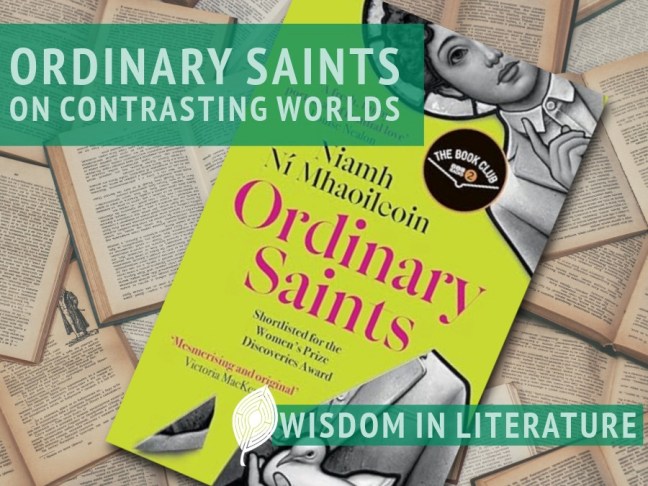
If there’s one thing that’s stuck out to me in my years being in the queer community it’s how many LGBTQ2S+ folk carry deep, deep baggage surrounding religion and faith. We all handle it very differently — some (like me) spending years or decades in intentionally traditional environments, others jumping headlong into progressive Christian spaces, and others so traumatized that they flee as far and as fast as they can from anything to do with faith — but so so many of us spent years of profound, intimate wrestling with God about our sexuality or gender identity that, for good or for ill, that arena has left a permanent mark on us and our personalities. Moreover, once we’ve come through the other side, that struggle often makes those within our communities of origin seem very foreign to us, such that any engagement with them feels like a cross-cultural experience. Last month, I had the great pleasure of reading a novel that deals with these facts of queer life, and family life more broadly, Niamh Ni Mhaoileoin’s* stunning debut Ordinary Saints.
The book has a startling premise: Its main character, Jay, an Irish lesbian expat trying to put her Roman Catholic family (and the Church’s long shadow over her homeland) behind her, discovers that her parents are pushing for her late brother Ferdia, who died while studying to become a priest, to be made a Saint. In fact, the campaign has basically taken over her mother’s life. Moreover, it becomes apparent that those in the Church leading the charge may be trying to turn him into a symbol of something she’s not sure he was. And so she must reckon not only with her feelings about parents and her brother, whom she adored but who was also favoured over her growing up and who wanted to be a representative of an institution that would come in many ways to define itself by its rejection of people like her; but her feelings about God and the Church as well.
While Jay is deeply angry and cynical about the Roman Catholic Church, the book itself is much more nuanced. As often as we may see the self-protective, power-hungry, and scandal-ridden institution that the Church has all too often been (and here we can substitute any church or religious institution), we see just as much the beautiful vision of the world it opens up for the faithful, especially through her mother’s devotion to miracles and the lives of the Saints, and in Ferdia’s sense of calling simply to be present for those who need it. And to me that’s what sets Ordinary Saints apart from the many books written about the Church’s legacy in Ireland. It isn’t trying to take down the Church, but rather shows how differently it looks from within and from without.
It’s not that the true believers don’t see the scandals or don’t feel sad, ashamed, and betrayed by them, but that the institution’s this-worldly problems can’t touch the beautiful world it unleashes for them. But this can also lead to denial or minimizing of the problems and prevent them from holding the institution to account. On the flip side, though, those who are either victims of the institution’s blind eye, or feel victimized by its advocacy of exclusionary policies, also need to understand that their ‘true believer’ families or friends’ devotion is not directed ‘at’ them. I’m reminded of an analogy that I used when I was wrestling with these issues fifteen years ago. Belonging to an intentionally traditionalist community is like being inside a beautiful bulldozer; no matter how small and confining it looks from from the outside, on the inside it feels spacious and luxurious and filled with all sorts of wonderful things. The problem is that that bulldozer is moving, and crushing everything in its path. Those inside may notice this, but think it’s okay because everyone is welcome to join them inside the bulldozer. Others may see it and want to stop the destruction but are powerless because of the centuries’ worth of momentum the bulldozer has gained. (Sadly, one thing I have to add from my old analogy that didn’t seem relevant fifteen years ago is that it would seem there are also those, wolves among sheep, who enjoy the destruction.) From the outside, though, folk aren’t interested in the least in being inside a bulldozer and simply want not to be crushed.
Religion has the power to inspire a lot of creativity, beauty, love, and grace in the world. It also has the power to inspire a lot of destruction, ugliness, hatred, indifference, and unkindness. Whether we find ourselves on the inside or outside, it’s easy to forget that both of these are true. But I’m very glad that Niamh Ni Mhaoileoin remembers it, and was able to portray it so powerfully in this gorgeous novel.
*In case you’re wondering, that’s pronounced ‘Neev Nee Valoan’
 Matthew Root