
Even in our Western democratic societies that have preached the value of being able to do and be whatever one wants in life, there are some choices that are seen as being better than others. One of the most maligned choices, perhaps surprisingly, is to lead a simple, quiet life. We applaud those who take big swings in life and look down upon those whom we perceive as not ‘going for it’. As much as it’s wonderful that we value the openness to fulfill our greatest potential, it can easily turn us into a cult of ambition. Perhaps it’s for that reason that the late great Eastern Orthodox theologian Fr. Alexander Schmemann thought that the monastic movement we need is one stripped of all the trappings of monastic life as we think of it and to live just such a counter-cultural life: to work a simple job and live in a small apartment, without ambition for advancement, improvement, experiences, or material things.
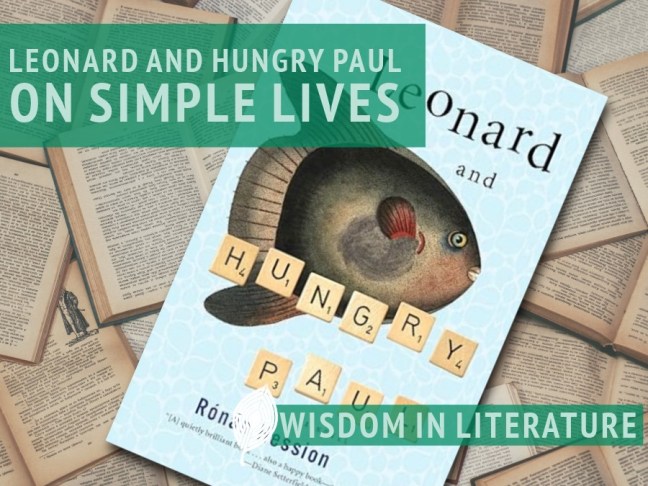
This year I read a novel that centers two men who live such quiet lives, Leonard and Hungry Paul, by Rónán Hession (2019). Leonard still lives in his childhood home, which he’s recently inherited following the death of his mother, to whom he’d acted as friend and caregiver in her final years. He’s single and never even really dated and works as an uncredited writer of children’s fact books. His social life revolves almost entirely around games nights with his good friend Hungry Paul (his epithet being universally deployed but never explained), who lives with his parents while working about one shift a week as a substitute postal worker and stands in contrast to his go-getter sister. Their simple lives are disrupted when, realizing how lonely he is now that he’s on his own, Leonard ponders going out with a woman in his shared office space. Meanwhile, Hungry Paul’s sister’s wedding — and her accusations of taking advantage of their parents — needles him into thinking more intentionally about how he wants to spend his life.
And, for me at least, that’s the beauty of this book. On the one hand, it’s a celebration of quiet lives that are so often viewed with suspicion and disdain in our culture. But on the other hand, it also asks its characters, and readers by extension, to make sure that however we choose to spend our life, we do so intentionally. Falling unconsciously into a quiet life by following the path of least resistance is a sad thing:
Solitude and peace lose their specialness when they no longer stand in contrast to anything. In a busy—or at least busier—life, quiet reflection provides resonance to experience. But to deprive life of experiences deliberately and to hide from its realities was not special.
Yet, relentlessly pushing forward to get the better spouse, the more impressive job title, the bigger house, the more luxurious vacation and so on can be just as unconscious and sad. The point is that:
making big decisions [is] just as consequential as not making them. Either way you [are] committing to something. We are never entirely outside of life’s choices; everything leads somewhere.
All told, this is an absolutely delightful, big hug of a novel. It proudly upholds the dignity and meaning of quiet lives in a world whose narratives are dominated by go-getters and attention-seekers, while also not being afraid to challenging everyone to think again and ensure whatever the life we lead my look like, we’re living it with intention. I absolutely loved it.
 Matthew Root