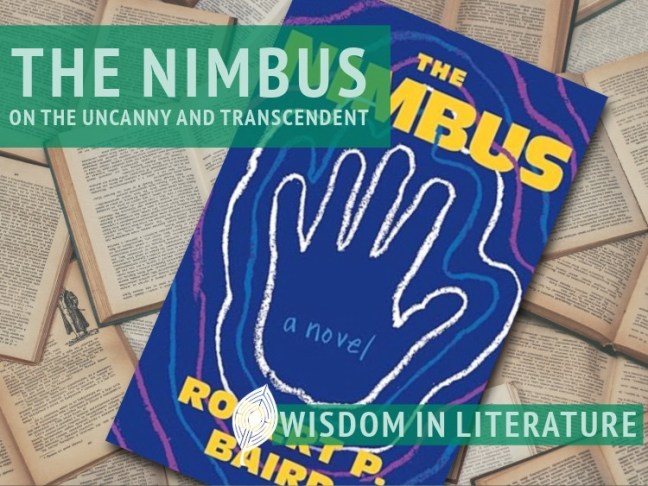
There’s a famous moment in the classic ‘nineties movie A Few Good Men when a military leader, played by Jack Nicholson, screams “You want the truth? You can’t handle the truth!” As much as that character is an antagonist in the film, he hit on something true. We all say we want openness, honesty, and transparency, yet don’t seem to be very good at dealing with it. If, as recent history tells us, this is true for us with simple things like vote-counting or public health data, how much more would it be true of the big questions of religions: Do we really want the answers we claim to seek? Would we be able to handle them if we had them? I thought of this often as I read an inventive and engaging novel earlier this year, The Nimbus, by Robert P. Baird.
In this novel, a young Chicago boy starts to glow with a nimbus, what appears to be a manifestation of the uncreated light of God — at least according to his religious studies professor father and a growing group of true believers. For as many people as see this and are amazed, an equal number — including the boy’s mother — see nothing at all: just a regular, healthy toddler. While much of the book is an effective satire of academia, to me it speaks to much bigger issues.
While the family’s life and parents’ marriage begin to suffer under the weight of all this, different people use the nimbus for their own purposes. To the downtrodden it becomes a symbol that miracles still happen in a harsh and unjust world. To others it’s an opportunity to make money. Others exhaust themselves trying to find a rational, scientific explanation that would make it less uncanny. To the boy’s father, it may be little more than a chance to push his struggling academic career. To the mother, it’s a terrible thing that is making her child an object of perverse curiosity, and is even putting him in danger. (And if it’s real and she just can’t see it, is her greater duty to share something beautiful with the world or to lovingly guard and protect her child from scrutiny?)
In this way, it makes the reader wonder how we would respond in such a situation. If we encountered something truly uncanny or miraculous, would we respond with faith or doubt? With humility or with dollar signs flashing in our eyes? And what about if we were among those who couldn’t see it? After all, as the Scriptures tell us, “Blessed are those who have not seen and yet have come to believe” (John 20.29). What is the loving course of action in a given situation?
Moreover, when it comes to issues of faith, the central tension is not just whether to believe, but whether the object is worthy of belief. Belief for belief’s sake, trust for trust’s sake is of no value, and can even be destructive when that faith is misplaced. And when it comes to something like a glowing child, we might rightly ask ourselves, if it is a miracle of God, WHY? Why this in a world so full of suffering?
In this way The Nimbus is far more than a campus novel or satire of academia. It peeks under our facades and pokes at humanity’s deepest hopes, questions, and fears. And, as we see all around us these days, what’s under the facade is rarely as beautiful or promising as we’d like.
 Matthew Root