
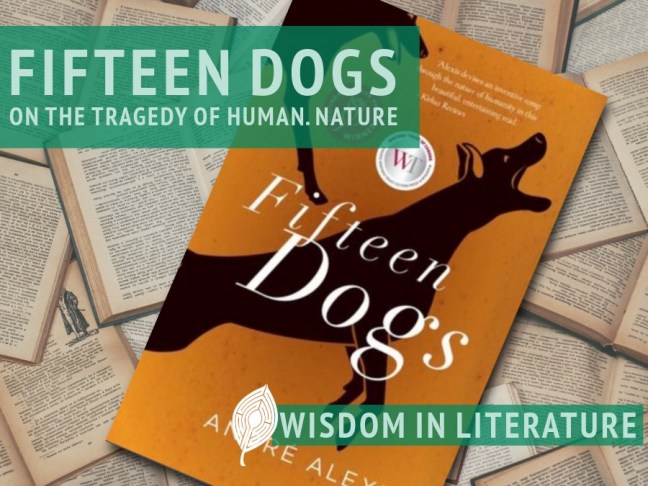
Every now and then, when I have a couple weeks to spare in between series, I take the opportunity to talk about books, and specifically the spiritual themes in them. As I like to say, as much as a good novel entertains us, it also gives us a window into something true about the human condition. That’s certainly true of the book I’ll be discussing today, the 2015 Giller Prize winner by André Alexis, Fifteen Dogs.
The premise of the novel is this: The Greek gods Apollo and Hermes are drinking at their favourite Toronto dive bar when they start debating whether it’s possible for mortals to die happy. To settle the argument, they make a bet: they give fifteen ordinary dogs human intelligence and see if any dies happy. The novel follows these fifteen dogs and the ways their shifting loyalties, relationships, and values mirror our familiar human divisions and foibles. The most striking division that opens up quickly is between those who use the gift of intelligence and language creatively, and so shift dog culture through storytelling, poetry, and song, and those who insist on keeping their often brutal dog nature as pure as possible.
While this is an unsubtle criticism and warning about the increasingly anti-intellectual, -art and -expertise attitude of our own society, for me, it goes deeper, and touches on the biblical story on the Fall itself. What makes the Genesis 2-3 story so compelling is its ambivalence about the human condition: the very thing that makes us ‘us’ is what ends up separating us from God, each other, the world around us, and even our very selves. The ancients didn’t need the prospect of nuclear annihilation, holocausts, or climate disaster to figure this out; they saw all the evidence they needed all around them.
Far from the ways the story came to be interpreted in Christianity (or at least Western Christianity after the fifth century), the most common way the story is interpreted in Judaism has been as an allegory for growing up:
There is a sense in which ignorance really is bliss. And yet, that same blissful ignorance also makes us incapable of acting and choosing knowledgeably, of changing course to stave off impending disaster. And so there’s a paradox here. Knowledge is the enemy of trust and faithfulness, yet without it our faithfulness is impoverished.
With this in mind, many Jewish interpreters read the story as something of a felix culpa, a ‘happy sin’ — not, obviously, in the Christian sense as the rationale for the coming of Jesus, but in the sense that this act of disobedience was a necessary act of independence that allowed humanity to grow into adulthood.
We see something of this in Fifteen Dogs. Their intelligence shatters their world: they are no longer afforded the opportunity be innocent and blissfully ignorant, only the choice between the hard road of embracing intelligence wisely and faithfully, or the easy but self-defeating road of rejecting intelligence in favour of an intentional and belligerent ignorance that is far from being either blissful or innocent.
As Wisdom traditions of all ages and places (including Fifteen Dogs) would tell us, only one of these paths can lead to genuine faithfulness. But that is the predicament of human nature.
 Matthew Root