
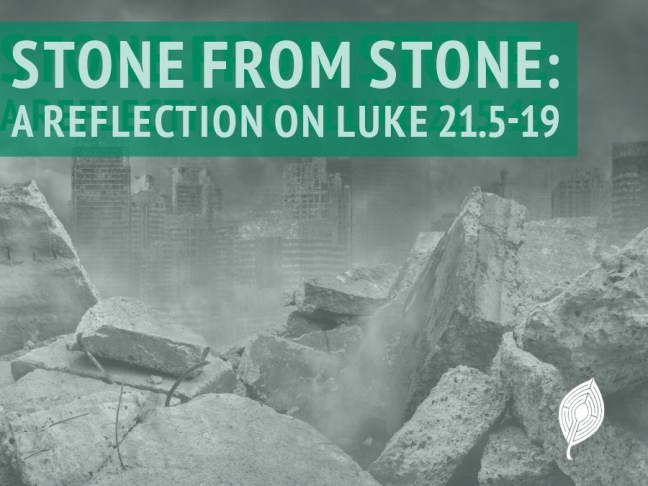
It seems that we int he West are in a period of structural dissolution. We have a political and social Right that is tearing down the establishment, a Centre trying to prop it up, and Left that has big ideas but which is increasingly marginalized from the conversation. This makes it an anxious time. And so it makes it an ideal time to ponder today’s Gospel reading, in which Jesus addresses the anxieties of his own age.
The story revolves around the Jerusalem Temple, which was not only the religious centre for the Jewish people, but also the crown of their monumental architecture, and even a huge driver of their economy. It was something they were understandably proud of, and it provided a beacon of stability in otherwise uncertain times. While Judea was at the time a nominally autonomous part of the Roman Empire, but the threat of a full-on invasion and assimilation was always there, and religious leaders were divided by both their religious sensibilities and desired approach to dealing with Rome. Anxious times indeed. But, hearing some people talking about the temple’s beauty and wealth, Jesus questions their confidence in it:
When some were speaking about the temple, how it was adorned with beautiful stones and gifts dedicated to God, Jesus said, “As for these things that you see, the days will come when not one stone will be left upon another; all will be thrown down.” (Luke 21.5-6)
Talk about a buzzkill. That symbol of national identity and religious commitment? It’ll soon be gone, Jesus says, torn down stone from stone. When they press him for more information, he pushes back, warning them against undue interest in apocalyptic predictions:
Beware that you are not led astray; for many will come in my name and say, ‘I am he!’ and, ‘The time is near!’ Do not go after them. When you hear of wars and insurrections, do not be terrified; for these things must take place first, but the end will not follow immediately. (21.8-9)
At the end of the day, anxious speculation about the future is at best unhelpful and at worst a destructive distraction. The future is, after all, none of our business (Acts 1.7). Time will march on, with historical events with it, but that’s just history being history:
Nation will rise against nation, and kingdom against kingdom; there will be great earthquakes, and in various places famines and plagues; and there will be dreadful portents and great signs from heaven. But before all this occurs, they will arrest you and persecute you; they will hand you over to synagogues and prisons, and you will be brought before kings and governors because of my name. This will give you an opportunity to testify. So make up your minds not to prepare your defence in advance; for I will give you words and a wisdom that none of your opponents will be able to withstand or contradict. You will be betrayed even by parents and brothers, by relatives and friends; and they will put some of you to death. You will be hated by all because of my name. But not a hair of your head will perish. By your endurance you will gain your souls. (21:10-19)
This is commonly thought of as a ‘mini-Apocalypse’, with veiled predictions of a terrifying future, but, in this context, I think he’s saying something far less mysterious. None of the things he describes is strange or uncommon: Nation will rise against nation; there will be earthquakes, famines, and plagues. These things are just part of life in our hurting and suffering world. But even before history has time to run its course as it does, he says, his disciples can expect persecution. Again, this doesn’t take a prophet or visionary to understand. The writing is on the wall. Everything Jesus was doing was attracting the wrong kind of attention: His teaching of the kingdom, his healing ministry, the company he kept — everything about him was disrupting the status quo and calling existing power structures, political, social, and religious alike, into question. The plot to kill Jesus is underway just a few verses later. So, inasmuch as his disciples follow his way and promote his teaching, the powers that be will come for them too. But all is not lost: The kinds of opposition they will face are themselves an opportunity to witness to the truth and live it out faithfully.
And at the end that’s what matters. History runs its course. Times of war follow times of peace, which follow times of war; times of disintegration follow times of integration, which follow times of disintegration. What is important is not to get distracted by it all, by our fears and anxieties, but simply to live faithfully — to call forth goodness, to bear good fruit in the world, to build bridges and tear down dividing walls — within our given circumstances.
It’s not easy, and has never been easy. Wars, famines, plagues, and disasters will always be with us on this side of paradise. But they are largely distractions from what we are called to do wtithin them. May God give us the strength, wisdom, and courage to be witnesses in thought, word, and deed, no matter the circumstances in which we find ourselves. Amen.
 Matthew Root