
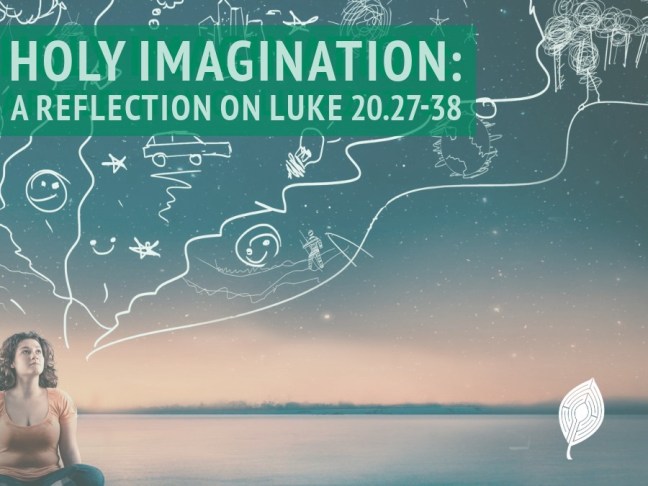
While it seems quaint now considering the times of uncertainty and flux we’re in now, I remember ten years ago or so talking to a friend about how it seemed all of our systems — government bodies, education models, and so on — weren’t working, but no one had the imagination to see how they might work better. Despite what’s happening, I think the sentiment still holds up, since these systems aren’t being changed as much as they’re being torn down with no desire for improvement. We’re stuck because we can’t imagine another way of being. I see something similar at work in today’s Gospel reading, in which the Sadducees lay a theological trap for Jesus.
The story goes like this:
Some Sadducees, those who say there is no resurrection, came to Jesus and asked him a question, “Teacher, Moses wrote for us that if a man’s brother dies, leaving a wife but no children, the man shall marry the widow and raise up children for his brother. Now there were seven brothers; the first married, and died childless; then the second and the third married her, and so in the same way all seven died childless. Finally the woman also died. In the resurrection, therefore, whose wife will the woman be? For the seven had married her.” Jesus said to them, “Those who belong to this age marry and are given in marriage; but those who are considered worthy of a place in that age and in the resurrection from the dead neither marry nor are given in marriage. Indeed they cannot die anymore, because they are like angels and are children of God, being children of the resurrection. And the fact that the dead are raised Moses himself showed, in the story about the bush, where he speaks of the Lord as the God of Abraham, the God of Isaac, and the God of Jacob. Now he is God not of the dead, but of the living; for to him all of them are alive.” (Luke 20.27-38)
The trap hinges on a certain way of understanding the resurrection of the dead. The Sadducees accepted only the Torah as Scripture, rejecting both the Prophets and the Wisdom literature, chronicles, and folk tales contained in the Writings. As such, their vision of the world and of God was limited by the commandments as they understood them. The only afterlife they could imagine was one that operated along the same principles as this life. And so, for them, the Levirite laws requiring a younger brother to marry an older brother’s widow so as to continue the brother’s line were the perfect trap for those theological mavericks proclaiming the righteous dead would be raised on the Last Day.
But Jesus isn’t having any of it. His God is so much bigger than all that:
Those who belong to this age marry and are given in marriage; but those who are considered worthy of a place in that age and in the resurrection from the dead neither marry nor are given in marriage. Indeed they cannot die anymore, because they are like angels and are children of God, being children of the resurrection.
They need to think outside their mental boxes: Life in the resurrection won’t be a carbon copy of this life. Far from it. If the Sadducees can’t break out of the limitations of their own conceptions, they can’t hope to understand the God they serve and to whom they desire to be faithful.
So many of today’s problems, both in the Church and in society writ large, require a similar explosion of imagination. We need big-thinkers and dreamers who can see past the barriers and problems and see a bigger and better, and more faithful way of doing life together, knowing that what isn’t possible for us is possible for God. We may not be successful, but if we fail, may it not be for lack of imagination.
 Matthew Root