
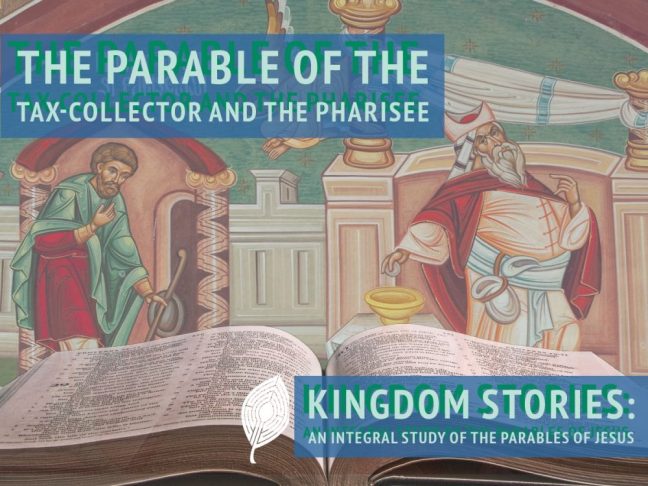
[Here’s a confession: When I was planning my Summer series on the Parables, I checked to make sure the parables from Matthew’s Gospel weren’t coming up soon in the lectionary, but failed to do so for the parables from Luke, which has left me a bit caught out this Fall! At any rate, today’s Gospel reading is an important text, so here is my Integral study of it again for you.]
Our tour through the parables of the lost and found continues today in a deceptively simple one, the Parable of the Tax-Collector (or Publican) and the Pharisee. But watch out: It’s a trap!
Text
Today’s text is found only in Luke 18.9-14:
[18.9] And [Jesus] also said to some who were convinced that they were righteous and thought others had no value: [10] “Two men went up to the Temple to pray, one a Pharisee and the other a tax-collector. [11] The Pharisee, standing by himself prayed like this: ‘God, I thank you that I am not like other people: thieves, unrighteous, adulterers, or even like this tax-collector. [12] I fast twice a week, I give a full tithe of everything I earn.” [13] But the tax-collector, standing far off, did not even want to lift his eyes to heaven, but was beating his breast and saying: ‘God, make atonement for me, the sinner!’ [14] I say to you, this man returned to his home in right standing with God rather than the other: For everyone who exalts themselves will be humbled, but one who humbles themself will be exalted.
Experience
My experience reading this text reminds me of the Prodigal Son: It’s clearly a wonderful story that’s popular for a reason, but also one that has accrued a lot of interpretive baggage for me over the years. I’d like to strip that back as much as possible and learn again. What was the occasion for the two men’s prayers? Who were the Pharisees? Who were ‘tax-collectors’ and why were they the quintessential ‘sinners’ in the New Testament? What does it mean to be in right standing with God? Also, recognizing that I’m skipping around Luke’s Gospel a bit, I’d like to know more about the narrative context.
Encounter
In Luke’s narrative we encounter Jesus and his audience, about whom we are only told that they are self-righteous.
In Jesus’ story we meet two men, both from groups that were stock characters or archetypes in the Gospels: a Pharisee and a tax-collector.
Explore
Literary Context
In Luke’s Gospel, chapter 18 is part of a loosely arranged collection of teachings set along Jesus’ journey to Jerusalem. The section offers a potpourri of recurring themes:
- confrontations with the Pharisees about:
- table fellowship (14.1-24)
- mercy, forgiveness, and the joy of restored relationships (15.1-16.9)
- the dangers of wealth (14.33; 16.10-14, 19-31; 18.18-26)
- self-righteousness and humility (16.14-18; 18.1-25)
- general teachings on discipleship (14.1-14, 22-35; 17.1-19)
- apocalyptic on the judgment and the need to be ready (17.20-37)
- teachings on prayer (18.1-14)
Three parts of this touch on today’s story: the repeated conflict with the Pharisees, the theme of self-righteousness and humility, and the context of teaching on prayer.
While the Pharisees are not explicitly mentioned as the audience for the parable, the description of the audience as people who trust in their own righteousness is consistent with the Pharisees’ portrayal in the Gospels (Levine & Witherington 491; Just 679).* And, of course, a Pharisee is one of the two characters in the story, so his ongoing conflict with this group is clearly in mind as Luke has him tell the story.
Luke frames the parable in terms of self-righteousness, introducing it as being told to those “who were convinced that they were righteous” and ending it with a tagline describing the ‘great reversal’, “For everyone who exalts themselves will be humbled, but one who humbles themself will be exalted” (cf., Matthew 18.4, 2.12; 1 Peter 5.6) Even if the parable’s meaning weren’t clear, this framing goes a long way in telling us what it was about — at least from Luke’s perspective (Bailey (2008) 344).
Finally, the parable is at least ostensibly about prayer (Green 644). It is grammatically linked to the previous parable, about the need for persistence in prayer. And prayer is the main action of this parable: Both men go to the temple to pray, we hear the content of their prayers, and God judges between them based on their prayers. (As a related aside, it is not strange that we are told the content of their prayers, as even private prayer was customarily spoken aloud (Just 682; Bailey (2008) 347).)
Temple Prayer
At the start of the parable, both individuals are said to be going to the Temple to pray. While it was possible to do this throughout the day, Jesus may have been specifically referring to the daily evening atonement sacrifice (Just 682; Bailey (2008) 346; Green 646). This inference is suggested by two details in the parable: The offering of incense at this service is a natural occasion for such ‘personal accounting’ as reported here; and the tax-collector’s prayer, often translated ‘God, have mercy [eleēson, cf., 18.38f] upon me…’ literally reads, ‘God, make atonement [hilastheti] for me.’ The Greek here often carries a sacrificial connotation that would perfectly fit the themes of this service (Bailey (2008) 349; Green 649).
At any rate, both men go to the Temple to do their business with God. But how effective will that business be? The Temple setting places this story in a long line of discussion within the Bible about the relative merits of ritual and moral behaviour. Of particular interest, Kenneth Bailey notes several similarities between this parable and Isaiah 66.1-6: That oracle also has God looking upon the Temple and rejecting the sacrifices of the arrogant, while vindicating the humble whom the arrogant reject (Bailey (2008) 352). Irrespective of whether Jesus had this oracle in mind, at the very least the parallels between the two texts remind us that Jesus’ teaching was inherently Jewish and participated in longstanding debates within Judaism.
The Pharisee
This section was getting so long that I spun it off into a separate post. But to summarize:
The Pharisees were an important religious party in first-century Judaism. There were many areas of agreement between the Pharisees and Jesus, but the two took very different approaches to the Law and its use within society, which made the Pharisees an ideal foil for Jesus in the Gospels.
While the Gospels are hard on the Pharisees, they don’t actually misrepresent their beliefs and practices. For example, the concern they expressed about table-fellowship that led to Jesus telling the Parables of the Lost and Found accurately reflects their separatism from those who did not keep the Law in the same way they did. And most to the point, the prayer of the Pharisee in this parable bears striking resemblance to extant Pharasaic prayers. They genuinely believed their practices made them righteous before God, setting them apart from other, less-observant Jews (to say nothing of Gentiles); and for that they were grateful (Levine & Witherington 492).
While Jesus elsewhere accuses Pharisees of hypocrisy, there is no hint of that here: this Pharisee goes above-and-beyond what he is supposed to do, and doesn’t do the things he’s not supposed to do (Green 647; Gonzalez 212f; Bailey (2008) 348; Capon). But he’s incredibly self-satisfied, judgmental towards others, and his ‘prayer’ comes across more as an unsolicited sermon than a prayer (Bailey (2008) 347). It’s this attitude that Jesus teaches against in the parable.
Tax-Collector
If the Pharisees were the archetypal ‘good religious folk’ in the Gospels, their opposite were the tax-collectors (Greek telones, traditionally ‘publicans’), the quintessential ‘sinners’. These were not official collectors of either Roman or Jewish taxes, but minor figures responsible for collecting local duties and tolls, by whatever means and with whatever markup they saw fit (Wills 75; Capon).They were widely despised on all sides, and generally seen as extortionists, collaborators with the enemy, and too deeply embedded in their sin to every truly repent (Wills 75; Green 649; Nuechterlein Proper 25C). That said, interpreters can often go too far and bring the language of ritual impurity into play with them. But despised as they were, they were not ‘unclean’, ‘defiled’, or ‘outcast’ — this tax-collector is able to come into the Temple, after all (Levine & Witherington 490)!
As hardened as tax-collectors’ reputations were, this tax-collector is repentant. He asks God to ‘make an atonement’ for him, and beats his breasts in anguish. Despite Levine’s opinion to the contrary, there is no hint of hypocrisy or false repentance here (Levine & Witherington 494). (As Bailey points, out, beating one’s breasts was a typically feminine gesture, so would be particularly strange for a man to perform if the feelings behind it were not genuine (Bailey (2008) 348). Much has been made over the definite article in his prayer: “…on me, the sinner” (Just 684). This is awkward English and so is often translated out, but this detail continues to be emphasized in Eastern Orthodox readings and piety to this day: as far as the prayer is concerned, he is the only sinner there is. This is obviously factually untrue, but it reveals the important point: where the Pharisee was comparing himself to everyone else, the tax-collector’s eyes were firmly only on himself, his own life, his own sin. We are not our neighbour’s judge and have no business looking at anyone else when we give our account before God.
Justification and Righteousness
The parable says that the tax-collector returns home righteous, or justified, before God. But what does this mean exactly? This is a loaded theological question, but unfortunately, an important one. The matter is further complicated for us in English because we differentiate between righteousness, being in a right relationship with God, and justice, being in right relationships within society and creation. But this is not a distinction made in either Hebrew^ or Greek. In those languages and thought-worlds, and therefore in our Scriptures, there is only justice, which comes from God but extends outwards throughout all our relationships. But just as importantly, because it is relational, it’s not something one can ‘have’ for oneself; rather it must be recognized by another.
So here in the parable, God has recognized the tax-collector as being just — as living in right relationships — in response to his repentance (Bailey (2008) 344; Just 684). This is remarkable. While Judaism was never the religion of ‘works righteousness’ Christians, and especially Protestants, have claimed it to be, it is true that one of the ways Jews were expected to live out their righteousness was observance of the Law. But in this story, a notorious law-breaker is leaves ‘righteous’. As Just summarizes, “Again, it boils down to a simple matter of whom one trusts for salvation” (Just 684). Do we trust in ourselves, like Jesus’ audience (and presumably the Pharisee in the parable), or do we trust only in God?
Meaning
If we put all this together, we see a message that is very similar to what we’ve seen in other parables of late: God is not a fan of bookkeeping; we might even go so far as to say that God is not a fan of ‘religion’, with all its rules and tidy boxes of ‘right’ and ‘wrong’ (Capon; Bailey (2008) 344). In this parable, the one who excels in religion but also delights in keeping score is passed over in favour of the one who has nothing to commend him but his humility before God.
But is the Pharisee passed over? Amy-Jill Levine has questioned the traditional interpretation of this parable, based on the Pharisees’ beliefs. She argues that the tax-collector goes home justified, alongside the Pharisee, not instead of — a translation that is grammatically possible (Levine; Levine & Witherington 494; Nuechterlein Proper 25C). Moreover, she argues, the mechanism of his justification is the above-and-beyond righteousness of the Pharisee, since according to Pharisaic belief, their piety could cover the sins of the less-observant (Levine; Schiffman; Levine & Witherington 495). This interpretation offers the more radical and attractive conclusion that both the super-observant and the less observant both leave in good standing with God. But, to get there we have to ignore both Luke’s framing and the whole thrust of Jesus’ teaching. Ideas of merit are simply nowhere to be found in his thought, so there’s nothing to suggest this interpretation other than Levine’s desire to justify the Pharisees. Again, we have to remind ourselves that Jesus is never critical of Pharisees’ law-observance or piety, only the way they use it as a weapon against others. Had the Pharisee been matter-of-fact about his feats and not compared himself (favourably of course) to those who don’t measure up to his standards, I have no doubt that he would have gone home justified ‘alongside’ the tax-collector and all the faithful doing their business with God in the Temple that day. If he is indeed excluded, it’s by his own self-satisfied, self-important, and judgmental attitude (Green 649; Gonzalez 212; Palamas 2; Capon).
However, within this simple parable, Jesus has laid a trap for us. Because, in identifying with the tax-collector, it is almost impossible for us not to think, ‘thank God I’m not like the Pharisee’, and thereby become the Pharisee ourselves (Gonzalez 213; Nuechterlein Proper 25C)! The real sin here is this tendency to divide the world between ‘us and them’, ‘good and evil’; as Michael Hardin and Jeff Krantz put it:
This Pharisee has God wrong. God is not about who is better than, smarter than, prettier than, richer than, holier than. God does not discriminate, God does not compare us with one another. (quoted in Nuechterlein Proper 25C)
And again, Robert Farrar Capon states:
It is therefore not a recommendation to adopt a humble religious stance rather than a proud one; rather it is a warning to drop all religious stances — and all moral and ethical ones, too — when you try to grasp your justification before God.
As Paul would remind us, when it comes to who and how we are before God, there’s no ‘us and them’, only ‘us’ and all of us (Romans 1-3; cf. Capon).
This itself would seem to undermine the theme of the ‘great reversal’. However, I have been convinced for some time that the real point of the great reversal is actually, as Paul Nuechterlein puts it, a ‘great equalization’ (Proper 25C): Through a proper humility before God and understanding that we are all sinners in need of salvation, we can all, like the tax-collector in the parable, be right with God and each other.
Challenge
Subversion of First Century Expectation
Capon has called this “an unacceptable parable” to first-century ears: Jesus has cast the prototypical righteous man as the villain and the prototypical sinner as its hero (Capon; Levine; Nuechterlein Proper 25C). This is as subversive as it gets!
Contemporary Challenge
We’ve already addressed Amy-Jill Levine’s Jewish challenge of Christian readings of the text. While I don’t think there’s much to commend her interpretation, her rejection of us-them thinking is absolutely on the right track, and hits at the real meaning of the parable (Nuechterlein Proper 25C). Once again, the second we identify with the tax-collector we fall into the trap of becoming the Pharisee. We don’t break the hold of religion on our hearts, but simply “shift the ranking of individual sins” (Nuechterlein Proper 25C). The real challenge is to break this way of thinking entirely.
One way Christians have handled this challenge, from the Church Fathers to this day, is to insist that we resist the temptation to identify with the tax-collector and only to identify with the Pharisee, recognizing our own self-righteousness and tendencies to dismiss those who don’t measure up to our (oh so human) standards, and then to repent.
Comparison may, as it is said, be the enemy of joy. But according to this parable, it is also the enemy of genuine faith and, ultimately, of salvation.
Expand
This interpretation helps us to grow in faith and in love by, paradoxically, focusing on ourselves. If there’s been one consistent thread throughout this series on the parables so far, it’s been that others are there for us to welcome and love, but not to judge. When it comes to our accounting with God, the only person we should be worried about is our self.
Summary & Conclusions
In this parable, Jesus contrasts two approaches to a relationship with God: one based on achievement, accounting, and comparison, and one based on a simple recognition that we all stand in need of God’s atoning mercy and grace. As far as Jesus is concerned, the first approach is a dead end and any true relationship with God, to say nothing of the rest of society and creation, must be grounded in the latter.
* For full references, please see the series bibliography.
^ I was taught that Hebrew does make this distinction, between tzadiqah ‘righteous’ and mishpat ‘justice’; however looking over Jewish texts for this study revealed to me that these words are generally understood to be synonymous, and (mostly Protestant) scholars wanting to differentiate the two have overblown the differences in connotation.
 Matthew Root