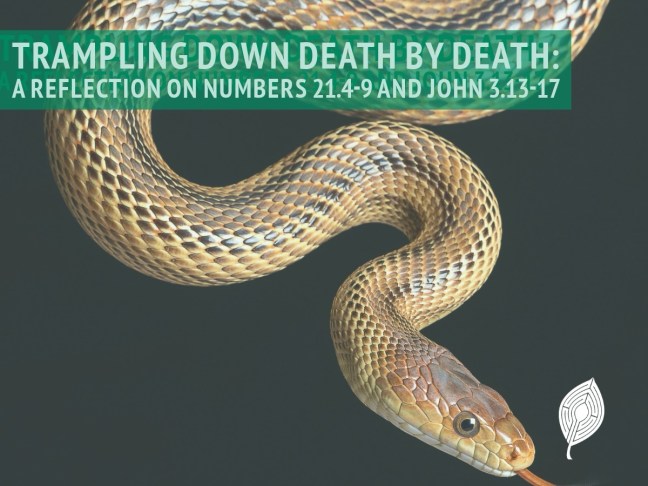
Today is the Feast of the Holy Cross in the Church calendar. This is one of those medieval feasts that’s hard for many of us to find our way into, since it is self-consciously a celebration of a symbol instead of what it symbolizes (c.f., the Feast of the Body of Christ). But it’s wonderful opportunity to reflect on some of the many fascinating connections our tradition has made between its various symbols. This is particularly true since the Church Fathers understood the Old Testament to be inspired inasmuch as it looked ahead to the life, death, and resurrection of Jesus of Nazareth. We see a great example of this way of thinking in the readings for today, which look at the cross through the lens of a strange event recorded in Numbers 21.
That story goes like this:
The people became impatient on the way. The people spoke against God and against Moses, “Why have you brought us up out of Egypt to die in the wilderness? For there is no food and no water, and we detest this miserable food.” Then the LORD sent poisonous serpents among the people, and they bit the people, so that many Israelites died. The people came to Moses and said, “We have sinned by speaking against the Lord and against you; pray to the Lord to take away the serpents from us.” So Moses prayed for the people. And the LORD said to Moses, “Make a poisonous serpent, and set it on a pole; and everyone who is bitten shall look at it and live.” So Moses made a serpent of bronze, and put it upon a pole; and whenever a serpent bit someone, that person would look at the serpent of bronze and live. (Numbers 21.4b-9)
This story participates in a long and shared human cultural tendency not only towards what we call ‘apotropaic magic’, that is the use of specific objects to ward off evil, but to a specific kind of apotropaic magic called ‘sympathetic magic’ that uses the very thing one wants protection from as protection. A classic example of this that we still see today, is the blue and white, eye-like nazar amulets worn to ward against the ‘evil eye.’ We see similar things in the Greek use of images of terrible creatures as charms and even in the gargoyle architectural tradition on medieval cathedrals. In the case of today’s reading, God instructs Moses to craft a serpent out of bronze that would heal anyone bitten by a snake just by looking at it.
Archaeological evidence suggests the use of bronze serpents as ritual objects was not original to ancient Israelite religion, but was common in Canaanite and Egyptian practice. At any rate, Moses constructs one here and it works to save those bitten by snakes from certain death.
This image lit up the imaginations of the first Christians and it was understood as a foreshadowing of the cross of Jesus. As odd as this may sound, it’s even found in one of the most common and popular passages in all of the New Testament, which is unsurprisingly our Gospel reading today:
Jesus said, “No one has ascended into heaven except the one who descended from heaven, the Son of Man. And just as Moses lifted up the serpent in the wilderness, so must the Son of Man be lifted up, that whoever believes in him may have eternal life. For God so loved the world that he gave his only Son, so that everyone who believes in him may not perish but may have eternal life. Indeed, God did not send the Son into the world to condemn the world, but in order that the world might be saved through him.” (John 3:13-17)
If we think through this analogy we can get a glimpse of how the first Christians were starting to understand the ‘work of the cross’. It’s easy for us to forget how strange a symbol the cross really is. It was after all an implement of torture and execution, as unlikely a symbol of salvation as a barbed whip or guillotine. But here it is held out, like the bronze serpent, as death destroying the power of death. As the famous Paschal hymn of the Christian East puts it:
Christ is risen from the dead
Trampling down death by death
And upon those in the tombs bestowing life!
This points to an alternative early understanding of the cross to the substitutionary models that would later become popular. If we look back to our series on atonement theologies, this splits the difference between Passover imagery, which is also apotropaic in function, and the nonviolent atonement imagery, which focuses on Christ’s death at the hands of human violence as God’s ultimate and final act of solidarity with those who are sinned against in a violent world.
But there’s an interesting detail to this story that we would do well to remember. In 2 Kings 18, King Hezekiah, in an act the Scriptures praise, destroys the bronze serpent Moses creates here. Why? Because people were worshiping it instead of understanding it as a symbol for God’s saving power. In the same way, we must be careful not to turn the cross into a kind of magical amulet or charm with power in and of itself. It is powerful as a symbol of Christ’s death and resurrection, not ‘as a thing’ in and of itself. Even in the Gospel passage, it is the Son of Man who must be lifted high for our salvation, not the cross. It has to be said (more and more today): throwing a cross on something doesn’t make it Christian. Something is Christian inasmuch as it participates in the humble. incarnational way of Jesus. The cross is a symbol of humiliation and defeat by the standards of this world, and so it must never become a tool for a theology of glory that seeks any kind of earthly power or dominion.
For, as Paul reminds us in today’s Epistle reading:
The message about the cross is foolishness to those who are perishing, but to us who are being saved it is the power of God. For it is written, “I will destroy the wisdom of the wise, and the discernment of the discerning I will thwart.” Where is the one who is wise? Where is the scribe? Where is the debater of this age? Has not God made foolish the wisdom of the world? For since, in the wisdom of God, the world did not know God through wisdom, God decided, through the foolishness of our proclamation, to save those who believe. For Jews demand signs and Greeks desire wisdom, but we proclaim Christ crucified, a stumbling block to Jews and foolishness to Gentiles, but to those who are the called, both Jews and Greeks, Christ the power of God and the wisdom of God. (1 Corinthians 1:18-24)
 Matthew Root