

A recurring topic of conversation with my traveling companion for this trip over the years has been what gives places that special feeling that, if it’s positive, we call ‘holy’ and, if it’s negative, we call ‘haunted’. It’s a feeling of otherness and strangeness in a place or person that is in more formal discourse called ‘the numinous’, from the Latin numen ‘divine power or presence’. This friend and I have previously traveled together to France and Italy, and we’ve often compared notes at the end of a day and found we’ve had similar feelings in the same places. (In Rome, the most numinous spaces for us both were the chapel of the Incarnation at the basilica of Santa Maria Maggiore, and an early church under the present basilica of Santi Silvestro e Martino ai Monti, while we felt nothing in the grander St Peter’s or St John’s Lateran.)
There were three main places on the recent trip to England that I’d say jumped out as ‘holy’: the chapels of Galilee and St. Cuthbert inside Durham Cathedral and the ruined priory on Lindisfarne. It has to be said that Durham Cathedral is perfectly situated to give a sense of grandeur and pilgrimage to a visit. Located on top of a bluff abutting a meander of the River Wear, the cathedral looms over the city. Walking up the ancient and winding roads leading to it, it was hard not to feel like those ancient pilgrims who sang their ‘Psalms of Ascent’ climbing Mt. Zion on their way to the Temple. Upon entering the building, the Galilee chapel is the first place one comes to.
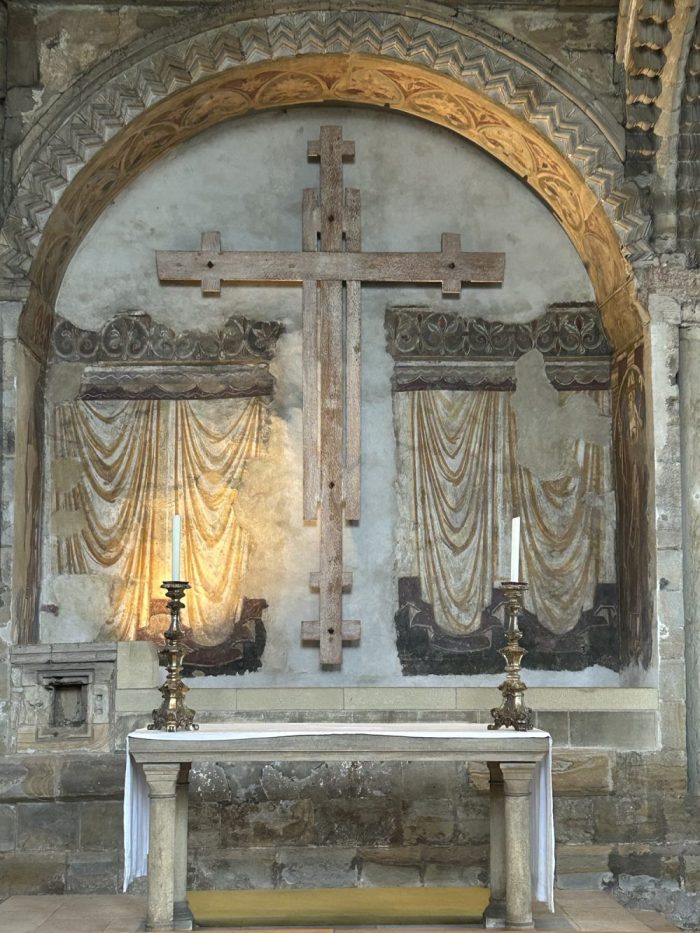
The name ‘Galilee’ is an architectural term rather than a dedication, simply referring to its position at the West end of the cathedral and therefore the beginning of processions, just as Jesus began his ministry in Galilee. Apparently in Durham, the chapel was built to accommodate an overflow of pilgrims coming to visit the relics of St. Cuthbert. Built in the twelfth century in the late Norman style, it differs slightly from the earlier high Norman Romanesque style of the rest of the Cathedral.
At any rate, the sense of holiness hit me immediately as I entered the space. While the chapel houses the relics of the Venerable Bede, for me the numinous was more concentrated on the other side of the room. Despite the busyness of the building on a gorgeous Sunday afternoon in August, the chapel itself felt quiet and peaceful, special and ‘other’ in an intangible way.
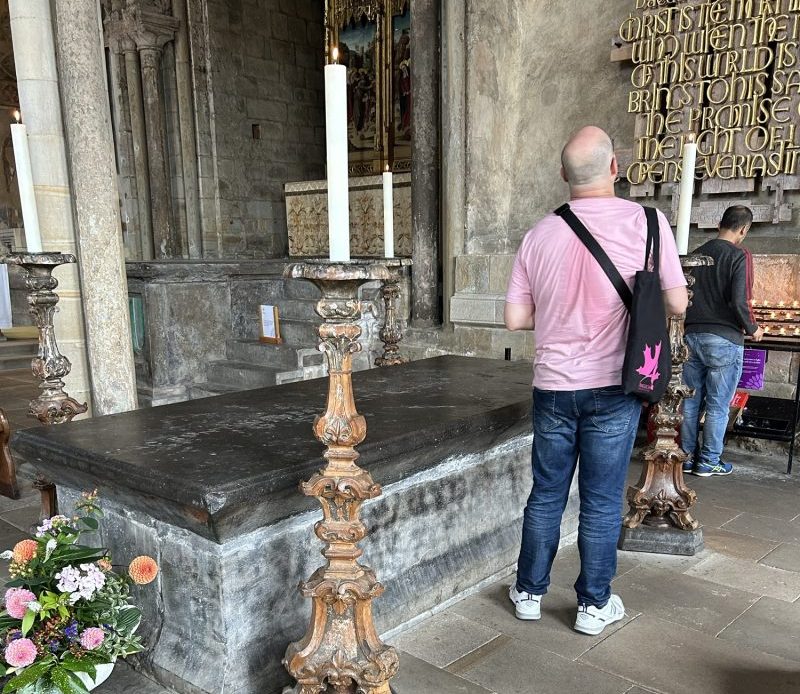
The shrine to St. Cuthbert is located in another part of the building, behind the quire and high altar. While the sense of holiness felt intangible in the Galilee Chapel, here for me this felt far more connected to the person of St. Cuthbert. I can’t say I felt his ‘presence’ per se, but the space felt ‘weighty’ somehow with a ‘something’ inherently connected to him.

The question remains: what is happening in places like this? It’s a mystery of course, but if in our limited and partial way we need to find a way of talking about it, for me the best is the idea of ‘energy’ — not in the ‘woo woo’ sense, but in its Christian theological sense. It arose primarily in the Christian East as a way of expressing the ‘knownness’ of an otherwise infinite and unknowable God. The Greek word energeia is related to the word for ‘work’, and at its heart, it simply means “inworking,” “activity,” or “operation.” It became used in the East to describe God’s tangible operation and inworking in our lives, such that it is believed that for the truly faithful, our very bodies are suffused with the divine energies of the Holy Spirit, and in this way our bodies and the places and objects they touch can become vessels for God’s presence on Earth. This was no abstract theological idea, but expressed their lived experiences of holy people and places. As St. Gregory Palamas put it in a wonderful homily for All Saints Day:
But what about things visible to us now? Who can speak adequately of the divine glory which constantly accompanies the tombs of the saints and their relics, the holy fragrance issuing from them, the flowing myrrh, the spiritual healings, the miraculous works, and all the other saving manifestations to us from that source?” (Homily 25.6)
Without using the technical language later developed in the East, the Venerable Bede himself expressed a similar belief about the relics of the saints, including St. Cuthbert: They were channels of God’s presence with real power to heal, alter the weather, or make salt water sweet.
What I appreciate so much about this idea is how it brings together in a common language the two different experiences of the holy I had in Durham. On the more obvious sense, it expresses how the shrine to St. Cuthbert, built around his remains — relics which had a long history of the miraculous before they reached their final resting place in that cathedral — could feel ‘holy’: the energies of God present in his bones continue to ‘energize’ the place. But on the other side, it also expresses how that first area inside the Galilee Chapel might carry a sense of holiness. For the energies of God are not just for a religious elite, but are in and about all of us, in and through the power of the Holy Spirit, who is “everywhere present and filling all things.” So, as the first place weary pilgrims would have reached upon arriving at their destination, the chapel too could carry the energies of their faithful hopes and dreams for their pilgrimage, and their faithful joy and relief at a safe journey’s end.
I apologize if this reflection got too technical or theologically obscure. The point is simply that when we travel on pilgrimage — or even go about our daily lives — we will encounter the holy, in many forms and many ways: In relics, in a place, in the wisdom of a monastic elder, or even in the hospitality of an inn-keeper or a conversation with a fellow traveler. Such experiences may be outside our normal experience, but they are not outside the lived tradition of our faith and theology. The longer I study theology, the more convinced I am that our theology is weird — not because our forebears delighted in obscure philosophical wrangling, but because they were desperately searching for language adequate to their ongoing experience of God in the world. We don’t need to know or use that language if it doesn’t serve us — it is after all just a collection of symbols that point to an experience. But what is important is that we are open to that experience and are able to give thanks and glory to God when it finds us, as it found me that Sunday in Durham.
Holy fathers Cuthbert and Bede, pray for us!
 Matthew Root
4 thoughts on “Encountering the Holy”