
Christians are without a doubt a ‘people of the Book’. No matter what tradition we may come from, one of the ties that binds all Christians together is our love for and commitment to following the Scriptures, the books of the Old and New Testament. But as I often feel the need to point out, Scripture is a far less intuitive and straightforward idea than we’d like it to be. Like any text, it must be interpreted, but unlike any other text, we must take extra special care in interpreting it. Way back in 2018, I wrote of this challenge like this:
While all written communication is hard, Sacred texts have always presented a special problem of interpretation. These are not just any texts, but texts which form and shape our identity. When I read Paul’s letters, I am trying not only to hear the man Paul and what he is saying to the men and women he’s writing to, but also trying to hear the Holy Spirit and what God might be saying to me and to the Church today.
And for those of us in an ancient tradition, our Sacred texts emerge out of a very different culture from our own. This has always presented challenges. There were Jewish writers of the early Roman Empire who were just as troubled by the stories of divinely commanded genocide in the book of Joshua as many of us are today. But, of course, the distance of time, space, and culture has only grown over the centuries. Scientific and technological discoveries, unprecedented shifts in how people live, mass migrations of peoples and the mixing of cultures and ideas that comes with them, and the opening up of the public square to historically marginalized voices have all increased the degree of difficulty in interpreting our Scriptures well and meaningfully in our present moment. And, these trends will almost certainly only increase in the future. There isn’t anything wrong with these developments — I feel we have so much to gain from them — but they do add to challenge of interpreting our Scriptures.
When I wrote that, I was wanting to develop a more intentional way of studying and reading the Scriptures, one that captured (though not be beholden to) the insights of Integral thought. Through that process, which you can see emerge in real time in my series “Towards an Integral Hermeneutic,” I developed a five-stop methodology, which I’ve since used to help me tackle several individual texts (see here, here, here, here, and here, for example), and the Books of Ephesians and Genesis 1-11.
As you can see in the image below, each step asks different questions, questions which I believe are critical in helping us read, understand, and apply the Bible better. Over the next few weeks, I’d like to re-introduce (and maybe demystify) this Integral Hermeneutic method by exploring these questions more fully. This will act as the third series in my broader project, Reading the Bible Better (part 1: A Brief History of Biblical Interpretation; part 2: Understanding Biblical Genres).
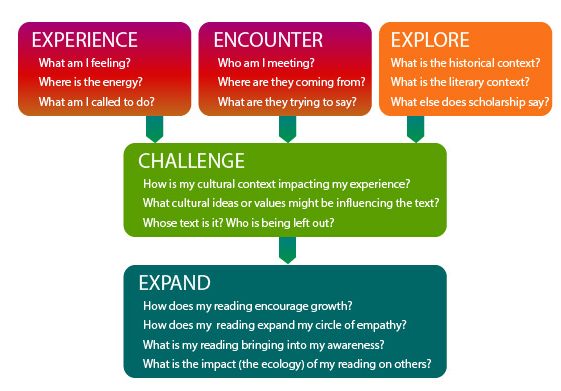
My goal with this series is not to made it too academic or ‘intellectual’, but to explore in practical ways why these questions are important and how they can help us better understand our Scriptures and, most importantly, be changed by them.
 Matthew Root
9 thoughts on “Big Questions: (Re)Introducing an Integral Hermeneutic”