
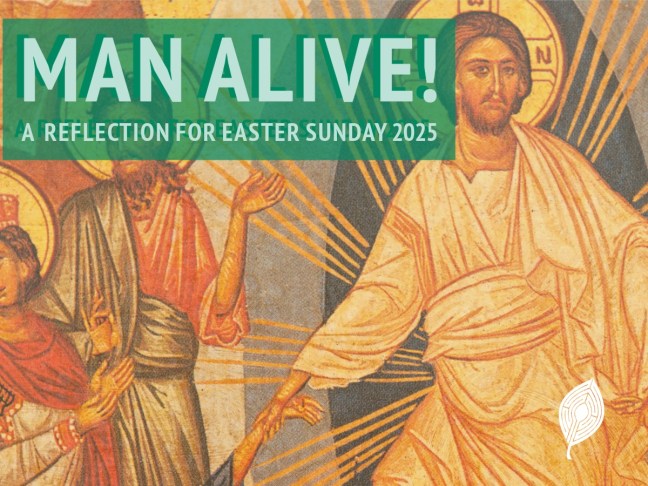
Alleluia! Christ is risen!
He is risen indeed! Alleluia!
These words are the core of the Christian proclamation. This is certainly true today, Easter Sunday, when we commemorate and celebrate Jesus’ resurrection from the dead. But is not just true today. It is the core of the Christian proclamation in every moment, of every day. While most Christians, and certainly all who claim some degree of orthodoxy, believe that this refers to something that happened, in history, to Jesus of Nazareth, those who seem to care the most about this factual and historical component often seem to forget that this is only one part of the Easter proclamation. Yes, God vindicated Jesus, put on the cross by an unholy alliance of Religion and Empire, showing that he was innocent and could not be defined, limited, or eliminated by their lies. But the resurrection wasn’t just about Jesus; it wasn’t just about some extraordinary thing that happened to one martyr’s body: The resurrection is about, and for us all.
This is the message of the Epistle reading appointed for today:
If for this life only we have hoped in Christ, we are of all people most to be pitied. But in fact Christ has been raised from the dead, the first fruits of those who have died. For since death came through a human being, the resurrection of the dead has also come through a human being; for as all die in Adam, so all will be made alive in Christ. But each in his own order: Christ the first fruits, then at his coming those who belong to Christ. Then comes the end, when he hands over the kingdom to God the Father, after he has destroyed every ruler and every authority and power. For he must reign until he has put all his enemies under his feet. The last enemy to be destroyed is death. (1 Corinthians 15:19-26)
In the Judaism of Jesus’ day, the resurrection of the dead was a key apocalyptic and eschatological symbol. It is apocalyptic in that it is the primary way God demonstrates God’s faithfulness to those who are oppressed in this world; and it is eschatological (from a Greek word meaning ‘pertaining to the end’) in that it was to mark the end of this world and the start of God’s Kingdom. That’s why the resurrection of Jesus was both so rich in symbolism and confusing for the disciples. Christ was raised, but Rome still ruled. It was apocalyptic without being eschatological — the sign of the end of time happened in the midst of time. (Hence Peter’s redefinition of what the ‘end’ means at Pentecost.) At any rate, here Paul sorts out this complication: Christ was raised as the first fruits of resurrected humanity. ‘First fruits’ isn’t a term that means much to most of us today, but it was an important symbol, both culturally and religiously — effectively, the promise of a bountiful harvest, or, metaphorically, the down payment on the full sum. If Jesus’ resurrection is the ‘first fruit’, then our own resurrection is the full harvest to come.
This same claim is made in Romans and 2 Timothy too:
- We have been buried with him by baptism into death, so that, just as Christ was raised from the dead by the glory of the Father, so we too might walk in newness of life. For if we have been united with him in a death like his, we will certainly be united with him in a resurrection like his. We know that our old self was crucified with him so that the body of sin might be destroyed, and we might no longer be enslaved to sin. For whoever has died is freed from sin. But if we have died with Christ, we believe that we will also live with him. (Romans 6.4-8)
- If we have died with him, we will also live with him (2 Timothy 2.11)
But there’s more!
While these passages focus on the future promise of the resurrection of the dead, Paul elsewhere insists that it’s not something we have to wait for. We have access to, and are called to embody, the resurrected life of God’s Kingdom in the here and now:
- And he died for all, so that those who live might live no longer for themselves, but for him who died and was raised for them. … So if anyone is in Christ, there is a new creation: everything old has passed away; see, everything has become new! (2 Corinthians 5.15, 17)
- So if you have been raised with Christ, seek the things that are above… (Colossians 3.1)
- Rather, speaking the truth in love, may we grow, in every way, into him, Christ, who is the head (Ephesians 4.15)
- …set aside the person you once where in your old way of life, ruined by its deceitful appetites; but instead to be renewed of mind in the Spirit and to clothe yourself with the new person, created like God for justice and the holiness of truth. (Ephesians 4.22-24)
This is nothing other than a consequence of the ‘end’ happening in the midst of time. God’s end-game is already happening in and through us, through the presence and power of the gift of the Holy Spirit.
So what’s the point of all this, especially on today of all days? It’s simply this: As we celebrate the resurrection of our Lord today, may we not forget that it is not only also a promise of our own resurrection in Him, but also a calling, to embody the new life of the Kingdom today, in the here and now, committed to truth, justice, mercy, and love.
Alleluia! Christ is risen!
He is risen indeed! Alleluia!
(And we are too, in him. Alleluia! Alleluia! Alleluia!)
 Matthew Root