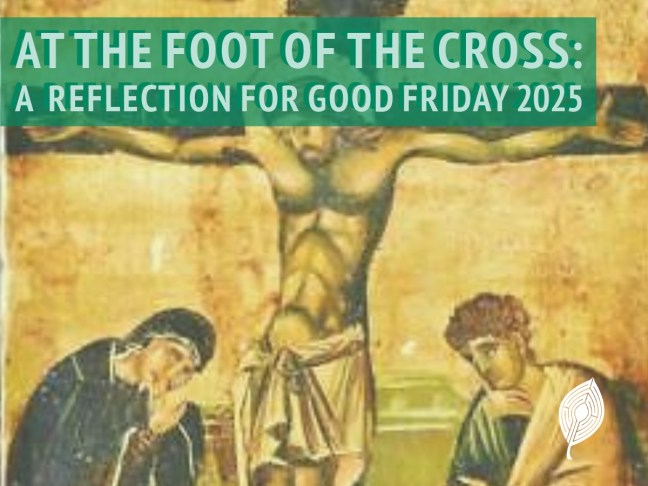
On Good Friday every year, we read the entirety of one of the Passion narratives, which means that today we get two whole, long chapters from the Gospel according to John. So, there are a lot of things one can touch on in a reflection or sermon on a day like today. A lot happens! But today, after all that, what stuck out to me the most was the very last image of the reading: John and Mary standing at the foot of the cross in their grief.
The scene flashed me back to an evening last month, when I, with my family, stood before a photo of a deceased family member, singing the Orthodox memorial prayers. I was struck then by how right it felt that the service brings up Mary as often as it does: Who better than Mary to understand what it means to grieve a loved one? As I noted about this a few weeks ago, the scene is a stark fulfillment of the prophecy that, when it came to her son, “a sword will pierce [Mary’s] soul too.” Imagine my surprise when this week in my readings preparing for my recent post on St. Maria Skobtsova, I discovered that Mother Maria made a similar connection and made it the basis of her whole ministry:
“Yea, a sword shall pierce thy own soul also” (Luke 2:35). This image is the great symbol of any genuine relation to man: in the Crucified she saw both God and her son, and by that she teaches us to see God — that is, the image of God — in every brother in the flesh of the Son of Man, who is also a son we adopt through our love, our compassion, our participation in his suffering, our bearing of his sins and lapses. To this day the Mother of God is pierced by the Cross of her Son, which becomes for her a two-edged sword, and by the swords of our crosses, the crosses of all Godmanhood. And, contemplating her super-worldly intercession for all human sins and weaknesses, we find in her a sure and true path that tells us to receive in our hearts the crosses of our brothers, to be pierced by them as by a weapon that pierces the soul. (“The Second Gospel Commandment,” published in Mother Maria Skobtsova: Essential Writings)
Here Mother Maria expresses the great mystery of the Incarnation: That in God becoming human, we are freshly able to see the image of God present in everyone. The particular and specific reveals the universal. This isn’t just nice theology — though it is. It is also a call to action. Mother Maria felt a special kinship with Jesus’ mother, for she too had lost a child and felt that she had gained the whole world in the process. She wrote: “I feel that the death of my child obliges me to become the mother of everyone.” And she devoted the rest of her life to serving the poor, refugees, and the persecuted.
Thinking on this image of Mary and John at the foot of the cross, I think they shared a similar experience to Mother Maria’s. In seeing her son die, Mary saw the suffering of all humanity and took on a vocation of motherly love and intercession for all those who love him (and even those who don’t). In seeing his friend die, John saw the suffering of all humanity and became a friend to all. Of all the characters of the New Testament, I see the most transformation in John: He went from a brash kid wanting Jesus to call down fire from heaven (which earned him and his brother the nickname “Thunderboys” from Jesus), to the Apostle of Love, who wrote:
For this is the message you have heard from the beginning, that we should love one another. … We know love by this, that he laid down his life for us—and we ought to lay down our lives for one another. How does God’s love abide in anyone who has the world’s goods and sees a brother or sister in need and yet refuses help? Little children, let us love, not in word or speech, but in truth and action. (1 John 3.11, 16-18)
There can be no greater love for the Jesus he saw die on the cross than to live like this.
Today we all join Mary and John at the foot of the cross. And many of us, like St. Maria Skobtsova, bring our own griefs and sorrows into this experience: The loss of a child, of a parent, of a sibling, or a friend haunts our experience of the cross. But the thing about love is that it’s never lost, never wasted. So while we stand in our grief today, may we also start to ask ourselves what we might do with our grief and sorrow, how we might resurrect it into a new expression of love, compassion, and solidarity with the suffering world.
Amen.
 Matthew Root
One thought on “At the Foot of the Cross: A Reflection for Good Friday 2025”