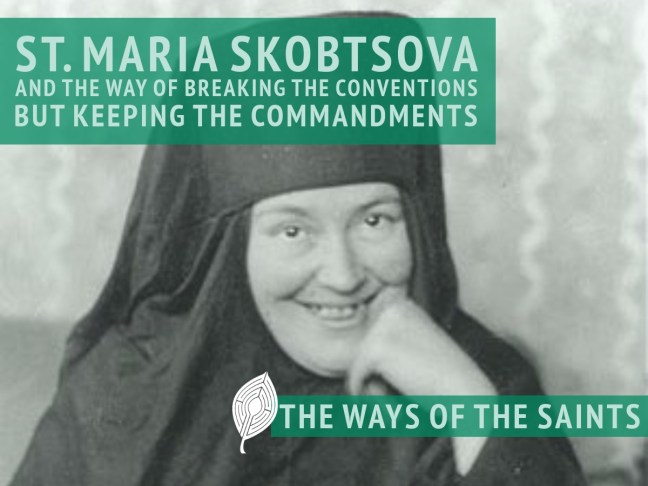
Today this series on the Ways of the Saints comes to an end. Over the past few weeks, we’ve seen how holiness expressed itself in a wide variety of people: men and women, Eastern and Western, monks and laity, from the first through twentieth centuries, and from Asia, Africa, Europe, and the Americas. They’ve also had a wide range of gifts, ministries, and vocations, creating not only a “great cloud of witnesses,” but an incredible and beautifully diverse one at that. But within this cloud, over the centuries a few people stand out as especially remarkable, for living out the Gospel in a particularly radical, vivid, and challenging way. St. Francis of Assisi was one such individual — so great was his wake that I followed up that past with stories of two Saints, Clare and Bonaventure, directly inspired by him! But another is far less famous, despite the fact that she was living and working just a hundred years ago. But her life and way was perhaps even more radical than Francis’s. For while he eschewed the social conventions of his day in more or less expected ways — rejecting any kind of material comfort or concern for appearance, concern for the poor and so on — the woman I’ll be talking about today broke all the typical conventions of Christian life and piety, and the light of Christ shone all through her the more brightly for it. I’m talking about the Saint Maria Skobtsova, also known as Mother Maria of Paris.
The future St. Maria Skobsova was born Elizaveta Pilenko on December 20, 1891 to an aristocratic family in Riga, now capital of Latvia, but then part of the Russian Empire. While she exhibited some signs of devotion in her childhood, she became a committed atheist after the death of her father when she was a teenager. After a move to St. Petersburg, she embraced revolutionary politics, even marrying a Bolshevik. But her encounters with revolutionaries and the intelligentsia left her disillusioned by their lack of ‘soul’; she complained that they cared a lot about humanity, but not about people. But moving in St. Petersburg’s educated circles also brought her into contact with fresh voices and ideas in Orthodox Christian theology, which was experiencing a genuine Renaissance at the time. Elizaveta’s views on Christianity began to soften — she even began classes at St. Petersburg during this time, a shocking thing for a woman — but she did not abandon her commitment to revolutionary values. She always remained her own person, and during the Russian Revolution she found herself under direct personal threat from both the Red (Communist) and White (Czarist) armies. At one point, only the intervention of an old family friend, who happened to be the judge at her trial, kept her from being convicted for treason. The two subsequently married (her first marriage having ended in divorce), and when the Soviets finally consolidated power, they fled (with Elizaveta’s mother and daughter from her first marriage), first to Georgia (where she gave birth to her son Yuri) and then to Yugoslavia (where her second daughter Anastasia was born), before finally settling in Paris’s vibrant Russian émigré community in 1923.
By this point, Elizaveta had developed (much like her American, Roman Catholic contemporary Dorothy Day) a commitment to radical social change as an expression of the Gospel of Jesus Christ. She poured her energy into both theological study and hands-on social work — to the detriment of her marriage, which soon collapsed (it had already been teetering after the death of Anastasia to influenza). Encouraged to take monastic vows, she was granted an ecclesiastical divorce, ensured her surviving children were provided for, and took on the name Maria. Mother Maria of Paris was officially born. Despite her passion for big ideas of theology and social change, she understood that you couldn’t love humanity with out loving people exactly where they were at. In one formative story from her younger days, she is said to have gone into a factory boarding house wanting to teach Dostoevsky to the workers; they sneered at her for thinking they’d be interested in Dostoevsky when their basic needs weren’t being met. Rather than leaving in a huff or in shame, she simply set down her teaching materials and got to work. After days of her tirelessly mending their clothes and scrounging up food for them, they came to her and asked her to teach them Dostoevsky. It’s a story that to me perfectly captures her spirit. She wanted to elevate the conditions of the poor, including their material conditions, but also their spirits, minds, and souls. No matter how dedicated she was to making sure people were housed, clothed, and fed, she never lost her love for literature and theology. She saw her work in housing and feeding, educating, and providing for the spiritual needs of Paris’s poor as equally vital parts of her Christian duty to treat every one with dignity:
Christian love teaches us to give our fellows material as well as spiritual gifts. We should give them our last shirt and our last piece of bread. Personal almsgiving and the most wide-ranging social work are both equally justified and needed.
As she put it elsewhere in more explicitly theological terms:
Each human being, manifested to us from the moment of the first Old Testament revelations as the image of God, in Christ discloses still more strongly and concretely his connection with God. He is indeed the image of God, the image of Christ, the icon of Christ. Who, after that, can differentiate the worldly from the heavenly in the human soul, who can tell where the image of God ends and the heaviness of human flesh begins! In communing with the world in the person of each individual human being, we know that we are communing with the image of God, and, contemplating that image, we touch the Archetype — we commune with God. (”The Mysticism of Human Communion”)
These are beautiful and bold words, but she lived them out as fully as possible for anyone in this world.
Having agreed to taking monastic vows only on the condition that she not be cloistered, Mother Maria turned her rented Paris house into a ‘convent’ with doors wide open to all. In doing this, she rejected every convention of keeping up appearances. She was a twice-divorced, chain-smoking, beer-drinking revolutionary, of questionable personal cleanliness, who often skipped church services to get on with her work. She even publicly denounced traditional monasticism as a bland substitute for conventional family life. She often resorted to begging for scraps from the food vendors at Les Halles, Paris’s large public market, such that she became known as “the cigarette-smoking beggar nun” among the labourers there. In other words, she lived her life as a scandal and didn’t care if that put anyone off. But scandal though she was, she was a scandal for Christ: It was all for the sake of sheltering the homeless, feeing the hungry, mending garments, and welcoming refugees, alongside hosting literary salons and theological debates. When France fell to the Nazis in 1940, she sheltered Jews and Fr. Dimitri, the priest working with her, provided false baptismal certificates to Jews in an attempt to keep them safe. Once the Nazis had started rounding up Jewish children, Mother Maria used her status as a nun to gain access to the camp where they were being kept and did what little she could to provide some comfort and material support for them. (For her efforts during the occupation, she is remembered within contemporary Judaism as one of “the Faithful among the Nations”.)
The house was, of course, eventually shut down by the Nazi authorities, and Mother Maria and her associates (including Fr. Dimitri and her now grown son Yuri) were arrested. Fr. Dimitri and Yuri both died at the Dora Concentration Camp, while Mother Maria was sent to the gas chamber at Ravensbrück on Holy Saturday 1945, a matter of days before the camp was liberated.
So, then, what can we learn from the way of St. Maria and apply to our own lives today? As with St. Francis and so many other of the wonderful Saints we’ve looked at in this series, I could take this in any number of ways. But what sticks out to me most is just how unconventional she was. More than anyone else I can think of, aside from Jesus himself, she embodied the spirit of that great quip (often credited to G.K. Chesterton) to “break the conventions and keep the commandments.” She had no time for social niceties and common piety, and certainly refused to waste time and effort keeping up appearances. And this is why, to my mind, she is the perfect Saint with which to end this series. For holiness manifests itself in myriad ways, but none of them are conventional. Authentically following Christ will always make us disruptors of the status quo and make nobody happy. (Especially our fellow Christians.) In the wonderfully paradoxical way of our faith, becoming more like Christ will make us more and more our unique selves in all our particularity. And in this, St. Maria Skobtsova is a perfect example. Conventions about how a nun should act, laws and ideals about marriage, be damned — She was a true revolutionary and radical, as Jesus was: a revolutionary of the human person.
As we enter into our Holy Week commemorations and prepare ourselves to celebrate our resurrection life once again with our Lord on Easter morning, may we too be willing to die to conventionality and ‘shoulds’, and take up the cross of our unique vocations (whatever they may be) with as much courage, conviction, and radicalism as our Mother among the Saints, Maria of Paris.
— “No amount of thought will ever result in any greater formulation than the three words, ‘Love one another,’ so long as it is love to the end and without exceptions.” — St. Maria Skobstova
 Matthew Root
3 thoughts on “St. Maria Skobtsova and the Way of Breaking the Conventions but Keeping the Commandments”