
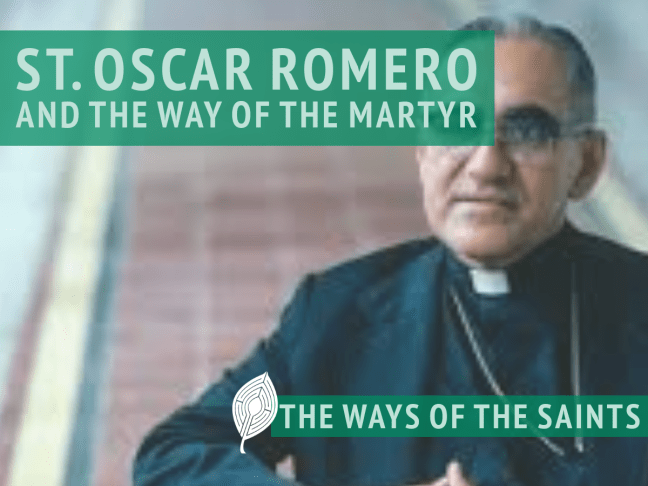
There are few words that get the Christian imagination going more than ‘martyr’. Indeed, our faith cut its teeth in times of periodic and local, but nonetheless violent persecution, when many Christians were executed, often in gruesome public spectacles. But our language here in English hides something important. For the Greek word martys, from which we get ‘martyr’, literally means ‘witness’. The martyrs are therefore people who witnessed to their faith in Christ to the point of death. Throughout this Lent, we’ve seen many martyrs in the communion of saints, people like St. Elisabeth the New Martyr, Maximilian Kolbe, Dietrich Bonhoeffer, Rev. Dr. Martin Luther King, Jr., and Fr. Alexander Men. (It’s a sad testament to the state of our world that all of these were martyrs from the twentieth century!) For many of these individuals, it was precisely the ferocity and vividness of their living witness to Christ that put them in the cross hairs of the enemies of the faith. The Saint I’d like to look at today is another such individual, the Salvadorean bishop Oscar Romero.
Óscar Arnulfo Romero y Galdámez (August 15, 1917 – March 24, 1980) was a Roman Catholic bishop in El Salvador. For most of his career, he was seen as being a conservative, by temperament if not in politics. He was cautious and guarded, but not opposed, to the ‘fresh air’ of Vatican II Roman Catholicism, and as his country’s politics devolved into factionalism, he was more comfortable with the right-wing military government than with the left-wing alternatives. He preferred an unjust but peaceful status quo to any social upheaval. So, when he was appointed Archbishop, it was largely to cheers of the governing authorities and the chagrin of progressive voices in the country. But in his new role, he quickly came up against the limits of his politics. A close personal friend, Fr. Rutilio Grande, who had been working among the poor creating self-supporting cooperatives, was assassinated, and the government subsequently turned a blind eye. As Romero later commented on this event: “When I looked at Rutilio lying there dead I thought, ‘If they have killed him for doing what he did, then I too have to walk the same path.’” And so, Romero found himself forced outside his comfortable conservatism and became an outspoken advocate for the poor and those who worked among them, drawing increasing ire from the government and their allied right-wing militias. Attempts at getting the Vatican and the American government (which was actively supporting the right-wing junta) to withdraw their support for the Salvadorean government on humanitarian reasons failed, but he continued his advocacy. Soon he emerged as one of the most visible advocates for the poor in the world. In 1980, he was given an honourary doctorate at the Université Catholique de Louvain in Belgium, where he summarized the state of affairs in his homeland in unflinching terms:
In less than three years, more than fifty priests have been attacked, threatened, calumniated. Six are already martyrs—they were murdered. Some have been tortured and others expelled. Nuns have also been persecuted. The archdiocesan radio station and educational institutions that are Catholic or of a Christian inspiration have been attacked, threatened, intimidated, even bombed. Several parish communities have been raided. If all this has happened to persons who are the most evident representatives of the Church, you can guess what has happened to ordinary Christians, to the campesinos [peasants], catechists, lay ministers, and to the ecclesial base communities. There have been threats, arrests, tortures, murders, numbering in the hundreds and thousands…. Not any and every priest has been persecuted, not any and every institution has been attacked. That part of the church has been attacked and persecuted that put itself on the side of the people and went to the people’s defense. Here again we find the same key to understanding the persecution of the church: the poor.
Just six weeks later, Romero was assassinated while in the midst of celebrating the Mass, an act which was also never properly investigated by the government. (A UN truth and reconciliation commission later found that he had been killed by right-wing nationalists.) His funeral, which attracted an estimated quarter million people was also attacked, leaving many dead or wounded. Romero was formally declared a martyr in 2015 and canonized as a Saint in 2018. For years, this process had been stalled due to questions about whether he was killed for his faith or for his politics. But when it came to vote at last, it was unanimous in his favour. And this is instructive: Solidarity and advocacy on behalf of the poor is not something outside the Gospel, but an essential part of it. Romero was no leftist radical — as we saw, he was more naturally a conservative — but spoke out against humanitarian abuses because the Gospel demanded it. And it was for this witness to the Gospel message that he was killed.
We all would do well to hope and pray we do not have to live through such circumstances as the Holy Martyr Oscar Romero did, but such times come, somewhere, in every generation. Like him, we are called to be willing to step outside our comfort zones and speak the truth in love to a world that does not want to hear it — even if we have to set aside our social respectability, political beliefs, or personal safety to do so. It is a challenging and uncomfortable thing to think about. But the good news is that we are not alone. We have the example of Christ, whose Holy Spirit is within us, transforming us, inspiring us, and empowering us to preach the Gospel with our lives and our words. And we have the great cloud of witnesses, the communion of Saints as examples, as advocates, and as intercessors, cheering us on.
Almighty God, you called your servant Óscar Romero to be a voice for the voiceless poor, and to give his life as a seed of freedom and a sign of hope: Grant that we, inspired by his sacrifice and the example of the martyrs of El Salvador, may without fear or favor witness to your Word who abides, your Word who is Life, even Jesus Christ our Lord, to whom, with you and the Holy Spirit, be praise and glory now and for ever. Amen.
 Matthew Root
One thought on “St. Oscar Romero and the Way of the Martyr”