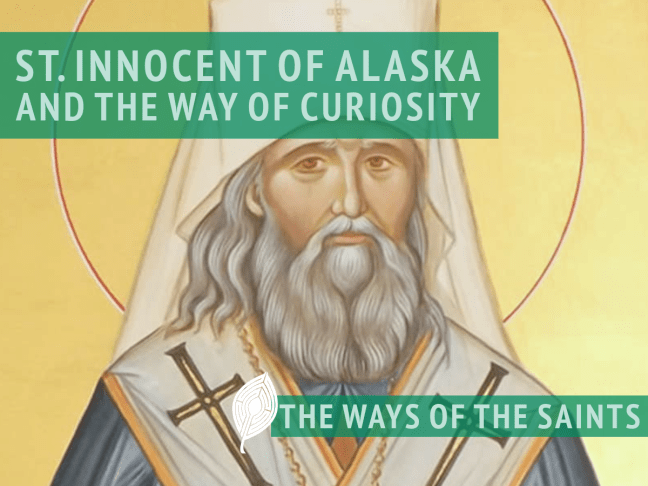
Towards the start of this series on the Ways of the Saints, we looked St. Herman of Alaska, a Russian missionary who stood up for and alongside the local peoples being exploited by the colonial administration; we also saw a wonderful example of the fruition of what he began in the figure of St. Olga of Kwethluk. Today I’d like to turn to a third figure from the Alaskan setting, St. Innocent Venianimov, who was not only an active and beloved pastor over a vast territory and among peoples speaking many different dialects and languages, but also took a scientist’s eye to the lands through which he traveled. For me, the way of St. Innocent is all about curiosity about the world, something well worth celebrating.
The future St. Innocent was born Ivan Evseyevich Popov on August 26, 1797, in a remote village in the Verkholensk District of the Russian Far East. Even as a boy, there must have been something special about him, as when he began his formal education, he was given a new patronymic, Veniaminov, in honour of a recently deceased bishop. He was married at the age of twenty and was ordained shortly thereafter. (The Eastern Orthodox tradition allows for married clergy but men must remain in the state (single or married) in which they were ordained, to prevent distraction or scandal.) Fr. Ioann (Ioann being a version of Ivan that was used in specifically religious contexts.. the joys of Russian naming conventions!) was posted to Irkutsk but within just a couple years volunteered to go with his family (including his aging mother and infant son) to the even more remote lands of Russian Alaska, to serve the growing Church there. (This was about a generation after St. Herman’s mission began its work.)
Fr. Ioann arrived at Unalaska in July 1824 and immediately set himself to work at learning the local languages and dialects, of which there were at least six spoken in his large parish. He adapted the Cyrillic alphabet to write the most common dialect, Unangan Aleut and set to work translating portions of the Bible and catechisms (basic instruction). In 1834, was transferred to Sitka, where he came into contact with the Tlingit people and began to study their language and customs as well. Throughout his ministry, he traveled extensively, and took a scholarly, scientific eye to whatever he encountered. He wrote about the climate and weather, about the migrations of the local peoples and fauna, about the geology and geography of the region, as well as its flora and other resources. This keen scientific mind also spilled out into his limited leisure time, in which he constructed musical instruments, furniture, and even highly technical devices such as clocks. His linguistic and scientific notes were of such a high quality that they were published when they were received back in Russia, in such works as Notes on the Kolushchan and Kodiak Tongues and Notes on the Unalaska District. (Since we have so many bad examples of European engagement with Indigenous peoples, I’ll also note that he insisted his local informants be credited as co-authors on all his linguistic publications.) We can even call him an ecologist, since his detailed notes on seal populations led him to suggest ways of harvesting them (the colony was still, after all, based on the fur trade) without collapsing their populations. He learned and taught European crafts and trades, and even introduced the relatively new science of immunization to the Alaskans!
On one of his trips back to Russia, Fr. Ioann received word that his wife had died, and he was asked to take up monastic vows. It was at this point that he received the name Innocent, by which he is commonly known today. He was raised to the role of archpriest, and then bishop over both Alaska (whose diocesan boundaries stretched down to California) and the vast territory of the Russian Far East. He spent about a decade in this role, most of it traveling in difficult conditions. Then, in a surprising turn of events for someone from such a remote part of Russia, in 1867, he was appointed as Metropolitan of Moscow, the highest position of the Russian Orthodox Church. He spent this part of his ministry ensuring religious texts were accurate, improving the wages of clergy (who were generally on starvation wages despite Russian Orthodoxy’s position as a state church), and constructing nursing homes for aged and infirm clergy.
So here we have another polymath, who (like St. Hildegard yesterday) could rightly be remembered for many things. But what always strikes me about St. Innocent of Alaska is his curiosity and love of learning. He didn’t just learn a local language or two to get by, but seemed to devour all of them. Likewise, he didn’t have to take records of the area, but did so because of his innate interest in the world around him. Even his hobby of clockwork points to a mind that simply demanded to know how things work, and to my mind that is such a valuable trait. St. Innocent was certainly a holy man, from his willingness to venture into unknown lands when no one else would volunteer, to his courage in traveling in often dangerous conditions, and his commitment to pastoring a far-flung flock. But again, for me, what stands out most about his way is his love of learning and curiosity about the world and its peoples. And this wasn’t a mercenary kind of interest — he respected Indigenous ways, credited Indigenous collaborators, and advocated for sustainable management of the fur trade. St. Innocent certainly had a singular life but I think we’d do well to adopt his way of curiosity as much as we can. I was once told that the key to life is asking, “What else I can I learn about this?” This ‘else’ is important because it keeps us from being complacent with what we already know or arrogantly thinking we know it all. To me that’s the spirit of St. Innocent.
Holy father Innocent, pray for us! Amen.
 Matthew Root