
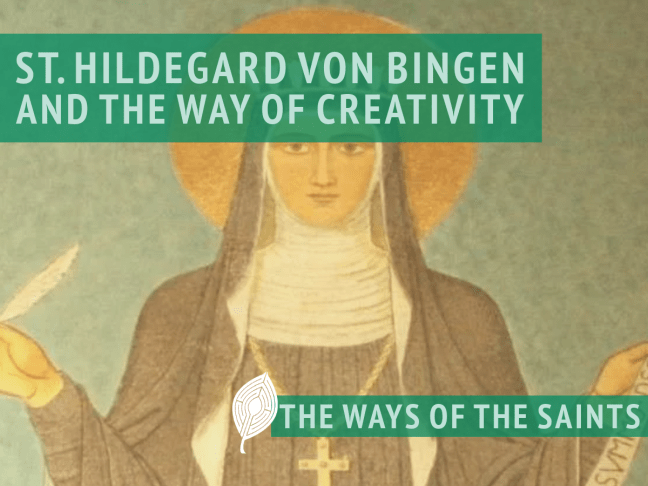
Five years ago now (!), after I wrote a sub-series on mystics in my my larger ‘Knowing God’ series, I found myself returning for weeks and months to the vivid imagery of St. Hildegard von Bingen’s writings: for example, God as a beautiful woman shining brighter than the sun, “who sets all living sparks alight,” “flame[s] above the beauty of the fields and shine[s] in the waters,” imparting life to all things through her green-bearing breath. While she ascribed these images to a vision from God, the vivid way she described them is what so captured my imagination. It takes a true creative to put a mind-bending mystical experience like that into such beautiful language. And that’s what I’d like to focus on today: St. Hildegard’s holiness as lived out in her way of creativity.
St. Hildegard of Bingen was born into a family of the minor gentry at the cusp of the twelfth century in what is now western Germany. From a young age she experienced visions. In a letter defending her experiences, she insisted:
I do not hear them with my outward ears, nor do I perceive them by the thoughts of my own heart or by any combination of my five senses, but in my soul alone, while my outward eyes are open. So I have never fallen prey to ecstasy in the visions, but I see them wide awake, day and night. And I am constantly fettered by sickness, and often in the grip of pain so intense that it threatens to kill me, but God has sustained me until now. (Letter to Guibert of Gembloux)
Whatever we may think of the source of these painful yet extraordinary experiences (some have suggested she suffered from epilepsy), she interpreted them as coming from God and didn’t let them stop her from pursuing either education or her interest in the arts. While details vary, it appears her life was consecrated to God’s service at a young age, at either eight or fourteen years old, under the care of the Countess Jutta von Sponheim, who taught her to read and write, and may have also taught her music. In her adulthood, she became a genuine polymath, excelling as not only a nun, mystic, and theologian, but also as an illustrator, musician, songwriter, playwright, and botanist and herbalist. Some of her compositions are still performed today, and she has been credited as the greatest scientist of medieval Germany. When she was 38 years old, Hildegard was selected to be the nuns’ leader. While this was initially supposed to be under the authority of a local abbot, she petitioned to run her convent independently, and was eventually successful in this. Throughout this time, she corresponded with important men and women, and, while her visions did raise questions for many powerful men, when put before the authorities, she was found to be fully orthodox and the Pope himself gave her his stamp of approval. She lived a long and full life, dying peacefully at the age of 81.
Clearly St. Hildegard von Bingen was a remarkable and accomplished woman. But, of all the areas in which she excelled, today I’d like to focus on her artistry and creativity. The arts are an incredible way many of us experience beauty, and therefore transcendence, and therefore, in some mysterious way, God. There’s a reason why the appreciation of beauty is one of the universal traits identified by positive psychologists as necessary for healthy human psychology. The arts can simply open us up to something greater than ourselves — and God delights in working with that. Because of this, artists are the unsung heroes of the faith. Sure, many Renaissance artists worked in religious motifs and are household names, but think of all the iconographers, stained glass workers, sculptors, architects, hymnographers and composers who lived and died in obscurity. The recognition of St. Hildegard as a Saint of the Church is a wonderful recognition of the importance of the arts and value of creativity in the life of faith. Of course, like any strength or character trait, in order to be holy, creativity must be exercised well and towards God, with a sanctified imagination. And few people in recorded history have been celebrated as much as St. Hildegard for this. So I’m grateful both for her example in living out her faith with imagination, creativity, and artistry — and for the Church in choosing to recognize and canonize her for it.
The Holy Spirit: living and life-giving,
the life that’s all things moving,
the root in all created being:
of filth and muck it washes all things clean—
out-scrubbing guilty staining, its balm our wounds constraining—
and so its life with praise is shining,
rousing and reviving all. — Hildegard von Bingen, Psalm antiphon for the Holy Spirit
 Matthew Root
One thought on “St. Hildegard von Bingen and the Way of Creativity”