
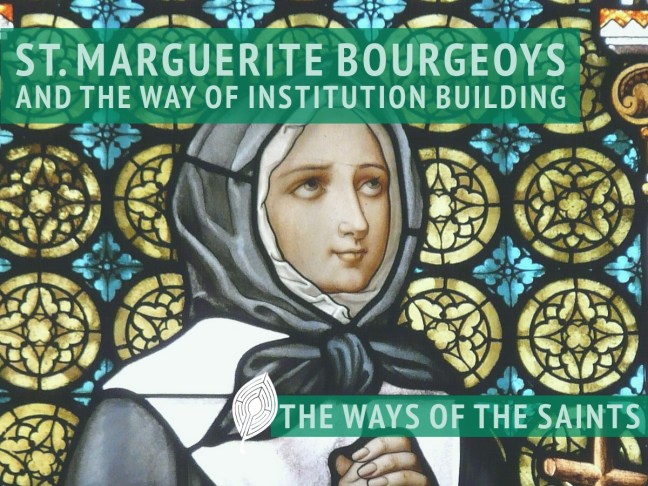
One of the basic premises of this series on the Ways of the Saints is that holiness manifests itself in an infinite variety of ways. Even if we are tempted to dismiss the radicalism of St. Francis of Assisi, the aggressive simplicity of St. Thérèse of Lisieux, or the bravery of Rev. Dr. Martin Luther King, as being ‘too much’ to be relevant to our own lives, there are always Saints whose holiness has manifested in ways that may look a lot more like our own lives. One such Saint was perhaps the seventeenth-century French woman St. Marguerite Bourgeoys. While her life also involved a lot of poverty, simplicity, and courage, she is best known for simply getting things done. She was a practical woman who built lasting institutions and therefore whose holiness still impacts people directly today.
Marguerite Bourgeoys was born in Troyes, in the Champagne region of France, on April 17, 1620. Initially refused from entering monastic life, she began working as a teacher for the poor. Before long she found herself the leader of a group of over three hundred laywomen who were similarly committed to serving the city’s poor. When she was thirty-two years old, her life took a dramatic turn. Upon meeting with an official visiting from New France, she accepted his offer to establish a school in Ville-Marie, now known as Montreal. When she arrived, she found that things weren’t quite as settled as she’d been led to be believe, so she expanded her ministry beyond teaching. She built the settlement’s first school, planned the construction of the Notre-Dame de Bon-Secours Chapel, acted as a protector for the filles du roi (girls and young women recruited to the colony to become wives for the colonists), founded a trade school, and basically did whatever needed to be done. She was so well-known and -loved in Ville-Marie that she became godmother to many of the community’s babies and a friend to many of the women. To assist her in these extensive duties, she founded the Congrégation de Notre-Dame, which she envisioned to be a new type of religious community for women, who would not remain cloistered but would rather be active in the life of the wider community. This was a controversial idea at the time and so, rather than surviving on either the dowries of its members or patronage, she managed to make the Congrégation de Notre-Dame financially independent and self-sustaining from the start. Unfortunately, in the 1690s, the life of the Congrégation proved to be too radical for the Church to handle and they were forced into a compromise model more closely resembling traditional monastic life for women; but by the time St. Marguerite died in 1700, its ranks had still swelled and included not only French women, but also locals from both the Canadien and Indigenous communities, and even English women. So beloved was she in the community that she was immediately venerated as a Saint locally (even though it took over 250 years for the Church to officially canonize her as such).
What I appreciate most about St. Marguerite’s way was her can-do spirit. She looked around at the needs of her community, rolled up her sleeves, and got to work. And, she used her God-given gifts of intelligence, leadership, and administration, to say nothing of perseverance and kindness, to do it. And so, for me, she remains a wonderful example to all of us. No matter the contexts of our lives, and our specific skill sets, there is always work to be done, and something we can do to pitch in. And so, as we enter into these last days of Lent, may we all remember and be inspired by her way. For so long, our practical lives in the West have been buoyed by solid government institutions devoted to things like health, education, and social welfare. But everywhere we look, these institutions are either under direct attack, or crumbling from underfunding. More and more, it will be up to us once again to work for the good of our communities. And so, more and more, the example of St. Marguerite is relevant. There is work to be done. Let’s get to it.
Holy Mother Marguerite, pray for us! Amen.
 Matthew Root
One thought on “St. Marguerite Bourgeoys and the Way of Building Institutions”