
One of the most challenging (and in some places controversial) ideas of the past decade or so has been the concept of privilege, those aspects of our identity that, even if they may not always grease the wheels of life for us, at least don’t act as roadblocks to our success. But while our conversations about privilege may have changed this century, it’s always existed in some form or another. In today’s Epistle reading, Paul talks about his own privilege and how he related to it both before and after his encounter with the risen Jesus. And so today I’d like to look a bit at how Paul engages with privilege in this passage and then explore how another Saint from Christian history used her privilege well.
Starting with the Epistle reading, Paul has this to say:
If anyone else has reason to be confident in the flesh, I have more: circumcised on the eighth day, a member of the people of Israel, of the tribe of Benjamin, a Hebrew born of Hebrews; as to the law, a Pharisee, as to zeal, a persecutor of the church; as to righteousness under the law, blameless. Yet whatever gains I had, these I have come to regard as loss because of Christ. More than that, I regard everything as loss because of the surpassing value of knowing Christ Jesus my Lord. For his sake I have suffered the loss of all things, and I regard them as rubbish, in order that I may gain Christ and be found in him, not having a righteousness of my own that comes from the law, but one that comes through faith in Christ, the righteousness from God based on faith. I want to know Christ and the power of his resurrection and the sharing of his sufferings by becoming like him in his death, if somehow I may attain the resurrection from the dead. Not th at I have already obtained this or have already reached the goal; but I press on to make it my own, because Christ Jesus has made me his own. Beloved, I do not consider that I have made it my own; but this one thing I do: forgetting what lies behind and straining forward to what lies ahead. I press on toward the goal for the prize of the heavenly call of God in Christ Jesus. (Philippians 3:4B-14)
Here he boasts of the incredible privilege he has had: Born to the right people, attending the best schools, and keeping the faith zealously and even perfectly. But then he calls all of that garbage compared to the importance of his Christian identity — not as just a badge of honour or team to play for but as a calling to share in Christ’s suffering, be like him in death, and so attain to his everlasting life. It’s a gorgeous passage, and if you’d like to read more about it, check out my previous post on it.
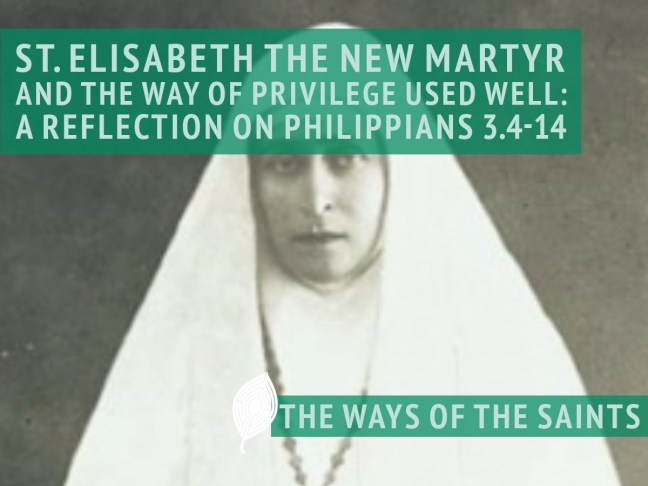
But in the context of this year’s Lenten series on the ways of the Saints, I can’t help but think of a Christian Saint who, by earthly standards, experienced a lot privilege in her life, but who used those advantages to the advantage of the Gospel, and therefore for the sake of others. This is St. Elizabeth the New Martyr, an actual German princess who married into the Russian royal family, before being killed during the Russian Revolution.
Born Princess Elisabeth of Hesse and by Rhine on November 1, 1864, St. Elisabeth was one of Queen Victoria’s many, many grandchildren across Europe’s royal courts. She was married to Grand Duke Sergei Alexandrovich of Russia, the fifth son of Emperor Alexander II, and subsequently became Eastern Orthodox, much to the chagrin of her Lutheran family, but to the delight of the Russian people. But her charmed life ended in 1905, when her husband was assassinated by socialist revolutionaries. Grand Duchess Elisabeth shocked many by publicly forgiving the assassin and advocated for him to be pardoned. She then left the trappings of the court, selling her jewels and properties and using the proceeds to found and fund a convent in Moscow, dedicated to Sts. Mary and Martha, wanting to combine the best of both of their values — prayer and work. She also founded a hospital, pharmacy, and orphanage, and later, during the First World War, set up a foundation to aid injured soldiers in their recovery. But when the Red Army took control of Moscow, they arrested her and sent her into exile in Siberia. There she was eventually beaten and thrown into an abandoned mine shaft, where — if the legends are to be believed, after several miraculous interventions — she eventually died. As it happens, St. Elisabeth’s tremendous virtue made her a greater, rather than lesser, target for the Red Army; upon hearing of her death, Lenin reportedly commented that “Virtue with a crown on its head” was a greater enemy to the revolution than “a hundred tyrant czars.”
So then, how might the way of St. Elisabeth inform our own ways? As Jesus would no doubt remind us, “From everyone to whom much has been given, much will be required; and from one to whom much has been entrusted, even more will be demanded” (Luke 12.48). St. Elisabeth was unquestionably given much in her life, simply by virtue of being born into the right family, completely unearned. But she who was given much offered much, including her wealth, time, and effort, and ultimately her very life. Few of us will have been gifted as generously as she was in life, but that does not mean we are without privilege of our own, privilege that we, like Paul are called to be willing to set aside, and like St. Elisabeth are called to use for the benefit of others. The simple questions before us are: If we are wealthy, how can we use our wealth to improve the lives of those with less than us? If we are white, how can we use the visibility that that can sometimes bring to raise up the voices and prospects of those who are not provided the same opportunities? If we are men, how can we use that to make more room for women to thrive? This is the responsibility that comes with privilege, and St. Elisabeth the New Martyr has given us a remarkable example of how to live it out.
Emulating the Lord’s self-abasement on the earth,
you gave up royal mansions to serve the poor and disdained,
overflowing with compassion for the suffering.
And taking up a martyr’s cross,
in your meekness you perfected the Saviour’s image within yourself,
therefore … entreat Him to save us all,
O wise Elisabeth.
Amen.
 Matthew Root
4 thoughts on “St. Elisabeth the New Martyr and the Way of Privilege Used Well: A Reflection on Philippians 3:4B-14”