
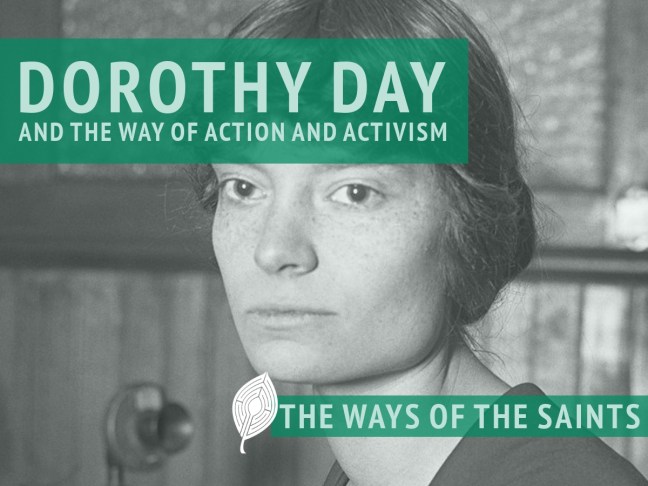
There’s a strange phenomenon in how the politics of the West has developed over the past few hundred years in that the right honours the role of religion in public life while setting aside its concerns for justice and transformation within that public life, while the left has tended to marginalize religion but shares those concerns about social justice and positive transformation. And so people of faith are often caught in the political landscape, with most of us finding ourselves pulled somewhere in the middle. But not everyone resolves such tensions in the same way. Yesterday, we looked at Maximilian Kolbe, a twentieth-century Roman Catholic Saint who associated himself with Europe’s far right, motivated by his fears about the rise of atheistic Communism, shock at how anti-Papist demonstrators were defiling religious symbols, and, yes, a dose of longstanding antisemitic conspiracy. But he was not made a Saint because of his politics, but rather because, when the moment of truth came, his faith commitments proved better than his politics and so he died a martyr at Auschwitz. I thought it would be only fair to today tell the story of another faithful twentieth-century Roman Catholic, but one whose faith commitments brought her into association with the far left in the United States: Dorothy Day.
Dorothy Day (1897-1980) was raised in a nominally Christian family, but became interested in the politics of justice in her youth. She recalled at eighteen being pulled between socialism’s concern for the poor, trade unions’ advocacy for working class Americans, and anarchism’s suspicion of authority and power. When she converted to Roman Catholic Christianity at the age of thirty, she saw her new faith not as a barrier to these values and political commitments, but as the best and most human means of living them out. She believed that a truly free society could only be founded on cooperation and generosity, and that the barriers of sex, race, and class that stood in the way of a just society could be best dismantled through the human solidarity taught by the Gospel and Church. Alongside Peter Maurin, she established the Catholic Worker Movement, which undertook direct aid for the poor (in the form of kitchens, shelters, and such) and nonviolent direct action to advocate on their behalf. These efforts led to several arrests, from her first at age 17 for participating in a suffragist march to her last at age 75 for defying an injunction while protesting on behalf of migrant farm workers.
The twentieth century being what it was, the question of Communism followed Day around throughout her life — whether through the activities of her old friends or accusations leveled against her. She was never in fact a Communist, even in her most radical, pre-conversion days, but had many friends who were Communists and she refused to malign the movement even as she rejected its goals and means. About Communists, she wrote, “I can say with warmth that I loved the people I worked with and learned much from them. They helped me to find God in His poor, in His abandoned ones, as I had not found Him in Christian churches.” And in the midst of the Cold War, Day grew increasingly concerned that the wealthy in the Western democracies could uses fears of Communism to promote the worst excesses of Capitalism, especially the concentration of wealth among the few and the oppression of the working class. She instead advocated for an economic system known as Distributism, a third way that understands both the excesses of Capitalism and Communism to be essential threats to human life and dignity, and advocates for the distribution of wealth, property, and the means of production among as much of the population as possible — think small businesses and cooperatives rather than large corporations or Politburos. Her commitment to the working poor often brought her into conflict with the Church hierarchy, even when — as she delighted in pointing out — it was they who were going against Church teaching.
So, with this brief sketch of her life and beliefs in mind, what can we say about Dorothy Day and how might her way inform our own? For me it’s how her theological convictions, firmly grounded in the Gospel teachings of Jesus, drove her to organize, work tirelessly, and advocate for the poor. Society, even the best of societies, needs goads, prophetic figures who shake us from our complacency and challenge us to do better. Dorothy Day was just such a goad. She also understood that calling for systemic social change did not take away her Christian responsibility to help people on the ground, and neither did feeding and housing people take away her Christian responsibility to demand systemic change — to dismantle the Jericho road, as Martin Luther King, Jr. put it so beautifully. She did not import these concerns from outside of the faith, bur rather saw in the Gospel the best set of teachings to uphold and promote genuine human dignity and solidarity.
The Gospel is never partisan, but it is always political: It has big things to say about what we should be concerned about in society: Shalom, the peace of God that is marked by the presence of just, healed, and whole relationships among all creation, in which the rich do not prey on the poor, in which the powerful use their power to raise up the powerless, and in which everyone has what they need. Few Christians of the past hundred years understood this and put this into practice as powerfully as Dorothy Day. And even as our own vocations won’t be the same as hers, we would do well to allow ourselves to be challenged by the incredible witness of her life and way.
Merciful God, you called your servant
Dorothy Day to show us the face of
Jesus in the poor and forsaken.
By constant practice
of the works of mercy,
she embraced poverty and witnessed
steadfastly to justice and peace.
Count her among your saints
and lead us all to become friends of
the poor ones of the earth,
and to recognize you in them.
We ask this through your Son
Jesus Christ, bringer of good news
to the poor. Amen.
 Matthew Root
One thought on “Dorothy Day and the Way of Action and Activism”