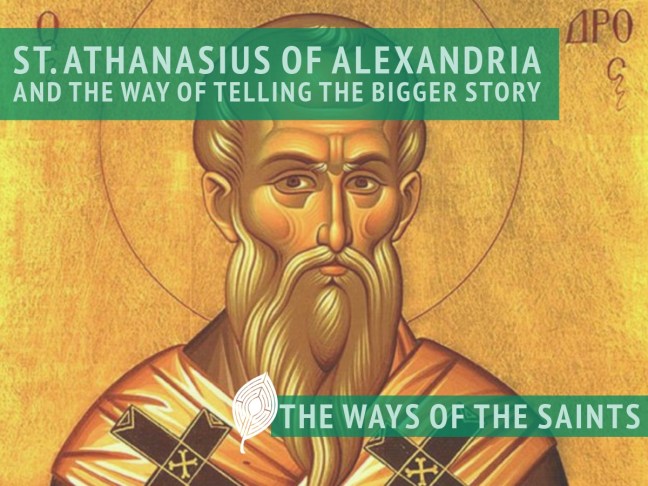
Very few people can say they have single-handedly changed the course of an entire religious tradition without being considered a founder themselves. But one person who can say that is St. Athanasius of Alexandria, a theologian and churchman who famously faced off against an entire Church teetering into the Arian controversy to defend the faith that is promoted in the Nicene Creed. He’s an incredible witness for us, of hope and trust in God in the face of a Church going off the rails, of perseverance in the face of incredible opposition, and, for me most of all, of telling the bigger story about God and salvation when a simpler, but smaller, story is at hand and attractive.
St. Athanasius was born in the last years of the third century, likely in Alexandria, Egypt, still at that time the second most important city of the Roman Empire and its greatest centre of learning. He was something of a theological prodigy, writing his most famous work, On the Incarnation, in his early twenties. But shortly thereafter the Church was beset by what has become known as the Arian Controversy, which revolved around a North African priest named Arius and his belief that the Son of God was not co-eternal or co-equal with God the Father. Arius was by all accounts extremely charismatic and wrote a series of popular hymns that helped to promulgate his ideas across the Greek-speaking parts of the Empire. These ideas were easy for the masses to adopt because they fit in nicely within a hierarchical understanding of the universe, which was the dominant cosmology of the time. (By way of historical and philosophical context, the Arian Controversy began in around 320 and the major proponents of Neoplatonism, which was the philosophical system that most clearly enshrined such a hierarchical cosmology, died in 271 (Plotinus) and 305 (Porphyry) respectively.) This way of thinking was dualist, insisted that pure spirit was absolutely perfect and good and that pure matter was an absence of spirit and therefore bad, with most things existing on a continuum between the two. For Arius, God the Son was the first emanation from God the Father. So, in the language of the controversy, the Son was of a similar essence (homoiousios) to the Father, but not the same essence (homoousios). Because of his effective messaging and how his theology fit comfortably into the general worldview of the time (at a time when Christianity was becoming the dominant and soon to be official religion of the Empire and so was attracting ‘the masses’ more and more), Arianism spread quickly — to the extent that St. Athanasius’s opposition to it was described as Athanasius contra mundum, ‘Athanasius against the world.’
There were lots of ups and downs in the story, and it often seems like Athanasius was winning every battle but losing the war. Indeed it took two Ecumenical Councils to finally defeat it in the East and even longer in the West, since many of the Germanic groups that eventually divided up the Western Empire were Arian Christians. But, Arianism was defeated, and it was primarily due to Athanasius’s strong incarnational theology. For Athanasius, humanity is saved by God taking on human nature. As St. Irenaeus of Lyons had put it in the late second century, “[T]he Word of God, our Lord Jesus Christ … through His transcendent love, became what we are, that He might bring us to be even what He is Himself” (Against Heresies, vol 5). Athanasius put the same idea a bit more pithily: “He [The Son of God] was made human so that he might make us sons of God” (On the Incarnation 54,3). In other words, in order for the Incarnation to do what Christians believe it did, the Son had to be God, in the same way that the Father is God. And if we have to sacrifice philosophical, syllogistic consistency, or easy accessibility for a wide audience to insist upon this point, then so be it. (The eventual Nicene articulation of the doctrine of the Trinity, which is the basis of ‘orthodoxy’ in pretty much every Christian denomination to this day, had to break the language of Greek philosophy in order to say what it needed to.)
This idea not only won the day at the Council of Nicaea in 325, but set the tone for all of the future Ecumenical Councils and therefore Christian orthodoxy as a whole: As much as we may think from the outside that these debates and official theological documents are too steeped in the language of philosophy, every single time, the side that sacrificed philosophical convenience for the sake of telling the bigger Christian story carried the day.
To me this is an amazing legacy that St. Athanasius has left us: not only a properly Incarnational official dogma about God, but also an approach to doing theology that insists that we not sacrifice the big, bold, and philosophically scandalous experience of salvation in Christ for the sake of ease of articulation, ‘seeker sensitivity’, or how well it fits in with dominant worldviews. No matter what we do or say, it must be because it’s the fullest expression of the Gospel, not because it’s easy or popular. So, what can we today take away and apply from the way of St. Athanasius? To tell the biggest, boldest Gospel story we can.
Almighty ever-living God, who raised up the Bishop Saint Athanasius as an outstanding champion of your Son’s divinity, mercifully grant, that, rejoicing in his teaching and his protection, we may never cease to grow in knowledge and love of you. Through our Lord Jesus Christ, your Son, who lives and reigns with you in the unity of the Holy Spirit, one God, for ever and ever.
Amen.
 Matthew Root
One thought on “St. Athanasius of Alexandria and the Way of Telling the Bigger Story”