
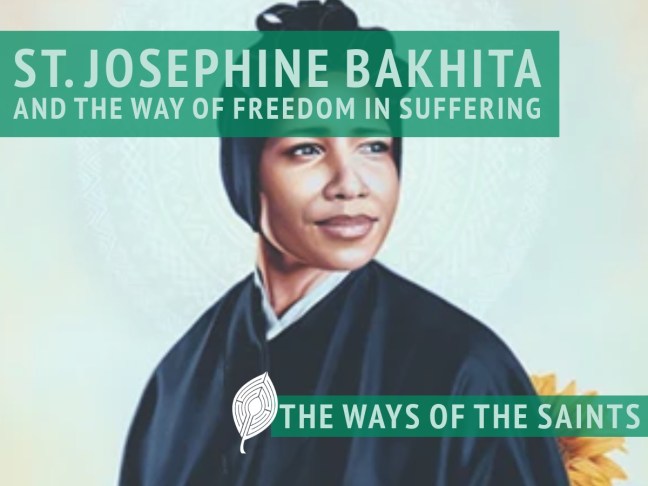
You may have noticed that most of the Saints discussed in this series so far began their lives in at least modest if not extreme comfort and wealth. In this we see the importance of privilege in providing people with the kinds of opportunities that can lead to becoming known and remembered, even if what they are remembered for is giving up the trappings of that privilege. So today I’d like to look at a Saint whose life started off very differently from this common story, St. Josephine Bakhita, the first female African Saint of the modern Roman Catholic Church.
St. Josephine Bakhita was born in around 1869 among the Daju people of the Darfur region of Sudan. While her family was of good standing in the community and she remembered “liv[ing] a very happy carefree life, without knowing what suffering was,” her life took a dramatic turn when she was just seven or eight years old, when she was abducted and sold into slavery. She passed through the hands of several ‘owners’ within the Ottoman Empire before finally being purchased by an Italian man working in Africa. Over her years of enslavement, she was regularly beaten and intentionally disfigured, to say nothing of the general humiliation of spirit — lack of freedom, initiative, and so on — enslavement entailed.
Then in 1888, while back in Italy as her master planned to move his family to Africa full time, her mistress left her in the care of some Canossian nuns. While there, Josephine was moved by their lives of service and their teachings about Jesus and so she became a Christian herself. When the family returned to take her back to Sudan, she refused to leave the convent. The issue came before the courts and the judge ruled that since according to European law, Sudan was a British territory in which slavery had been outlawed before her birth, and since Italian law did not recognize slavery at all, she was not, and had never been, legally a slave in Italy. And so she found herself a free woman, a freedom she used to return to the convent and serve Christ there. She was baptized in 1890 and officially entered the community as a novice in 1893. She was eventually moved to the Canossian community in Schio, Italy, where she remained for most of her remaining forty-two years.
Despite the suffering she endured at the hands of her masters and the years she had lost to enslavement, St. Josephine was known for her peace of heart and gentleness. When pressed about her experiences, she was quick to forgive her captors and even expressed gratitude for the course of her life, seeing in it the providential hand of God that led her into the faith and religious community that was her home. Her forgiveness is particularly remarkable: “I pity them!” she said of her various masters. “No doubt they were unaware of the anguish they caused me…. They did so out of habit, not out of wickedness.” Another time, she summarized her life story with the words, “The Lord has loved me so much. We must love everybody…We must be understanding and compassionate!” When asked if this included her captors and torturers, she said, “Why not! Poor things! They did not know the Lord.”
What then can we take from the way of St. Josephine Bakhita? First, for those who are living in any kind of oppression and suffering, her life demonstrates that these things do not define us, neither in terms of our inherent dignity as human beings, nor before God. And, while those of us outside of those experiences must be careful not to make theological claims about ‘God’s will’ in human suffering — it is always a terrible mystery — it remains that it is possible for those living within them to find value, meaning, transformation, and freedom within them. And, for those of us who cannot relate to the oppression she experienced, we may still take from her a powerful example of freedom from spiritual captivity. As Pope John Paul II said of her on a visit to Sudan in 1993, she was “the daughter of Sudan sold into slavery as a living piece of merchandise and yet still free — Free with the freedom of the saints.” The world tells all of us lies about us, about our worth and value. The way of St. Josephine Bakhita reminds us that, no matter where we start from, no matter what horrible things the world may throw at us, we do not need to believe those lies — and that is freedom indeed.
O Saint Josephine Bakhita, you were sold into slavery as a child and endured unspeakable hardship and suffering. Yet, you found freedom and peace in knowing God’s love for you. Inspire us with your resilience and faith to trust in God through our trials and sufferings. Help us to live with a heart full of forgiveness and humility, just as you did. Guide us to be compassionate towards others and steadfast in our faith, seeking God’s love in every moment of our lives. Amen.
 Matthew Root