
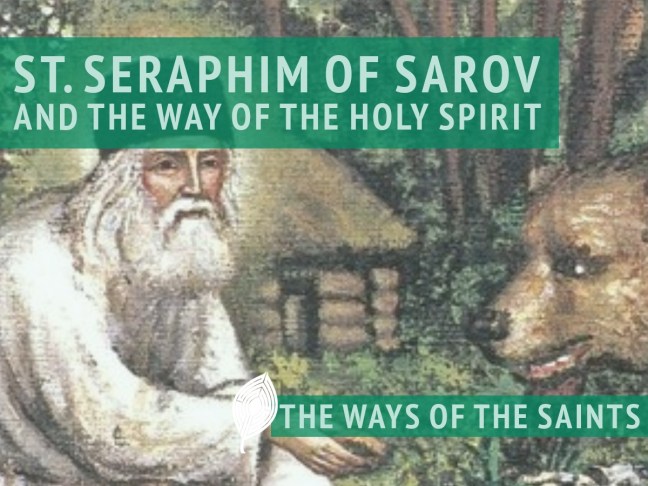
My feelings about the Church’s general marginalization of the Holy Spirit are at this point well-documented. I even did a whole series last year outlining the history of ideas about the Spirit of God and why they should be brought closer to the heart of our experiences and expectations today. I’ve also written about why I identify as a charismatic Christian, and written generally favourably about Pentecostal approaches to Scripture reading. Yet, if I look for a figure in history whom I believe embodied the life of the Holy Spirit in a particularly vivid and exemplary way, I don’t look to contemporary charismatics, but to nineteenth-century Russia and the wonderful Saint, the Elder, Seraphim of Sarov.
From a Western perspective, most of Russian history just feels like a depressing, opaque black box. But like every country and culture, it’s had ups and downs, periods of internationalism and periods of protectionism, periods of religious conservatism and periods of spiritual reform. And the nineteenth century was one of the most fascinating and creative periods of Russian religious history. It was focused around a new religious archetype, the starets, ‘elder’,’ a particular expression of a monastic vocation in which a monk acted as a kind of spiritual father for pilgrims (often numbering in the hundreds a day), interpreting, explaining and applying spiritual traditions for everyday Russians of all classes and walks of life. Russian Elders became known for their discernment, powers of healing, and prophetic words. St. Seraphim is among the most famous of these figures.
Born Prokhor Isidorovich Moshnin in either 1754 or 1759, he was given the name Seraphim when he became a monk. This odd name refers to the class of biblical angels, but it literally means ‘burning ones’, and as we’ll see, it’s not an inappropriate name for the man. After being ordained as a priest and serving for a time as the confessor for a convent, Seraphim retreated into the woods to live as a hermit. But his fame began to grow — only increasing after he publicly plead a judge for leniency towards a group of thieves who had attacked him and left him with a permanent limp. Additionally, the monks and nuns living near his hermitage regularly saw him communing casually with wild animals of the forest, including bears and wolves. One nun reported that his face shone with joy and the light of the Transfiguration (this is a common Eastern Christian description of the experience of the Divine Light, which featured so prominently in the Hesychast Controversy) while feeding a bear.
In 1815, following instructions received in a vision Seraphim began welcoming pilgrims to this hermitage, marking the start of his life as a starets. His reputation grew quickly and soon hundreds of pilgrims a day came to see him, seeking healing or words of wisdom. While he lived by a very strict rule of prayer and fasting, he was famous for his gentleness and joy towards his visitors. He would greet everyone with the traditional Easter greeting, “Christ is risen!” and called them “my joy.” “Cheerfulness is not a sin!,” he once said, when someone expressed surprise at his joyful demeanour. He taught pilgrims many things, but he was most known for impressing upon them the life of the Holy Spirit. Indeed, his most famous saying, oft repeated in the Orthodox world today, is, “Acquire the Spirit of Peace, and thousands around you will be saved.”
The following story recounted by his first biographer, Nikolay Aleksandrovich Motovilov, also highlights the role of the Spirit in St. Seraphim’s life and teaching. On one visit during the winter, Motovilov and the hermit were sitting together in the woods. St. Seraphim told him, “It is necessary that the Holy Spirit enter our heart. Everything good that we do, that we do for Christ, is given to us by the Holy Spirit — but prayer most of all, which is always available to us.” Motovilov pressed him further, asking how one might know the Spirit is with us. After failing to convince him with stories of the saints, Seraphim grabbed him and said, “We are both now, my dear, in the Holy Spirit.” Suddenly, Motovilov was filled with peace and joy, and he saw the face of the elder shining with the Divine Light. Smiling, the Saint then told him, “Do not fear. You would not be able to see me like this if you yourself were not also in the fullness of the Holy Spirit.”
So what might we take away from the way of St. Seraphim of Sarov? Sometimes monastic saints are hard to relate to; after all, they intentionally take on a stricter way of life than most of us know or understand. But the beauty of St. Seraphim was his insistence that the blessings of spirituality are not just for some kind of elite, but are for everyone, by virtue of the gift of the Holy Spirit, which is given to all the faithful in baptism. It may not manifest itself in our lives in extraordinary feats of prayer and fasting, or in communing with predators (and, really, don’t try that at home!); and we may not shine with the Divine Light (though who knows that may be happening beyond our perception!). But the Spirit can most certainly manifest itself as it did in St. Seraphim in joy, in compassion and gentleness towards those we encounter, and in an openness to helping others in whatever way we can.
“Acquire the Spirit of Peace, and thousands around you will be saved.” – St. Seraphim of Sarov
O Heavenly King, the Comforter, the Spirit of Truth,
Everywhere present and filling all things,
Treasury of blessings and Giver of life:
Come and abide in us and cleanse us from every impurity,
And save our souls, O Good One!
 Matthew Root