
Of all of St. Francis’s many legacies, the one for which he’s probably best known today is his great love for all of creation and instinct that God was present within it. In his famed ‘Canticle of Creation’, he speaks of his fellow creatures as family: “Brother Sun,” “Sister Moon,” “Brothers Wind and Air,” and “Sister Water,” and so on. There are many famous stories in which he communes and converses with wild animals, and so he has become in our own day the patron saint of environmentalism. But while most of us would share his instinct that we can know God from our fellow creatures, the question of how that happens gets pretty tricky pretty quickly. Similar things could be said for the rest of St. Francis’s radical vocation. This became all the more important in the decades following St. Francis’s death: What to make of St. Francis’s practical and instinctive teaching and lifestyle in the new intellectual environment of the high middle ages? It was the man who became known as St. Bonaventure, a devoted Franciscan but also a devoted academic theologian, who took on this task. The language he found to explain how we might know God from the world around us remains helpful for all of us who are committed to our Christian faith but who nonetheless are as likely to experience God in a forest as in a cathedral.
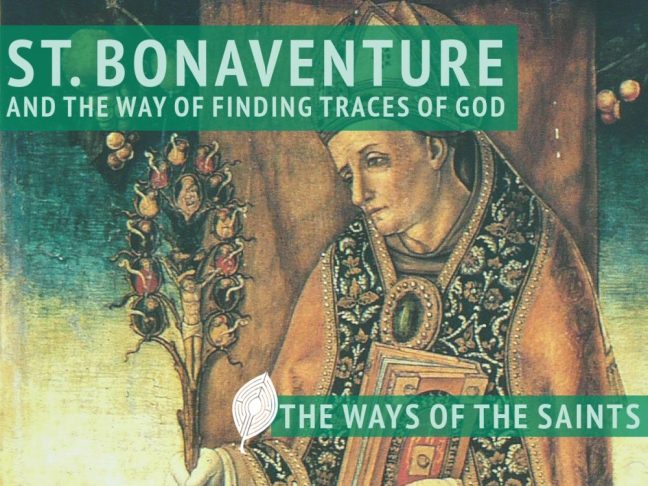
Born Giovanni di Fidanza sometime between 1217-1221 in what is now central Italy, the man we know as St. Bonaventure came by his devotion to St. Francis honestly. As a child, St. Francis interceded on his behalf during a severe illness, and Bonaventure credited him for his speedy (he believed miraculous) recovery. After beginning studies at the University of Paris, he became a Franciscan monk in his early twenties. He quickly rose up the ranks of both the University and his Order, known for both his keen intellect and good character. The upshot of this was that he was in positions where his ideas and interpretations could influence and inspire many, but the downside was that it meant his adult life was dominated by politics and controversies, in the academy, among the Franciscans, and in the Church at large. It was a tumultuous time in the Western Church, with upstart reform movements of varying degrees of orthodoxy upsetting the status quo, alongside the shift from theology being the purview of monasteries to that of urban universities, and the West’s rediscovery of Aristotle (Bonaventure was an almost exact contemporary of Thomas Aquinas). And all of these impacted Bonaventure’s life and helped to shape his theology. And again, while St. Bonaventure’s life may have been dominated by politics, his true contributions were in finding a solid theological grounding for Francis’s vision of the Christian life. And it’s one part of this — Francis’s ecological instinct — that I’d like to focus on today.
Like any good medieval theologian, St. Bonaventure was a mystic at heart, and so the intimate experience and knowledge of God is his main theological question. He understood that there were three drives in all of us: the animal (that is the physical or sensory), which draws us to the world outside of us; the intellectual, which draws us into ourselves; and the divine, which draws us towards God. If used properly, however, each of these three drives can lead us to union with God. And this means that, in keeping with St. Francis’s example, St. Bonaventure understood the whole world to be a theophany — a revelation of God — if only we have ears to hear and eyes to see it properly. The “whole material world,” he wrote, is “a mirror through which we may pass over to God.” The reason why created things can be conduits to knowing the Creator is because they are “vestiges” (traces, or footprints) of God in the world. In a very real way, God is present “in them by his being, power, and presence” (Bonaventure, The Soul’s Journey to God 2.1). He later adds:
In beautiful things St. Francis saw Beauty itself, and through His vestiges imprinted on creation he followed his Beloved everywhere, making from all things a ladder by which he could climb up and embrace Him who is utterly desirable.
Or more simply, “Every creature is a divine word because it proclaims God.”
He’s used a lot of different symbols here: the vestige, but also a mirror, a ladder, and the ‘divine word’. But the point of all of them is that God leaves something of Godself in every creature. And so we can learn something of God from every creature. As I’ve previously written about this idea:
As one teacher (commonly said to be Thomas Merton, but I have not been able to source the quote) put it, “When I go out to feed the rabbits, I contemplate the eternal rabbithood of God.” While, remembering what we said earlier in this series about having to unsay everything we say about God, we must not take this idea too far, the truth it conveys is that all things, even a rabbit, express something of the Wisdom of God that created the universe. Of course, the rabbit may not express God in a particularly helpful or robust way — just as the sentence “The cat sat on the mat” doesn’t tell us much about the English language (or the cat, or the mat, for that matter) — both are legitimate expressions of what they convey. In the words of former Archbishop of Canterbury Michael Ramsey: “Transcendence … is always through the world. It is through the natural that we encounter the supernatural, although the supernatural eludes the ability of the natural to exhaust its meaning” (God, Church, World, 26f).
A lot of his language resonates very strongly with many of the mystical theologians of the Christian East (Maximus the Confessor, Symeon the New Theologian, and Gregory Palamas to name the big three), and so it also offers a nice natural meeting place between the two traditions.
But most importantly, St. Bonaventure’s thought offers us a wonderful way of understanding how we might know and experience God in the world. And, while there is a lot that can be said about St. Bonaventure and how his way of holiness can inform our own, for me this is the big one. By embodying and thinking through the consequences of St. Francis’s teachings on creation, he offers a wonderful opportunity to us, the very possibility of meeting God in everyone and every thing we see. And to that I say, ‘Amen!’
“Therefore open your eyes, alert your spiritual ears, unlock your lips, and apply your heart so that in all creation you may see, hear, praise, love and adore, extol and honor your God” – St. Bonaventure
 Matthew Root
One thought on “St. Bonaventure and the Way of Finding Traces of God”