
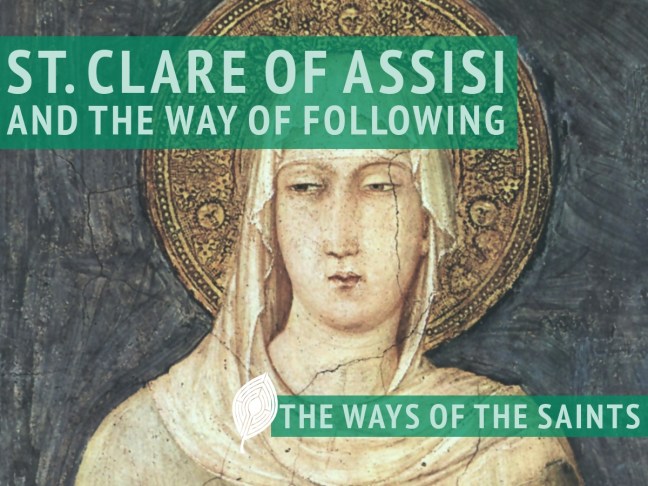
Yesterday, we looked at the life and way of St. Francis of Assisi, undoubtedly one of the most influential persons in Christian history. Over the next two days, we’ll look at two examples of Saints directly inspired by him, and see two ways the legacy of St. Francis was lived out. First, today, is the way of St Clare, the way of faithful following.
On the one hand, I feel a bit badly about framing the life of St. Clare in this way, particularly as one of the disproportionately few women in the series and because she was a leader in her own way in her own right. But as I’ve read through various tellings of her story, it is her desire to follow the way of her beloved friend and mentor St Francis, and through that, to follow Christ himself, that most stands out about her.
Chiara Offreduccio, the future St. Clare, was born in July 16, 1194 in Assisi, to a wealthy but pious family. She and her sisters were taught the faith by their mother, and possibly more formally in the local cathedral. Pious though they may have been, her family still expected her to fulfill her duties to them, and, of course, making a successful marriage was at the top of that list. But her early devotion was galvanized when she heard a young St. Francis preach in the streets. And so, she went to St. Francis asking him to take her on as a disciple. He received her and she had her hair cut off as a symbol that she was officially to be off the marriage market. Despite the strong, even violent, urgings of her father to return to the world and marry well, she was insistent that she had found her path.
But as passionate and devoted as Clare was to living out St. Francis’s vision, she also represented a challenge for him. After all, he and his band were all males and devoted to an itinerant lifestyle, and so it would be scandalous for her to join them and unsafe for her to be on her own. So he had her installed in a series of local convents. It must be stressed that this was not out of any sense that women were not able to live in accordance with his Rule of Life; Francis believed firmly that women were just as capable as men, and, against the norms of the time — and even ours, really — even used the obviously feminine language of motherhood to describe his role and ministry. At any rate, after, much to her family’s horror, one of Clare’s sisters joined her (she too was eventually canonized, as St. Agnes), and the two were moved to a small building of their own and they quickly attracted other women who were inspired by St. Francis’s way of life. Together, they became known as the “Poor Ladies” and lived a simple and austere life in accordance with a Rule of Life which Francis wrote for them. (This is the origin of the order known to this day as the Poor Clares, of which Claire was made abbess in 1216.)
‘Austere’ doesn’t really begin to describe their commitment to poverty: they worked hard, sought constant prayer, ate a simple vegetarian diet, observed near complete silence, went barefoot, and slept on the floor. St. Clare understood this to be in imitation of Christ and its aim was to fully contemplate the love of Christ in and for all things. (As we saw briefly with St. Francis, in renouncing the world, he came to love the world all the more. This was St. Clare’s aim as well.) In this radical commitment to voluntary poverty, St. Clare and her sisters followed far more closely to St. Francis’s path than many friars, as the Franciscan order was beset by controversies and Francis eventually had to loosen the strictures of his Rule and step away from the community in order to live as he felt called to. But, as abbess, St. Clare governed humbly, even insisting on taking on the most menial tasks for herself. Because of this humility and poverty of spirit, Clare was nicknamed ‘Franciscus’, ‘another Francis’. And, indeed, she was one of Francis’s greatest champions, praying for him, encouraging him, and caring for him during times of illness. Writers today often call Clare Francis’s ‘best friend’ and ‘soul mate’, and while perhaps anachronistic, one does get the sense that this was the closeness of their devotion to each other. After a protracted illness in which she refused to lessen the harshness of her practice (which was, I must point out, contrary to both the wishes of Church leadership and the wisdom of the greater monastic tradition), she died on August 11, 1253. So great was her renown even during her life, that she was canonized as a Saint just two years later.
So what are we to say about the way of St. Clare? As awkward as it is to speak of a great and saintly woman in terms of her following a man, to me her commitment to being faithful to Christ through being faithful to St. Francis’s way is what stands out the most. No one was able to live out the devotion to poverty preached by St. Francis as well as she did. It was in her that his vision was most faithfully realized. And, of course, there’s nothing wrong with being a follower. Our society likes to remember and hold up the pioneers, inventors, founders as symbols of greatness and achievement. But that can make it seem like the only way to be important is to do something new, when the fact is, most of us will not be called to such a life. There is great beauty in following a path trailblazed by someone else; really, it’s one of the main advantages of being in an ancient faith tradition. We have so many examples, so many paths to holiness, provided for us by those who’ve gone before us that we don’t need to reinvent the wheel in every generation. That’s a truly beautiful thing. And no one embodied that spirit better than St. Clare of Assisi.
“Go forth in peace, for you have followed the good road. Go forth without fear, for He Who created you has made you holy, has always protected you, and loves you as a mother. Blessed be You, my God, for having created me.” – Last words of St. Clare of Assisi
 Matthew Root
One thought on “St Clare of Assisi and the Way of Following”