
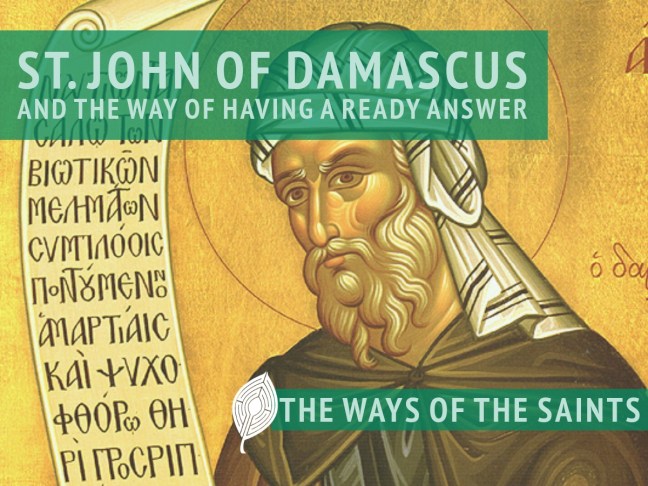
Over the years I’ve noticed an interesting trend, where young Christian men — always men, and always at around 19-21 years old — develop a sudden fascination with apologetics. (I was not immune to this trend; that’s actually how I first noticed it, when a friend two years younger than me developed the same interest I had two years after me.) For those who may not know, apologetics is a branch of study dedicated to articulation the reasonability of Christian beliefs, through finding supporting evidence and the use of formal logic. Most people, myself included, grow out of this fascination pretty quickly. In my case, I grew tired of its echo chamber and came to understand that the things it attempted to ‘prove’ are simply unprovable. But that said, there will always be times when we as people of faith will be called on to answer for ourselves. Why, of all things, are we Christian? Why would we choose to follow a crucified homeless carpenter from the backwater of the Roman Empire? As the First Epistle of Peter puts it, “Always be ready to make your defense to anyone who demands from you an account of the hope that is in you” (1 Peter 3.15). Few people in Christian history have had a greater influence in doing just this than the Saint I’ll be writing about today, St. John of Damascus, who rose to the occasion to defend traditional, orthodox Christianity against attacks from both inside and outside the faith.
John born in Damascus in around 675. His father was an official in the local government of the early Umayyad Caliphate, just as his grandfather had been at the end of Byzantine control over the city. (Indeed, the names in various records align to suggest that John’s grandfather may have been the one to negotiate the city’s surrender.) He enjoyed a privileged upbringing, receiving education in both Greek and Arabic that allowed him to pursue interests in not only theology but also law, philosophy, and the fine arts, especially music. While it would seem he followed in the family tradition of civil service early in his adult life, he eventually left Damascus and became a monk — traditionally at the Mar Saba monastery near Jerusalem.
As with so many of the ancient figures we’ve looked at in this series, it was controversy that brought John back into the public eye. In this case, it was the Iconoclastic Controversy. The Iconoclasts rejected the tradition, widespread if not nearly universal before, of the veneration of icons, believing it to be a violation of the biblical commandment against idolatry. The timing of this Controversy was no accident, as it arose at the same time as the new iconoclastic religion of Islam was making tremendous inroads into historically Byzantine lands. Questioning of religious images was everywhere in the air. An iconoclastic Emperor came to the throne in Constantinople and began an outright assault on icons in all his lands. And here John’s circumstances of living under Umayyad Muslim rather than Byzantine Christian rule worked to his advantage. Free from the Emperor’s jurisdiction, he mounted what became the canonical defense of iconography (and remains so to this day!), Apologetic Treatises against those Decrying the Holy Images.
In the process of defending this practice, however, he did far more. He undertook a thorough summary, synthesis, and defense of Christianity itself, his landmark An Exact Exposition of the Orthodox Faith. This text proved to a huge boon to the millions of Christians who found themselves under Muslim rule, who had to answer for their faith, both to their increasingly Muslim neighbours, and to themselves as they had to justify remaining Christian when there were significant benefits of finance and opportunity in converting.
His actual writings on these topics are fascinating and represent some of the earliest attempts at Christian systematic theology. But their contents are beyond the scope for today’s post. What I’d like to highlight about the way of St. John of Damascus is how truly he followed Peter’s instruction to “always be ready to make your defense to anyone who demands from you an account of the hope that is in you.” Sometimes these questions will come from critics from outside the Christian faith; sometimes they will be posed by fellow Christians who disagree with us on important issues of doctrine and practice; and sometimes these questions will come from our own hearts, whether in doubt or simply curiosity. The question before us is whether we are ready to answer those questions. And in this way, we would do well to follow the way of St. John of Damascus, and be ready and willing.
Champion of orthodoxy, teacher of purity and of true worship,
The enlightener of the universe and the adornment of hierarchs:
All-wise father John, your teachings have gleamed with light upon all things.
Intercede before Christ God to save our souls.
Amen.
 Matthew Root