
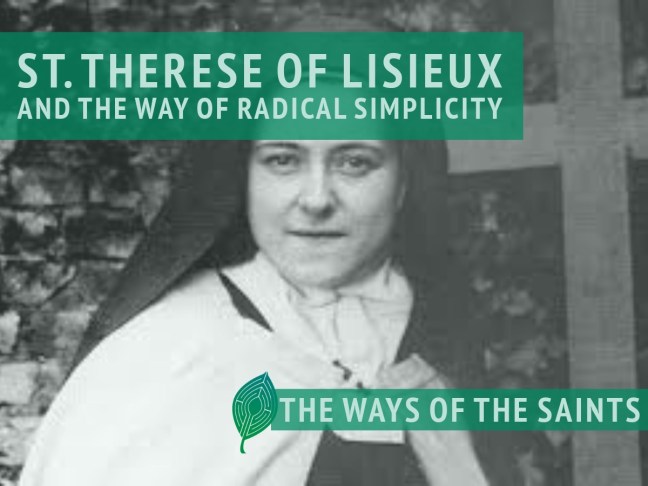
As we approach the half-way point of Lent, especially in this exhausting and anxious year, I think we’re all in need of some refreshment. And I have no doubt that that’s why the Old Testament reading appointed for today, from Isaiah 55, resonated so strongly with me today. It speaks of the wonderful and refreshing, expansive abundance of God. It makes everything seem so simple, and that in turn reminds me of the way of one Christian Saint who lived as though it really is that simple: St. Thérèse of Liseux.
But first let’s look at Isaiah’s oracle. It begins with an open invitation from God:
Hey, everyone who thirsts, come to the waters; and you that have no money, come, buy and eat! Come, buy wine and milk without money and without price. Why do you spend your money for that which is not bread, and your labour for that which does not satisfy? Listen carefully to me, and eat what is good, and delight yourselves in rich food. Incline your ear, and come to me; listen, so that you may live. (Isaiah 55.1-3a)
After a couple beautiful verses that speak of God’s faithfulness to the covenant with Israel through the line of David, the prophet continues:
Seek the Lord while he may be found, call upon him while he is near; let the wicked forsake their way, and the unrighteous their thoughts; let them return to the Lord, that he may have mercy on them, and to our God, for he will abundantly pardon. For my thoughts are not your thoughts, nor are your ways my ways, says the Lord. For as the heavens are higher than the earth, so are my ways higher than your ways and my thoughts than your thoughts. (Isaiah 55.6-9)
Between the two parts of the oracle highlighted here, we have a powerful expression of both God’s providence (loving care for creation) and holy transcendence (otherness and ‘beyondness’). Together the offer the faithful a freedom from anxieties: For God is generous and good and, even when the world feels like it’s falling apart, God knows and understands far better than we ever will. (Remember: this oracle was almost certainly written in the midst of the Exile; this is no empty profession of warm weather in the midst of Summer, but the hope of warm weather in the midst of a cold and miserable Winter.)
But of course, the world isn’t that simple, is it? We can’t just ‘let go and let God’.
Or can we?
Enter St. Thérèse of Liseux, a young French nun, who in the late nineteenth century, dedicated herself to a life of radical simplicity that reflects just this sort of approach to God. She ate what she was given. She did the work put before her. She took slights and misunderstandings as her instruction manual. Basically, if the Abandonment to Divine Providence attributed to Jean-Pierre de Caussade is the formal legislation, the life of St. Thérese is the case study of just that kind of life. (As one writer described her autobiography (The Story of a Soul), “She did not so much write a book as live it, and then it wrote itself.”)
Born in 1873 into a large and loving family, St. Thérèse of Liseux quickly demonstrated a simple devotion to God. I don’t mean simple as in silly or naive, but as in matter-of-fact. She communed with God in the family garden, setting up shrines in the fence post, and wrote of her childhood experiences of the sacraments with great reverence. In a lot of ways, her own account of her childhood reads like that of the idealized Catholic girlhood. Her greatest desire was to join the local Carmelite community and, after interceding directly with the Pope himself while on pilgrimage to Rome, she was allowed to enter early, at the age of just fifteen. She lived happily (and simply) in that community, though not without conflict or trouble, until she succumbed to tuberculosis at the age of 24, in 1897. Her autobiography, which she did not want to write and did so only under obedience from her Superior, was published shortly after her death and became a huge hit. She was officially canonized as a Saint of the Roman Catholic Church in 1925. Since then, she has become one of, if not the, most popular Saint among rank-and-file Roman Catholics.
The way of St. Thérèse is best and most famously demonstrated in her parable of the little flower:
Jesus chose to enlighten me on this mystery. He opened the book of nature before me, and I saw that every flower He has created has a beauty of its own, that the splendor of the rose and the lily’s whiteness do not deprive the violet of its scent nor make less ravishing the daisy’s charm. I saw that if every little flower wished to be a rose, Nature would lose her spring adornments, and the fields would be no longer enameled with their varied flowers. (The Story of a Soul)
After describing a variety of people with vastly different lives, she concludes: “What delights God is the simplicity of these flowers of the field, and by stooping so low to them, He shows how infinitely great He is.” Thereafter she took to describing herself as “the little flower,” which remains a nickname and epithet for her to this day. In a world full of big, bold blooms of roses and lilies and sunflowers, she understood her vocation to be the simple Spring daisy poking its head out from the grass.
She was encouraged in this humble path when, reflecting on her own inability to do the great work she believed she were required for saintliness (”I am too little to climb the steep stairway of perfection”), she searched for an “elevator” to Jesus, and searching the Scriptures, found the words from Proverbs, “Whoever is a little one, let him come to Me” (Proverbs 9.4 according to her; contemporary English translations of that verse read: “‘You that are simple, turn in here!’” which amounts to a similar idea and better captures the simplicity of her life!. But, for God’s care for the “little ones,” see Mathew 10.42 and 18.6-14))
And so she dedicated herself to the “little things” she could do at all times. In one famous incident, she was doing the washing with a sister who kept spraying her with filthy water; rather than complain, she decided to treat it like a baptism. Another time, she was asked to do a task that she new the sister next to her loved doing, so she intentionally moved slowly, earning the ire of the person who had asked her to do it, who then asked the other sister to help instead. About this, she reflected, “If my little acts of virtue can be mistaken for imperfections, imperfections can just as easily be mistaken for virtue,” and so she became very suspicious of perceived or performed piety or holiness. She understood all of this as an exercise in love:
In a transport of ecstatic joy I cried: “Jesus, my Love, I have at last found my vocation; it is love! I have found my place in the Church’s heart, the place You Yourself have given me, my God. Yes, there in the heart of Mother Church I will be love; so shall I be all things, so shall my dreams come true.
Love proves itself by deeds, and how shall I prove mine? The little child will scatter flowers whose fragrant perfume will surround the royal throne, and in a voice that is silver-toned, she will sing the canticle of love.
This intentional simplicity of St. Thérèse’s life did not mean she was oblivious to the wider world. When she was still a child, she became deeply concerned with the fate of a notorious criminal and fervently prayed that he would repent before his execution. She wrote about this incident as “God lift[ing] me out of my narrow world in a very short time. … [F]reed from my scruples and over-sensitiveness, my soul grew.” Later, she developed a particular care for the fate of clergy, and devoted herself to praying for their encouragement.
What then can we take away from St. Thérèse’s way of radical simplicity and love? For me it’s the challenge of it. My thought world (to say nothing of the social and political worlds!) is full of complexity that requires a lot of nuance to navigate well and faithfully. St. Thérèse’s way cuts right through all that and asks, simply, “What does love say about this?” and just does it. Certainly we can’t all live as she did, but we’re not all called to. But we can absolutely learn to follow God, to follow love, with simple faith and trust — to respond to that invitation uttered by Isaiah simply to come as we are and be nourished by our Lord’s goodness.
“Your arms, My Jesus, are the elevator which will take me up to Heaven. There is no need for me to grow up; on the contrary, I must stay little, and become more and more so.” – St. Thérèse of Lisieux
 Matthew Root
One thought on “St. Therese of Lisieux and the Way of Simplicity: A Reflection on Isaiah 55.1-9”