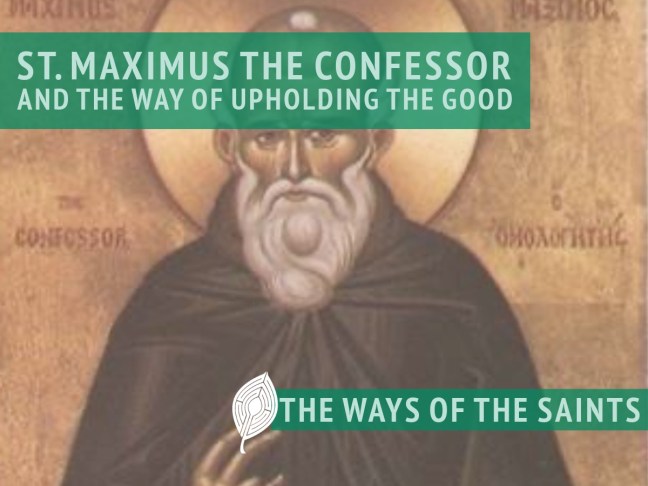
When we see or hear something that is popular and powerful, but which is a bit off, containing untruths mixed in with profound truths, how do we respond? It’s an evergreen question, both in society at large and among people of faith. Today I’d like to look at how one great Saint of the Church, St. Maximus the Confessor (c. 580-662), managed just such a question.
While some early biographies of him suggested otherwise, it’s clear from his educational background and access to people of power that St. Maximus came from a high-born family, likely in or near Constantinople. He studied all of the philosophical greats of antiquity, including Plato and Aristotle (remember: Aristotle was never ‘lost’ in the East), and their later commentators such as Plotinus, Porphyry, Iamblichus, and Proclus. Later, he worked as a high-ranking civil servant, becoming a close aide to the Emperor himself. But eventually, Maximus retired into monastic life. He is best known for his role in refuting Monothelitism, the belief that Jesus only had one, divine, will. As with all of the christological controversies that rent the Church in late antiquity, it was a highly technical debate that is hard to see as relevant for Christian life, and hardly worth schism. But they were the big issues of their day, and Maximus insisted that Jesus needed to have a fully human will for his sinless life to have any meaning for us. The fortunes of the debate ebbed and flowed for years, and, sadly for Maximus, during one ‘ebb’, he was convicted of heresy and had his tongue cut out and dominant hand mutilated for his troubles. (This is what the epithet, ‘the Confessor’ means: in this context a confessor is someone who suffered for the faith without being martyred.) He was exiled to what is now Georgia and died there in 662. Monothelitism was finally officially defeated at the Third Council of Constantinople in 680-681, and St. Maximus was vindicated and almost immediately began to be venerated as a Saint.
While his role in defeating Monothelitism is why St. Maximus became famous, it’s not the focus of what I’d like to talk about today. Instead I’d like to talk about his role in interpreting the work of Pseudo-Dionysius. As background, Ps.-Dionysius was a fifth- or sixth-century writer of mysterious origins. Whether intentionally or unintentionally, he was almost instantly conflated with the New Testament figure Dionysius the Areopagite. But at any rate, his work caught on like wildfire in the Christian East (and the West a couple hundred years later). It represented a powerful and comprehensive mystical theology of creation, salvation, Christian experience, and liturgy that resonated with many readers. The only problem was that it was steeped in a thoroughly Neo-Platonic worldview that was essentially at odds with Scriptural claims about God and the world. It had dualist assumptions that spirit is good and matter bad, for example, and understood creation to have been a series of emanations, creating a hierarchical universe.
So how should this work be received by the Church? Neither blanket acceptance nor outright rejection seemed appropriate to St. Maximus. (And indeed even in his own day the texts were so popular that the latter option wasn’t really a possibility.) So instead, he brought Ps.-Dionysius’s thought back within a Christian worldview, reframing it in biblical language and restraining its more extreme ideas. In other words, he took a popular and powerful but likely heterodox text and interpreted it in a way that allowed orthodox believers to keep using it. It was lest that he changed what Ps.-Dionysius was saying than that he embraced it within the broader Christian theological tradition and language. Because of this approach, Maximus’s writings make up a plurality of the collection of texts known as the Philokalia, which form the basis of Eastern Christian monastic spirituality.
I think this is a tremendous legacy and example for those of us who call ourselves Christian. When we encounter things that aren’t quite right it’s easy just to attack them. When we come up against things that are meaningful and exciting it’s easy simply to accept them uncritically. The trick is to find and embrace the good, true, and beautiful and position it in a better (bigger, broader) framework. To take up the later language of the Ignatian tradition, it’s “to try hard to save the proposition of one’s neighbour.”
For that I’m not only grateful for St. Maximus’s example, but try to take on this way as my own as much as possible.
Holy Father Maximus, pray for us!
Champion of orthodoxy, teacher of purity and of true worship,
Enlightener of the universe and adornment of hierarchs:
All-wise father Maximus, your teachings have gleamed with light upon all things.
Intercede before Christ God to save our souls.
Amen.
 Matthew Root
3 thoughts on “St. Maximus the Confessor and the Way of Upholding the Good”