
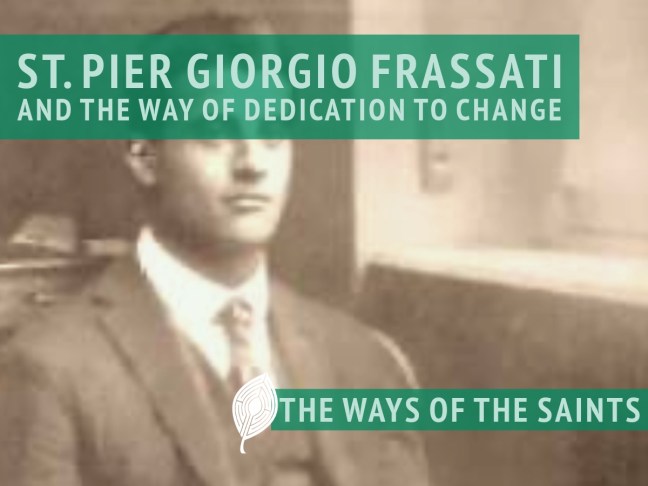
It’s a truism to say that the world is complex and so it’s natural for our response to that complexity to be complicated. But one of the things that is so wonderful and challenging about the lives and ways of the Saints is how often they just cut through all that complexity to offer the simplest solutions. Pier Giorgio Frassati, a twentieth-century Italian Saint, is one such figure. Only twenty-four years old when he died after contracting poliomyelitis, he left a tremendous impact. Why? Because, like St. Anthony and St Francis and so many others before him, he simply took the Beatitudes and the Gospel command to give generously to the poor at face value. Because he did so in modern times and without formally rejecting his ties to ‘this world’, he remains a fascinating example for us.
Pier Giorgio Frassati was born in 1901. His father ran a newspaper and was involved in progressive politics, while his mother was a painter of moderate renown. But from an early age, he showed a special devotion to the poor. There are stories from his childhood about taking off his shoes to give them to a shoeless child, and breaking down in tears when his parents turned away a drunk man asking for food. These tendencies remained as he entered adulthood, but were directed towards advocacy for social change as well as practical charitable acts: “Charity is not enough,” he said. “We need social reform.” To support the cause of social justice, Frassati joined different groups, including the Third Order of Saint Dominic, Catholic Action, and the Society of Saint Vincent de Paul. He also followed in his father’s journalistic footsteps and launched a newspaper, Momento, advocating social reform based on the 1891 papal encyclical Rerum novarum (’Concerning Revolutions’). This encyclical, which is widely said to have set the tone for all Roman Catholic social advocacy since, insisted on a middle way, rejecting both unrestricted capitalism and socialism and insisting on mutual responsibilities of labour and capital, including rights to private property and improved working and living conditions for the poor. He even picked his university specialty, engineering, with a view to improving conditions for miners. In all of these activities, Frassati was dedicated to combating inequity and inequalities through bringing people together in community.
Despite all this — all the more remarkable considering he died in his mid-twenties! — he was not known to be a serious or dour figure. Rather, he was naturally attractive and charismatic, exhibited a love for practical jokes, enjoyed spending time with friends, and was an accomplished athlete, particularly in mountain climbing and swimming.
He died in July 1925, only days after experiencing the first symptoms of poliomyelitis. As word spread of his death, it is said the streets of Turin became filled with those whom he had helped or who had been inspired by his advocacy. Within just a few years, Turin’s lower classes began to clamour for him to be recognized as a Saint. This is a long process in the Roman Catholic Church, but these hopes will finally be officially realized this Summer, exactly a century after his death.
So what about the way of (soon-to-be) St. Pier Giorgio Frassati might we emulate? There are few people out there whose lives seem to better reflect the spirit of the Beatitudes, and for this alone he is worth our attention. But beyond that, I see in him a wonderful ability to hold things together that people, especially those involved in reform movements, too often separate. He gave generously of his personal wealth to specific situations, but also advocated for systemic social change. And, while he was completely dedicated to his causes, he didn’t get bogged down by them and still embraced the world with joy. These are wonderful and important qualities, if we want our lives and ministry to be both impactful and sustainable.
Holy father Pier, pray for us!
“I would like for us to pledge a pact that knows no earthly boundaries or temporal limits: union in prayer.” — St. Pier Giorgio Frassati
 Matthew Root
One thought on “St. Pier Giorgio Frassati and the Way of Dedication to Change”