
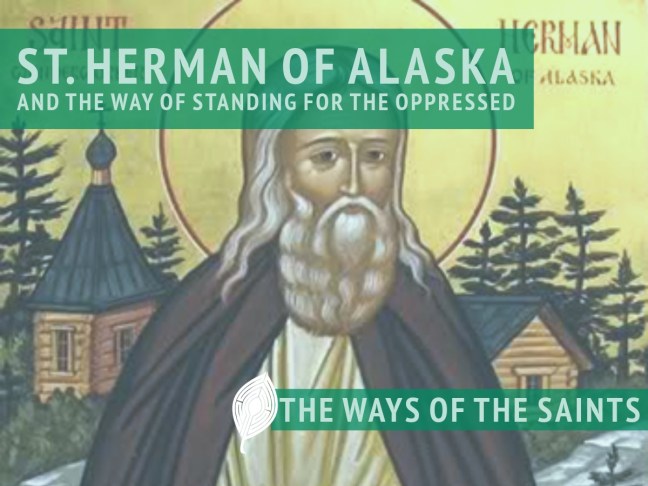
It’s fair to say that the story of the Churches’ encounters with the Indigenous peoples of the Americas were, on the whole negative, and in many cases catastrophic. But there is one example that stands out as a shining light amidst the imperialistic darkness: the Russian mission in Alaska led by St. Herman of Alaska. While, yes, they too were part of a colonizing agenda, they didn’t play along, and rather than helping assimilate or oppress the Alaskans, they helped them resist. In so doing, they were the midwife of the birth of the vibrant Indigenous Orthodoxy that remains to this day in Alaska. And so today, I’d like to explore the life and way of St. Herman to see what it might have to say to us.
There is no agreement about the early life of St. Herman, but it seems clear that he entered monastic life at two famed monasteries of Sarov and Valaam. There he encountered both traditional heyschasm, which was having a revival in Slavic monasticism at the end of the eighteenth century, and ‘staretsdom’, the practice of established monks acting as spiritual directors to both junior monks and pilgrims. Wanting a more solitary life, Herman signed up to join a group of ten monks sent to minister to the residents of Russian Alaska, arriving in 1794. Much like the early French and English exploration of North America, the Russian colony was driven by the fur trade. When Herman arrived at Kodiak, he was greatly disturbed by what he saw. The local population (largely Sugpiaq and Unangan Aleuts) was being treated as virtual slaves by the officers of the Russian-American Company and its manager Alexander Baranov, who became the first colonial governor. The Aleut men were forced at gunpoint to hunt even in the most dangerous weather conditions, the women and children were being physically and sexually abused, and alcoholism was widespread in the ethnically Russian populations. The monks also found themselves without the provisions they had been promised and were forced to work the land with hand-made wooden tools.
St. Herman quickly became a thorn in the side of the Russian-American Company. The stories often read like Saturday morning cartoons, with the wily Herman thwarting Baranov’s villainous plans at every turn. All this was in the service of defending the locals from the oppression of the Russian officials. At the same time, the monks also engaged with local culture with curiosity and openness. Because of this open posture, they saw at least as many points of connection between local traditions and Christianity as differences, and used these as cultural bridges. Because of all this, in the battle between the locals and the Russian authorities, the monks were firm friends and allies of the Aleuts. Many thousands asked to be baptized. As it happened, the Russian-American Company officials were against this, as the law offered protections to baptized Christians and so this would put their continued exploitation on shaky legal ground. But despite opposition, the monks baptized over 7,000 in the Kodiak region.
But this very active, engaged, and political life was not at all what Herman had had in mind when he decided to head ‘East’ to the Alaskan frontier. And so, roughly fifteen years after arriving at Kodiak, Herman retreated to nearby Spruce Island. There he lived simply, wearing deerskin, eating simply from what was available to him, and sleeping on a bench in the local-style hut he built. But, in a tale as old as St. Anthony the Great, his desires for a simple life came up against the people’s desires to be near him. A guest house, a church, and eventually even a school for orphaned children, were built near his hermitage to keep up with the pilgrims. In 1837, St. Herman died, beloved and deeply respected by the Aleut peoples he had served.
So what might we learn from the way of St. Herman? First and foremost, it’s about standing up against oppression. Herman wanted a quiet life, but when he saw what was happening around him, he couldn’t turn a blind eye. But he did it in his own way. Some of his fellow monks wrote letters back home seeking structural changes — and that is a good and needful response. But he used his own, more down to earth, almost practical-joking, strengths to defend and improve the lives of those around him. (Ferris Bueller or Nanabush had nothing on him!) He also found a way to balance these responsibilities with his own internal sense of vocation towards a solitary life, eventually settling into a routine of welcoming guests to his hermitage on feast days and Sundays, while keeping to himself the rest of the time.
What a wonderful example for all of us!
Holy Father Herman, pray for us!
If we love someone, then we always think of that one, we strive to please that one; day and night our heart is preoccupied with that object. … For our good, for our happiness, at least let us give a vow to ourselves, that from this day, from this hour, from this minute, we shall strive above all else to love God and to do His Holy Will! — St Herman of Alaska
 Matthew Root
2 thoughts on “St. Herman of Alaska and the Way of Standing with the Oppressed”