
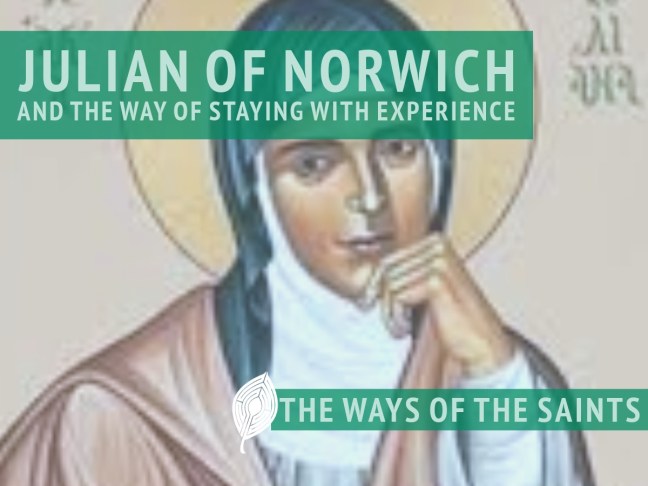
Outside the writers of and individuals mentioned in the Bible itself, there is no Saint I’ve written about more than Julian of Norwich (who is not ‘officially’ a Saint because of the way the Roman Church defines these things but is absolutely a Saint for my purposes here). Two years ago, we spent the entire Lenten season working through the “long text” of her Showings of Divine Love. But even more than her mystical visions or her wonderful theology, what still impresses me most about Julian is how she handled having her visions in the first place. It’s a way of holiness we’d all do well to emulate and so it’s worth talking about today.
Julian of Norwich was a fourteenth-century anchoress, a type of monastic who lived alone in a cell in the church walls, having taken vows of solitude and stability in addition to the normal vows of poverty, obedience, and chastity. But, unsatisfied with even this extreme vocation, she prayed for three further things: a tangible experience of Christ’s suffering on the cross, a life-threatening illness, and what she called ‘three wounds’: “true contrition, … loving compassion, and … longing with my will for God” (Showings of Divine Love (long text), Ch 2). She was fully aware that these were weird things to pray for, and so she placed these desires within a condition: “Therefore, I said: Lord, you know what I want, if it be your will that I have it, and if it be not your will, good Lord, do not be displeased, for I want nothing which you do not want” (Ch 2). As I’ve previously noted about this:
This is a wise example for all us as we approach our own spiritual lives: not to focus on outcomes, but on openness to what is best for us. It’s not that we shouldn’t have desires, or seek divine blessings and peak religious experiences, but that they aren’t the point. We would do well to follow Julian’s lead and hold what we want in life and what we want from God with an open hand. True prayer is always like Jesus’ in the Garden of Gethsemane: “…not my will but yours be done, O Lord.” … Ultimately, no matter what we pray for, it is in the service of the bigger and better goal of becoming more like Christ.
Odd as they may seem to us, God did answer Julian’s prayers. In 1373, she experienced a severe illness and in her fevered state had a graphic vision of Christ on his cross (and much, much more).
But what impresses me most about Julian is what she did after her vision. It seems that she wrote down what she experienced fairly quickly, in what is now known as the ‘short text’ of her work, Showings of Divine Love. But she didn’t leave it there. She stayed with those images and those visions, and thought about, contemplated, and prayed through them — and especially the pieces she didn’t understand — for decades before writing the ‘long text’. There are at least two reasons why I find this so impressive.
First, she completely avoided the trap of spiritual consumerism that’s so easy to fall into with peak religious experiences. (This is the trap St John of the Cross would later write about.) They are strange, wonderful, and exciting, and so it’s natural to want more and more of them rather than being grateful for what God has already given us. But as far as we know, Julian neither sought nor experienced any visions after her illness.
And secondly, she never lost her curiosity for what she had experienced, poring over the images — not only praying through them, but also engaging in active theological study to better place them within the framework of the received Christian tradition — until she was satisfied she understood them.
And this is the main way I believe Julian can be an example for us. Her whole posture when it came to the desires of her heart and the fulfillment of those desires is one of complete faithfulness. She held them with an open hand, insisting God only fulfill them if it be God’s will. And when she received them, she did so with gratitude, curiosity, and years of patient and diligent follow-through.
What an example!
This has been a short post today, but if you’d like to learn more about and from this wonderful Christian Saint, check out my 2023 Lenten Series, “Keeping Lent with Julian of Norwich”
 Matthew Root
One thought on “Julian of Norwich and the Way of Staying with Experience”