
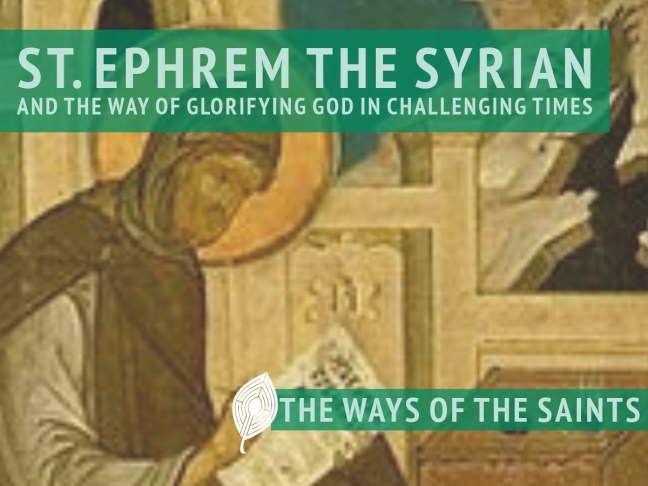
Last week I went to my first Eastern Orthodox service in well over a decade. I was struck once again by its unique hymnography, which doesn’t shy away from either theological sophistication or deep cuts of biblical allusions, and which delights in literary phenomena such as irony and paradox. In all of this, this tradition follows in the footsteps of one of its great early hymn writers, St. Ephrem the Syrian. In today’s post in this Lenten series exploring how we might follow the ways of the Saints in our own journeys of faith, I’d like to look a bit more at this man, his legacy, and, in particular, a fascinating fact about his life that humbles and inspires me.
The man we know as St. Ephrem the Syrian was born in the early fourth century in the city of Nisibis, in what is now southeastern Turkey. While he was growing up, the Christian community in NIsibis was fairly new; his Bishop, Jacob (who as it happens was among the signatories of the First Council of Nicaea) was just the second overseeing the Church in the city. Shortly after his ordination as a deacon, Ephrem began writing hymns in his native Aramaic (also known as Syriac) tongue. He became known for his keen mind and clever lyricism, a style that delighted simultaneously in the continuity and surprise inherent in the Gospel message. Again if you appreciate the sophistication and use of irony and paradox that are so common in Eastern hymns, to a great degree you have St. Ephrem to thank for it.
As an example of his style, here’s a stanza from one of his series known as the Hymns of Light:
The Light of the just and joy of the upright is Christ Jesus our Lord.
Begotten of the Father, He manifested himself to us.
He came to rescue us from darkness and to fill us with the radiance of His light.
Day is dawning upon us; the power of darkness is fading away.
From the true Light there arises for us the light which illumines our darkened eyes.
His glory shines upon the world and enlightens the very depths of the abyss.
Death is annihilated, night has vanished, and the gates of Sheol are broken.
Creatures lying in darkness from ancient times are clothed in light.
The dead arise from the dust and sing because they have a Savior.
He brings salvation and grants us life.
He ascends to his Father on high. He will return in glorious splendor
and shed His light on those gazing upon Him.
Or, this hymn on the Incarnation highlights his love of paradox:
Glory to Him, Who came to us by His first-born!
Glory to the Silence, that spoke by His Voice.
Glory to the One on high, Who was seen by His Day-spring!
Glory to the Spiritual, Who was pleased to have a Body,
that in it His virtue might be felt, and He might by that Body show mercy on His household’s bodies!
Glory to that Hidden One, Whose Son was made manifest!
Glory to that Living One, Whose Son was made to die!
Glory to that Great One, Whose Son descended and was small!
Glory to the Power Who did straiten His greatness by a form,
His unseen nature by a shape!
With eye and mind we have beheld Him, yea with both of them.
This is amazing stuff! But what I’d like to focus on today is not the wonderful blessing of St. Ephrem’s creativity, but the context in which he used it.
For Nisibis was located right on the hotly contested border between the Roman and Sasanian (centred in Persia) Empires. According to a Roman historian Ammianus Marcellinus, it was “the strongest bulwark of the East,” with immense city walls, high towers, and a highly-fortified citadel. It was in Roman hands for much of Ephrem’s life, but found itself consistently under threat from the Sasanian army. Three times the city successfully withstood the siege, until it finally fell on the fourth attempt, in 363, and its Roman population forced to leave. And that’s what floors me about St. Ephrem: He wrote his stunning poetry while his city was under constant threat, and consistent attack. It is one thing to write beautiful music and theology when life is stable, but to do it in times of great fear is another matter altogether.
During the third siege of Nisibis, in 350, the Sasanians tried to undermine the city walls by rerouting a local river into them. During this terrifying event, St. Ephrem wrote a series of stunning hymns comparing the plight of the city to Noah’s Ark. You can read both the faith and desperation in these words:
Lo! All the billows trouble me; and You have given more favour to the ark:
for waves alone encompassed it, mounds and weapons and waves encircle me.
It was unto You a storehouse of treasures, but I have been a storehouse of debts:
it in Your love subdued the waves; I in Your wrath, am left desolate among the weapons;
the flood bore it, the river threatens me.
O Helmsman of that ark, be my pilot on the dry land!
To it You gave rest in the haven of a mountain; to me give You rest also in the haven of my walls!
Those of us who have until now been blessed to have lived in easy times can easily forget that the world’s history has seen far more anxious times than consoling ones. Part of the blessing of belonging to a tradition with a long memory is that it reminds us of the resources of faith that kept our forebears going in their times of trouble. This was the focus of my series “Theology from under the Rubble,” which explored the examples of faith we have across the world and generations, from the Bible’s book of Lamentations about Jerusalem’s fall to Babylon, through St. Augustine writing about the sack of Rome, to Jürgen Moltmann seeking a theology built for “life after Auschwitz.” St. Ephrem is another such figure, writing some of the most memorable hymns of the whole Christian tradition while his city’s walls were being shaken. And, when the walls did eventually fall, he did not lose faith, but continued to write, teach, and glorify God in his new home of Edessa, where he eventually died in 373.
So what can we take away from the way of St. Ephrem? That when our Scriptures say “I will bless the Lord at all times, his praise shall continually be in my mouth,” all times means all times. Awful, terrifying times may test our faith and our mettle, but they do not need to destroy it. Like Ephrem, we can face them with faith, curiosity, and confidence that God is good, even when the world isn’t.
Out of Paradise, a river floweth,
flooding all the earth with joy unending,
cheering souls with compunction and saving fear:
Ephrem, the wine bowl of gladness inspired of God,
from all eternity chosen to light the Church with his sacred hymns, his sermons, his shining canticles,
whereby he filleth faithful souls with godliness
Amen.
 Matthew Root
3 thoughts on “St. Ephrem the Syrian and the Way of Glorifying God in Challenging Times”