
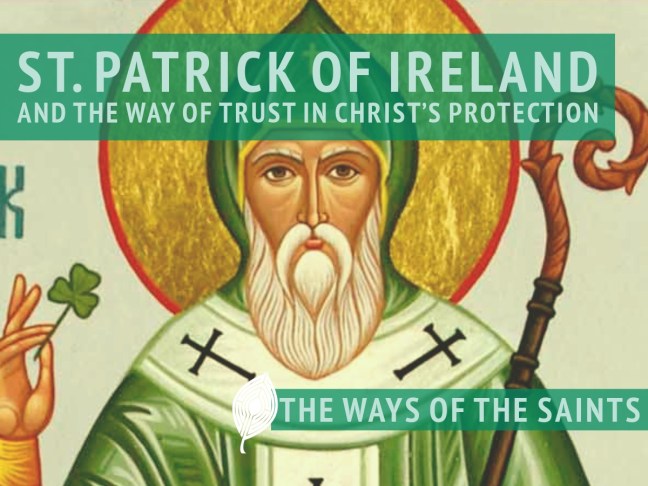
Of all the commemorations of the Saints on the calendar, few are as well known among society at large as St. Patrick’s Day, which is of course, today, March 17. So, it felt too strange not to explore the way of St. Patrick of Ireland today. The problem is that, while few Saints are better known, there are also few Saints whose lives are more shrouded in legend than him. So let’s try to demystify the man and see what we might take away from the stories about his life to apply to our own.
St. Patrick of Ireland was a fifth-century Romano-British bishop, who is credited with bringing Christianity to Ireland. Most of what we know of his life comes from his Confessio (’Declaration’), an autobiography, which is attested from at least the ninth century and is generally judged to be genuinely his. In it we see a simple and forthright style of thought. It begins, for example:
My name is Patrick. I am a sinner, a simple country person, and the least of all believers. I am looked down upon by many. My father was Calpornius. He was a deacon; his father was Potitus, a priest, who lived at Bannavem Taburniae. His home was near there, and that is where I was taken prisoner. I was about sixteen at the time. (1)
By this account, St. Patrick was attacked by an Irish raiding party and enslaved with thousands of others. Though raised in a Christian home, it wasn’t until his enslavement that he was convicted to follow the Gospel:
I turned with all my heart to the Lord my God, and he looked down on my lowliness and had mercy on my youthful ignorance. He guarded me before I knew him, and before I came to wisdom and could distinguish between good and evil. He protected me and consoled me as a father does for his son. That is why I cannot be silent – nor would it be good to do so – about such great blessings and such a gift that the Lord so kindly bestowed in the land of my captivity. This is how we can repay such blessings, when our lives change and we come to know God, to praise and bear witness to his great wonders before every nation under heaven. (2-3)
Six years into his captivity, he reported hearing a voice telling him his freedom was at hand and that a ship was waiting for him. He escaped and, seeing a ship moored nearby, convinced its owner to take him back to Britain. Some time after returning home, he received a vision in a dream: a man from across the Western (i.e., Irish) Sea approached him with a letter declaring him to be “The Voice of the Irish People.” accompanied by a crowd of Irish voices begging him to return to them. After studying and being ordained in Europe, he returned to Ireland to fulfill the calling of his vision. While his own reports suggest he faced a lot of opposition, both in Britain and in Ireland, his missionary efforts were rewarded and he has long been credited with bringing Christianity to Ireland.
Apart from these basic details from his autobiography, the rest of his life is little but wild legend — the shamrock as an image of the Trinity (the earliest version of that story only dates to the 18th C!), driving the snakes out of Ireland (where there weren’t any to start with), and so on. Because of this, St. Patrick can easily seem like a cartoonish, legendary figure. But I think even from his own writings one thing that stands out is his trust in God’s protection. We get this same sense from the hymn known as “St. Patrick’s Breastplate.” This text, also attributed to St. Patrick, is recorded as early as the ninth century, and continues to be among many Christians’ favourites. A prayer of confidence in God’s protection, it begins by ‘binding’ the power of God: as creator, as the Son in his incarnation, death, resurrection, and ascension as divine judge, as the one who empowers the angels, apostles, and saints, and as the power behind the elemental forces of the world. This power is claimed to have many benefits to the faithful:
I bind to myself to-day,
The Power of God to guide me,
The Might of God to uphold me,
The Wisdom of God to teach me,
The Eye of God to watch over me,
The Ear of God to hear me,
The Word of God to give me speech,
The Hand of God to protect me,
The Way of God to prevent me,
The Shield of God to shelter me,
The Host of God to defend me,
Against the snares of demons,
Against the temptations of vices,
Against the lusts of nature,
Against every man who meditates injury to me,
Whether far or near,
With few or with many.
It then asks for Christ to act as, for lack of a better word, a bubble of protection around all sides:
Christ with me, Christ before me, Christ behind me, Christ within me, Christ beneath me, Christ above me, Christ at my right, Christ at my left, Christ in the heart of every man who thinks of me, Christ in the mouth of every man who speaks to me, Christ in the eye of every man that sees me, Christ in the ear of every man that hears me.
These are such exalted words, it’s no wonder they have inspired so many over the centuries! The repetition of God’s power and Christ’s presence for us brings to mind the wonderful words of Romans 8:
If God is for us, who is against us? He who did not withhold his own Son, but gave him up for all of us, will he not with him also give us everything else? Who will bring any charge against God’s elect? It is God who justifies. Who is to condemn? It is Christ Jesus, who died, yes, who was raised, who is at the right hand of God, who indeed intercedes for us. Who will separate us from the love of Christ? Will hardship, or distress, or persecution, or famine, or nakedness, or peril, or sword? As it is written: ‘For your sake we are being killed all day long; we are accounted as sheep to be slaughtered.’
No, in all these things we are more than conquerors through him who loved us. For I am convinced that neither death, nor life, nor angels, nor rulers, nor things present, nor things to come, nor powers, nor height, nor depth, nor anything else in all creation, will be able to separate us from the love of God in Christ Jesus our Lord. (Romans 8.31-39)
Whether or not the words of the hymn were written by Patrick himself, they certainly seem to reflect his way of bold confidence in the power of God. And in our world where so much seems impossibly hard, we would do well to bring in this confidence to our own lives. For with God, nothing is impossible. And though we will face trouble in the world, God, in Christ, has overcome the world.
Holy Bishop Patrick, faithful shepherd of Christ’s royal flock:
You filled Ireland with the radiance of the Gospel: The mighty strength of the Trinity!
Now that you stand before the Savior, pray that He may preserve us in faith and love!
Amen.
 Matthew Root