
Last Sunday, we saw how throughout the Scriptures, in the life of Jesus, and across Christian history, the desert or wilderness has been a major symbol for what I call ‘the arena’ — that place where we as individuals stand up, show up, and test our mettle. The term used in this context comes from a speech by Teddy Roosevelt, in which he said:
It is not the critic who counts; not the man who points out how the strong man stumbles, or where the doer of deeds could have done them better. The credit belongs to the man who is actually in the arena, whose face is marred by dust and sweat and blood; who strives valiantly; who errs, who comes short again and again, because there is no effort without error and shortcoming; but who does actually strive to do the deeds; who knows great enthusiasms, the great devotions; who spends himself in a worthy cause; who at the best knows in the end the triumph of high achievement, and who at the worst, if he fails, at least fails while daring greatly, so that his place shall never be with those cold and timid souls who neither know victory nor defeat.
Thought of in this way, the desert wasn’t the only such arena in Jesus’ life. Rather, there’s another arena whose spectre hung over his whole ministry, and towards which he had to “set his face” (Luke 9.51): Jerusalem. This particular arena is the focus of today’s Gospel reading. It says:
At that very hour some Pharisees came and said to Jesus, “Get away from here, for Herod wants to kill you.” He said to them, “Go and tell that fox for me, ‘Listen, I am casting out demons and performing cures today and tomorrow, and on the third day I finish my work. Yet today, tomorrow, and the next day I must be on my way, because it is impossible for a prophet to be killed outside of Jerusalem.’ Jerusalem, Jerusalem, the city that kills the prophets and stones those who are sent to it! How often have I desired to gather your children together as a hen gathers her brood under her wings, and you were not willing! See, your house is left to you. And I tell you, you will not see me until the time comes when you say, ‘Blessed is the one who comes in the name of the Lord.'” (Luke 13.31-35)
Jerusalem carries an ironic symbolism in the Gospels, at once the spiritual capital and focus of Israel’s political hopes, ambitions, and identity, but also for that very reason, a symbol of failure and disappointment. “Jerusalem, Jerusalem, the city that kills the prophets” indeed. And here, it seems pretty clear that Jesus knew how his next trip to Jerusalem was going to go. It’s a text full of of foreboding. And yet his face remained set on going there and seeing it through. Moreover, his heart was still filled with love for, and a desire to protect, this place that was going to kill him: “How often have I desired to gather your children together as a hen gathers her brood under her wings.”
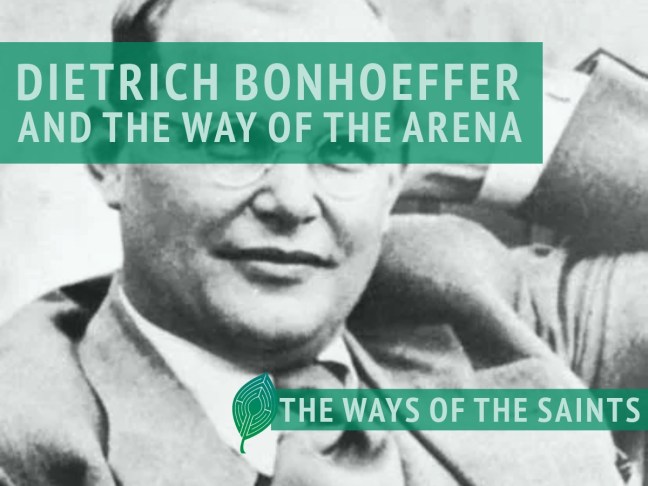
As I was reading this passage, I couldn’t help but think of the twentieth-century German theologian Dietrich Bonhoeffer. He too felt called to leave a place of safety for the arena. Born into a wealthy and well-connected family Bonhoeffer became a prominent theologian, teacher and speaker while still a young man. His Christian convictions, however, quickly put him on the outs with the country’s Nazi leadership and the official German churches, which had all bowed to Nazi ideology. When the Second World War broke out in 1939, Bonhoeffer was in the United States on a lecture tour. He could have easily stayed there — and indeed was being strongly pressured to do so. He was given job offers, an assurance of safety, and the possibility of rebuilding his career and continuing his theological vocation. But he refused to do this. Instead, he felt called to return to Germany. As he wrote at the time:
I realize that I’ve made a mistake by coming to the United States. I must stand by the Christians of Germany during this difficult time in our national history. I will have no right to participate in the reestablishment of Christian life in Germany after the war if I do not share this time of trial with my people.
And so he returned. He used family connections to get a job in the government bureaucracy and joined the resistance, even to the point of participating in a plot to assassinate Hitler. He was discovered and sent to prison, where he was eventually killed just days before Berlin fell to the Allies. From his cell, he later reflected on his motivations for returning and for risking his life in the resistance:
[I]f we want to be Christians we must show something of Christ’s breadth of sympathy by acting responsibly, by grasping our ‘hour’, by facing danger like free men, by displaying a real sympathy which springs not from fear, but from the liberating and redeeming love of Christ for all who suffer. To look on without lifting a helping hand is most un-Christian. The Christian does not have to wait until he suffers himself; the sufferings of his brethren for whom Christ died are enough to awaken his active sympathy. (”After Ten Years,” Letters & Papers from Prison, 23f)
There is much to say about Dietrich Bonhoeffer’s life, and how his ‘way’ might inform our own. (See my post on him from my “Theology from under the Rubble” series for more.) But today I’d like to focus on this one aspect: His refusal to stay on the sidelines during a moment of national disaster and shame. He entered the arena knowing full-well what the consequences would be.
I think it’s also important to note that this was his arena. His return to Germany stands as a powerful witness and example for us, but it doesn’t make the efforts, witness, and examples of those who did stay away any less powerful or important. The point is to identify what our arena may be and to enter it with boldness and faith.
O God, early in the morning I cry to you. Help me to pray. And to concentrate my thoughts on you; I cannot do this alone. In me there is darkness, But with you there is light; I am lonely, but you do not leave me; I am feeble in heart, but with you there is help; I am restless, but with you there is peace. In me there is bitterness, but with you there is patience; I do not understand your ways, But you know the way for me. — Prayer of Dietrich Bonhoeffer with and for fellow prisoners
 Matthew Root
3 thoughts on “Dietrich Bonhoeffer and the Way of the Arena: A Reflection on Luke 13:31-35”