
[This post is adapted from content from my post “Beyond ‘I Have a Dream’ ,” published in 2020.]
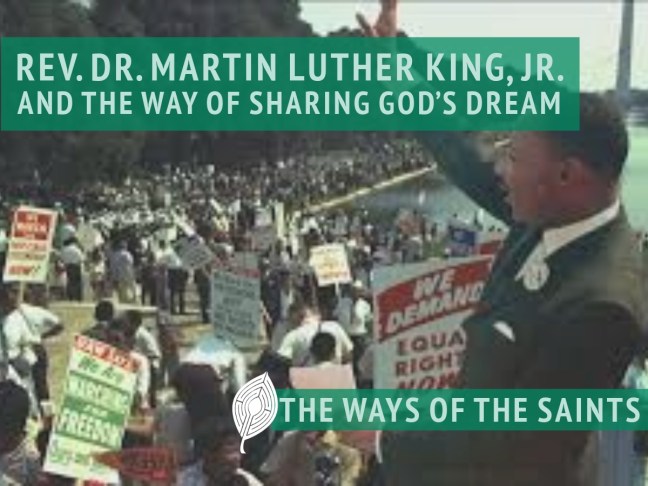
Today in this series on the Ways of the Saints, ancient and modern, I want to hear the voice of Rev. Dr. Martin Luther King Jr., a towering figure in the history of American race relations and one of Western history’s greatest orators. But precisely because of his rightful fame, his legacy has in recent decades been tarnished — one might even say ‘whitewashed’ — by the ways white American culture has appropriated and misappropriated his message. Dr. King was no shrinking violet who simply dreamed non-violently of a better day. He was a firebrand who believed in direct action, protested injustice wherever he saw it, was harassed by the police and FBI, faced off against police dogs, and by the time he was assassinated, was among the most hated people in his country. And yet despite the pervasive, persistent, and violent opposition he faced, Dr. King never lost sight of his dream — which was nothing other than the biblical vision of peace, or shalom — and never ceased sharing that dream with others.
In many ways, King’s thought was in continuity with what came before him. His language was filled not only with the words of the Scriptures, but also of the Spirituals; and his speeches and sermons carried on in their traditional themes of freedom (“Free at last! Free at last! Thank God Almighty, we are free at last!), the Exodus (“I have been to the mountain top and I have seen the Promised Land!”), and hope (“I have a dream that one day this nation will rise up and live out the true meaning of its creed: ‘We hold these truths to be self-evident, that all men are created equal'”).
But what I think is more interesting and important for us to hear today is the more challenging side of King’s thought, which put a spotlight on the failures of dominant (white) culture. When Dr. King was arrested after a demonstration in Birmingham, Alabama ended in police violence, many leaders in the white church – even those opposed in principle to segregation – criticized King for his tactics, nonviolent as they were. (As they say, the more things change, the more they stay the same.) He penned a response from his prison cell, which — to our shame — remains as relevant and challenging today as it was almost sixty years ago. And it is well worth hearing at length (and if you have time, please follow the link above and read the whole thing). But to summarize, it his message was:
- To those who complained that the timing of his movement was wrong, he insisted that the timing for inconvenient truths is never ‘right’ for those who need to hear them.
- To those self-proclaimed ‘moderates’, he insisted that not taking a side in matters of justice is taking the side of injustice: “It is wrong to use immoral means to attain moral ends. But .. .it is just as wrong … to use moral means to preserve immoral ends.”
- To those who called him an extremist, he insisted that Jesus too was an ‘extremist’ by their accounting. He put the matter plainly: “Will be be extremists for the preservation of injustice or will we be extremists for the cause of justice?”
Despite being labeled an extremist by many whites, Dr. King had to face accusations within the black community of being too soft and unfocused: Soft, for making nonviolence an absolute condition of seeking justice, and unfocused, because he saw beyond the needs of black Americans and fought against injustice wherever he saw it. One of the flash points for this was his opposition to the Vietnam War, which some thought was a distraction from the cause at hand. But, believing that injustice against one person was an injustice against every person, King refused to be silent:
I am convinced that if we are to get on to the right side of the world revolution, we as a nation must undergo a radical revolution of values. We must rapidly begin… the shift from a thing-oriented society to a person-oriented society. When machines and computers, profit motives and property rights, are considered more important than people, the giant triplets of racism, extreme materialism, and militarism are incapable of being conquered.
A true revolution of values will soon cause us to question the fairness and justice of many of our past and present policies. On the one hand we are called to play the Good Samaritan on life’s roadside, but that will be only an initial act. One day we must come to see that the whole Jericho Road must be transformed so that men and women will not be constantly beaten and robbed as they make their journey on life’s highway. True compassion is more than flinging a coin to a beggar. It comes to see that an edifice which produces beggars needs restructuring.
But critically, this ‘political’ talk was no less a part of God’s dream for his country and the world than any other part of his message. Justice is justice. Injustice is injustice. Either our society reflects God’s peace for every one, or it doesn’t. And so, Rev. Dr. Martin Luther King, Jr., had much to say, both to this own time and to ours. His words and witness worked, inasmuch as they led to important and needed legislative changes. And yet, like the prophets of old, so many of his words and so much of his dream remain unfulfilled. And so he remains a witness to the cause of justice in the world, his words popping the self-satisfied egos of a culture that wants to bask in how far it’s come while only paying lip-service to how far we have to go.
And this is what I believe we can and should take away from the way of Dr. King. He had a dream — a dream inspired by the Scriptures and reflecting God’s good intentions for all creation — and shared it, consistently and insistently, even when nobody wanted to hear it. And that’s a needful example for all of us.
Hear what the Holy Spirit is saying to the Church.
 Matthew Root
5 thoughts on “Rev. Dr. Martin Luther King, Jr. and the Way of Sharing God’s Dream”