
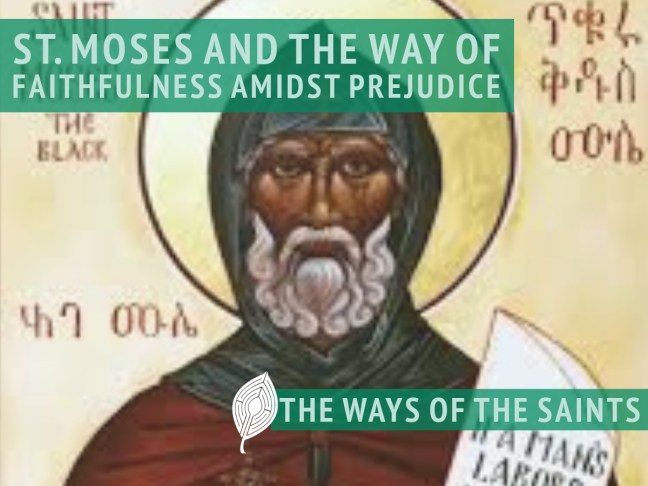
Last year, my Lenten series looked at the wisdom recorded in The Sayings of the Desert Fathers. One of the figures we briefly met there was a certain Abba Moses, better known in hagiographical history as St. Moses the Ethiopian, St. Moses the Abyssinian, or St. Moses the Black. From these cringe epithets, you can probably guess that St. Moses hailed from Sub-Saharan Africa and that his skin colour set him apart in the olive-complexioned world of fourth-century Egypt. And, sadly like so many today, St. Moses experienced prejudice because of his skin-tone. But, knowing that this world was not his true home, he remained faithful despite these hurtful ways his fellow monks broke faith with him. Today I’d like to look at this a bit more and see what wisdom we might take away from the Way of St. Moses.
According The Sayings of the Desert Fathers, Abba Moses had a difficult life. While little is known about his childhood, he spent at least some of his adult life enslaved. When he was freed, he resorted to violence and robbery to make ends meet. Eventually, he was converted and joined a monastic community in the desert. There he experienced racism, both what today we could call micro-aggressions and macro-aggressions. On the ‘micro’ side of things, it is reported that when he was ordained, his bishop joked that he was now “completely white” (Abba Moses 4). On the ‘macro’ side, he had to deal with fellow monks saying things like “Why does this Black man come among us?” (Abba Moses 3) and even barring him from entering the sanctuary with taunts of “Out, Black man!” (Abba Moses 4). Now the way these stories are spun in the Sayings, the monks weren’t actually acting out of racial prejudice, but rather testing his faith and mettle. But even if that’s true, it still meant that Abba Moses had to deal with it, and that the monks knew it would be a sore spot for him. Race was understood to be a wound they could use to test him. That this came to mind so easily is itself racist. As Martin Luther King Jr. famously put it, the ideal is for a world in which people are judged “not be judged by the color of their skin but by the content of their character.” That in the hyper-competitive environment of desert monasticism, the immediate thought was to test Abba Moses based on the colour of his skin rather than the spiritual disciplines other monks were tested against is very distressing indeed. And, heartbreakingly, one detail suggests that at least some times, this did get to Abba Moses, leading to such internally racist thoughts as wondering if indeed someone with “skin dark as ashes” had any business in a monastic community (Abba Moses 4).
Before getting to Abba Moses and his way of holiness, it’s important to note that these monks were clearly working from a faulty paradigm, which misapplied the metaphor of light as a symbol of God’s presence and of purity to skin tone. We need to be so careful with our symbols and how we deploy them! In order to mitigate such misapplication of this symbol, we would do well to balance it with the equally beautiful and biblical metaphor of God’s presence in darkness.
Abba Moses responded to these ‘tests’ by holding his tongue. When asked by his fellow monks about his experience he simply replied, “I was grieved, but I kept silence.” I don’t think this is passivity in the face of injustice — since Moses’s reputation was of having been a violent brute, I don’t think he’d have had a hard time standing up for himself. Rather, he was inspired by the humble way of Christ, who forgave his enemies, and taught those who would follow him that it was the humble and meek of the world who are truly blessed. Like the great Civil Rights activists of the twentieth century, St. Moses undertook a kind of nonviolent resistance that refuses to rise to the bait. Holding one’s tongue is a controversial strategy. There are definitely times when it’s important to speak up. But, there can also be a lot of power in silence and in not giving those who are wilfully misunderstanding you the satisfaction of a defensive response. And in Abba Moses’ case, his commitment to setting his ego aside and allowing the arrows of his detractors to bounce off him, let him to become famous for his resolve, generosity, blamelessness, and forgiveness. In the most famous story associated with him, when asked to cast judgment on another brother’s sins, he picked up a leaking jug of water, and when asked about it, told the community that he knew his sins trailed him just like the water so he had no right to judge someone else.
I mentioned at the start of the post that St. Moses’ traditional epithets call attention to his skin colour. But in recent years, I’ve seen evidence of those who love him pushing a different epithet, and one that is much more in line with that vision of Dr. King for us all to be judged on our character: They refer to this man, who was initially known for his imposing physical stature but who cultivated the way of quiet, resilience, humility as St. Moses the Strong. And I love it.
So what can we take away from the way of St. Moses the Strong? It’s so easy to become discouraged or distracted when we face opposition — especially unfair and prejudicial opposition. St. Moses’s example teaches us that often the strongest response is no response at all: not the silence of fear but the silence that comes from the peace of knowing the truth, grounded in confidence in who we are both as humans created in the image and likeness of God and as individuals transformed ‘in Christ’, coupled with the humility that refuses to judge others based on their worst moments. It’s a challenging way for sure, but it is a powerful manifestation of the way of Christ.
Rejoice, you who were made strong by surrendering your weakness to God.
Rejoice, for the arrows of the enemy cannot touch you.
Rejoice, holy Elder Moses, righteous teacher of true spiritual wisdom.
Amen.
 Matthew Root
One thought on “St. Moses and the Way of Faithfulness amidst Prejudice”