
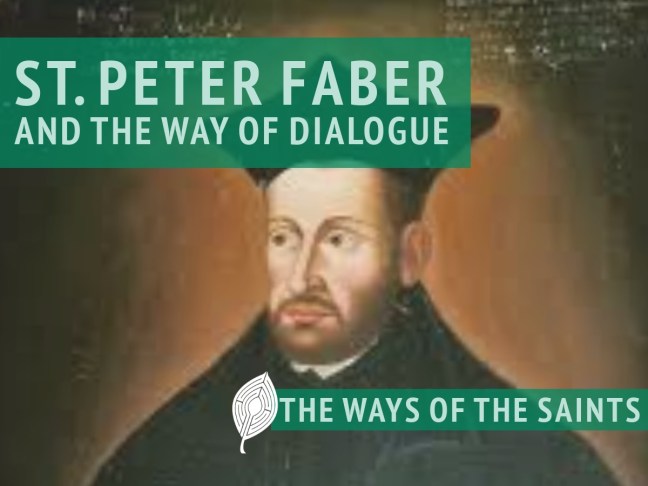
Of all the things that make optimism hard to find in our current social and political climate, one of the ones that I find most concerning is the lack of civility, grace, and curiosity in public discourse. Everything is attacks, knee-jerk responses, and assuming the worst possible motives — for one’s allies as much as one’s enemies. But as they say, the more things change, the more they stay the same. This is hardly the first time we’ve been in such times. Today in this series on the Ways of the Saints, I’d like to explore the life of St. Pierre Favre, better known in English as Peter Faber, who during another time of deep distrust and incivility, rose above it all, extending a hand to his opponents and seeking first and foremost to clean up his own side’s act.
Peter Faber was born in 1506 to a humble, though well-connected, family in the Duchy of Savoy, now part of France. Through his family connections, he was able to pursue education at the University of Paris and during his studies providentially met and became fast friends with the future Sts. Ignatius of Loyola and Francis Xavier. Together, these men of very different backgrounds and temperaments founded what became the Society of Jesus, or Jesuits. Faber took quickly to the sacred practices Ignatius had developed, which eased his natural scrupulousness and helped him to discern his vocation. Ignatius later said that Faber was the most skilled at leading the Spiritual Exercises for others in spiritual direction.
His vocation sorted, Faber’s ministry took him to Germany, ostensibly to combat the Protestant Reformation there. But while he was distraught by the impacts of the Reformation — not only the breakdown of Church unity, but also the social disorder and violence that went with it — he was even more disturbed by what he saw among those still loyal to Rome. Why wouldn’t the people be attracted to Protestantism, he wondered, when the Catholic clergy around them were living large while either unable or unwilling to address the spiritual and practical needs of the people they were supposed to be serving? As he wrote back to his superiors, “They are led astray not so much by the teaching and seeming good of the Lutherans as by the wickedness of those very ones who should be examples of zeal.” The first concern, he realized, was not refuting Protestant teaching, but getting their own Catholic house in order. And so he traveled throughout Germany, instructing clergy, influencing the nobility, and speaking to the masses. In so doing, he brought thousands back into the Catholic fold. No matter which ‘side’ of this historic divide one may sympathize with, the important point is that in a situation where people’s spiritual needs weren’t being met, St. Peter Faber stood up and ensured that they were.
While these efforts were of course intended to stop the growth of the Reformation, Faber didn’t see the Protestants as an enemy to be defeated. He was ashamed by the Catholic rhetoric that delighted in anticipating the Reformers suffering in hell, a hatred he believed was turning more and more people off Christianity entirely. He didn’t want to attack the Protestants, but to pray for them, and have open and honest dialogue with them about their differences. After all, he was just as appalled by many of the same abuses in the Church as they were. In this he embodied one of the principles from Ignatius’s Spiritual Exercises: “to try hard to save the proposition of one’s neighbour,” in other words, not to assume the worst motivations or meaning in what someone is saying, but to try to assume the best instead. As he wrote, “Whoever would like to help the heretics [sic — he was still a man of his time after all!] of this time should have much charity towards them and love them truly.”
Sadly, his itinerant lifestyle took its toll on him, and Faber died at the age of 40.
So then, what might we learn from the way of St. Peter Faber? First, he’s a great example to us of the value of sacred practices in setting our priorities and understanding our vocation. But more importantly, it’s his generosity of spirit and discerning heart. He went into a situation with a mission to combat his Church’s opponents but had the insight to realize that the best thing he could do was focus on making sure his Church was really being the Church it claimed to be. This ‘get your own house in order’ mentality would serve us all well, both in our personal lives and relationships, and in our fraught social and political moment. And because he was so aware of the failings of his own side, he was able to approach the ‘other side’ with greater openness and grace. No matter who he was talking to, he approached the conversation with love, ensuring his conversation partner felt seen and heard. Pope Francis spoke well when he commended him for:
his dialogue with all, even the most remote and even with his opponents; his simple piety, a certain naïveté perhaps, his being available straightaway, his careful interior discernment, the fact that he was a man capable of great and strong decisions but also capable of being so gentle and loving.
And to that I say, ”Amen!”
“Take care, take care, never to close your heart to anyone.” – St. Peter Faber
 Matthew Root
One thought on “St. Peter Faber and the Way of Dialogue”