
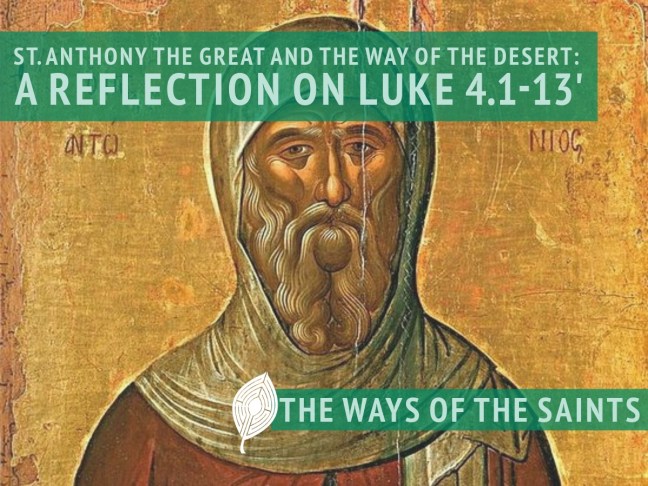
There are few symbols more evocative in the Biblical imagination than the desert, or wilderness. Such stories as the Hebrews wandering in the wilderness for forty years, the exile across the barren lands of the Syrian Desert, and Jesus’ forty-day battle of will and wit with Satan have gained an archetypal status in the tradition. The last of these, which is recounted in today’s Gospel reading, has become synonymous in Christian spirituality with the arena — the place where we show up and have our strengths, weaknesses, and mettle tested. Today I’d like to look at this story and the role it played in Jesus’ life, and then how it inspired the rise of desert monasticism and specifically St. Anthony the Great.
As recounted in the Gospels, immediately after the wondrous theophany of his baptism, which was punctuated by a heavenly voice saying, “You are my Son, the Beloved with you I am well pleased” (Luke 3.22), Jesus is led by the Holy Spirit into the desert. There he encounters Satan, who tries to beguile him with temptations and half-truths, and trick him into misappropriating his ‘Sonship’ and ‘Belovedness’ by showing off, testing God, and establishing his kingdom (which is not of this world) through the ways of this world. Jesus resists the temptations, being confident enough in his identity and in God’s love to trust that God would accomplish what needed to be done in and through him in God’s own way. His mission and mode of operations thus confirmed, Jesus then goes to Galilee where he takes up Isaiah’s vision of the one who would heal the sick, free the captives, and bring good news to the oppressed as his own. So we can say that the desert was a formative experience for Jesus, confirming his identity and mission. And ever since, the desert has become synonymous with the spiritual battlefield or arena.
By the fourth century, as Christianity slowly moved from being a persecuted religion to the preferred religion of the Roman Empire, hundreds of men and women responded to this existential crisis in the faith by taking Jesus’ example literally, and fled to the desert to fight their own demons (literal or figurative). Chief among these was the man known to history as St. Anthony the Great. (Note: Last year’s Lenten series involved daily reflections on the desert fathers; see here, here, and here, for a few notable posts in that series.)
Born into a wealthy family in Lower (i.e., Northern) Egypt, St. Anthony’s life took a dramatic turn one day after hearing the words of Jesus from Matthew 19.21: “If you want to be perfect, go, sell what you have and give to the poor, and you will have treasures in heaven.” He felt compelled to take the exhortation literally, and sold off the lands he’d inherited, donated the proceeds to the poor, and fled to the desert. There he undertook a life of extreme asceticism, spending his day in practical labours and prayer, eating little, limiting contact with others, and battling the temptations that found him there. Despite his best efforts at maintaining a solitary life, a community eventually developed around him and his cell. While not the first Christian monk, St. Anthony was certainly the most famous, locally in Egypt during his life, and, through St. Athanasius’s biography The Life of Saint Anthony, around the whole Roman world. And his example inspired thousands to take up the monastic vocation for themselves.
Our knee-jerk response to hearing St. Anthony’s story is to immediately say something like, “Of course, most of use are not going to be called to follow Jesus’ teachings and example as literally as he was.” While this is no doubt true, we’d do well to interrogate why we’re so quick to dismiss the idea. It probably says a lot more about our own culture than his that so few of us can imagine taking up a radical vocation such as his. But that said, the monastic life has never been for everyone. And St. Anthony knew that well. Famously, when God showed him who his equal in spiritual valour was, it was an urban physician who said his prayers and gave generously to the poor (Sayings of the Desert Fathers, St Anthony 24). Abba Anthony himself put it this way: “Whatever you find in your heart to do in following God, that do, and remain within yourself in Him.” In a similar vein, he said:
Whoever you may be, always have God before your eyes;
whatever you do, do it according to the testimony of the Holy Scriptures;
in whatever place you live, do not easily leave it.
Keep these three precepts and you will be saved. (St Anthony 3)
So the example from St. Anthony’s way of life for us is not to flee for the desert, but to find our own desert — the arena for our own wrestling with God. And once we find it, to show up, consistently, and to whatever it is we are called to do there to the best of our abilities, strength, soul, and mind. For some of us that may be to dedicate our lives to intentional poverty as St. Anthony did, but for others it may be to take up a healing vocation (like the one who was Anthony’s equal in the city), to teach, to parent, or any other job or ministry. Sadly, in a bruised and broken world like ours, our deserts can also be indelible parts of who we are: our race, sexuality, gender or gender identity can be an arena in which we are called to wrestle with God, ourselves, and others.
As St. Anthony reminds us, this is not easy. The desert is always a place of temptation, as it was for Jesus. (As St. Anthony put it, “This is the great work of a person: always to take responsibility for their sins before God and to expect temptation to their final breath” (St. Anthony 4). ) But God is gracious and good and will meet us there.
“One who knows oneself, knows God: and one who knows God is worthy to worship Him as is right. Therefore, my beloveds in the Lord, know yourselves.” — St. Anthony the Great
 Matthew Root
5 thoughts on “St. Anthony the Great and the Way of the Desert: A Reflection on Luke 4:1-13”