
This year, my Lenten series is looking at the Ways of the Saints, what we might learn and apply from the lives of those who have embodied Christ in a particularly poignant or instructive way. Today will be a bit different, as my thoughts are on the life of a family member who passed away this week after a long struggle with various physical and mental health challenges. In some ways this will diverge quite a bit from the intention of this series, as in all honesty, he’s not someone who ‘showed up’ in many of his relationships and responsibilities (least of all for himself). And yet that also makes him perfect for this series, because despite his many failings, by God’s grace, he managed to embody Christ in his own unique way, a way that was a blessing to many. As someone who struggled and failed, and yet was also a vessel for God’s love in the world, he’s just like the rest of us.
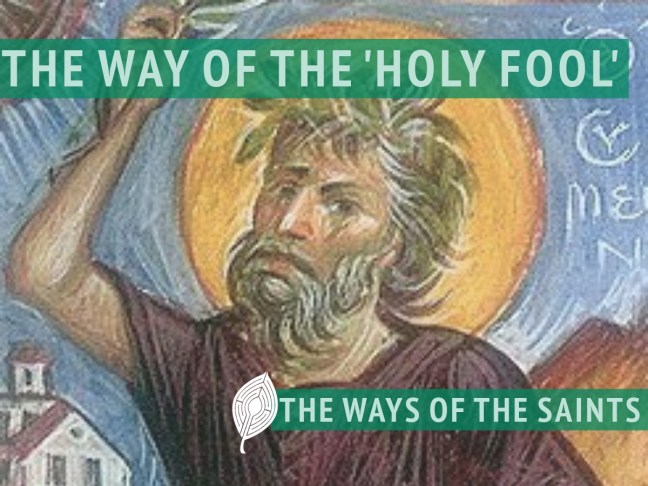
If there is any pattern or trope of saintliness that this man (I’ll not use a name to respect the privacy of those more closely impacted by his death) followed it was that of the ‘Holy Fool’, individuals who throughout history have shirked the conventions of their societies and in so doing drew attention to the gulf that exists between ‘the way things work’ and what is ultimately important. Of course, not all social conventions are bad, and so these saints often left a difficult wake, causing a lot of hurt and confusion along the way. And yet nevertheless something about their lives was recognized as godly. In the fourth century, St. Isidora of Egypt’s behaviour was so antisocial that she was publicly ridiculed and even beaten, but was recognized for the patience and forbearance with which she endured others’ scorn. In the sixth century, St. Simeon the Fool was an outright nuisance in his Syrian town, but also healed many through his prayers. In eleventh-century Greece, St. Nikolas the Pilgrim so annoyed those around him with his constant repetitions of the phrase ‘Lord have mercy’ that he was repeatedly sent away from homes and monasteries; yet a cathedral was named in his honour just a few short years after his death. In the fifteenth century, St. Basil the Wonderworker of Moscow began by shoplifting to feed the poor and ended up naked on the streets himself; but even in his worst condition, he commanded respect — even getting away with rebuking Ivan the Terrible in his own royal chambers! In eighteenth century France, St. Benedict-Joseph Labre rejected his family’s wealth and, eventually found his calling on the road in a constant pilgrimage, surviving on only the goodwill of others. Some of these ‘fools’ likely suffered from what today we understand to be mental illness or cognitive impairments, but this just means that our tradition has space for those living with even severe mental illness to be holy. And the fact remains: across time and space, God has somehow been revealed in the lives of those who couldn’t or wouldn’t ‘fit in’ to society’s norms.
This family member of mine could be considered a ‘fool’ in this sense. In so many ways, did not fit into society (and had no interest in doing so) or live up to his responsibilities. And yet, there were ways in which he was unquestionably holy. Much like the holy fools of old, his rejection of social norms acted as a goad for those of us who live more conventional lives. But most importantly, as much as he rejected society, he had a huge heart for others who didn’t fit in. And so he was able to welcome and make easy friends with a wide assortment of people who didn’t receive much in the way of attention or friendship, ranging from those who were just a little odd to those with severe developmental and cognitive disabilities. He loved far more openly and widely than many of us (myself first and foremost) could imagine. As my mother commented, “This will sound sentimental, but I wish they could donate his heart, because nobody had a bigger heart.” And in this, without question, he followed and manifested the way of Jesus in his life. Like Christ, he loved “the least of these,” without reservation or condition. And that is a truly beautiful and humbling thing.
And so as I have said goodbye to this complicated man whom I often found difficult to love, I am grateful for him and his witness. May his memory be eternal, and may his big-hearted love be an example for us all. Amen.
–
Holy fathers and mothers Isidora, Simeon, Basil, Nicolas, and Benedict-Joseph, pray for us and for our newly-departed brother in Christ!
 Matthew Root
2 thoughts on “The Way of the ‘Holy Fool’”