
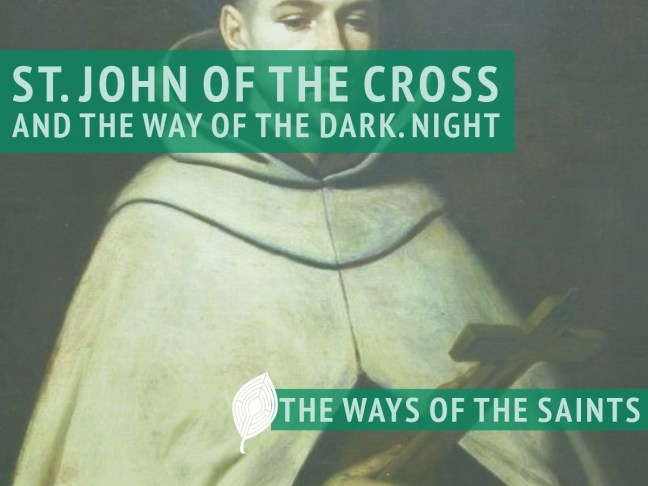
One of the better known concepts of Christian spirituality today is the idea of the ‘Dark Night of the Soul.’ But juts because It’s well-known doesn’t mean it’s well understood. It refers to an extended period of spiritual dryness in which no consolation can be found, but which, in hindsight, is paradoxically experienced as a time of great beauty and spiritual nourishment. Having gone through one of these times myself I can tell you that a) it’s not fun, b) knowing it’s a ‘Dark Night’ doesn’t make it any better, and c) it’s a huge — and pardon my language here — mind-fuck. But today I’d like to focus less on the phenomenon of ‘Dark Nights’ than on the man who coined the term, St. John of the Cross. We’ll see here that he came to the idea honestly (and brutally so), and that his path of holiness is both (thankfully) unique, and also remarkably relatable. And this, I think, makes him the perfect figure with which to begin this Lenten series on the Ways of the Saints.
Juan de Yepes y Álvarez, who would become known as Juan de la Cruz, or John of the Cross in English, was born on June 24, 1542, while Europe was in the thick of the Protestant Reformation. By way of context, the Council of Trent (the Roman Church’s official response to the Reformation) would be convened in 1545, and Martin Luther died in 1546. While Spain was a strongly Catholic country, the reforming spirit was alive and well, and John would become an important figure in the Catholic Reformation there. Somewhere around the time of his ordination to the priesthood in 1567, John encountered St. Teresea of Avila, who was leading a reform movement within the Carmelite monastic order. St. Teresa believed that the Carmelites had become too lax in their observances and therefore too worldly to be effective witnesses to the Gospel. John quickly founded a small monastic house that was the first male community to adopt Teresa’s reforms. After initial successes that led to the expansion of this first house and the founding of additional communities, the backlash against the Carmelite reform movement was in full swing by the 1570s. Years of legal attempts at halting the reforms ended in a stalemate, and in 1577, opponents of John and Teresa took matters into their own hands. John was forcibly taken captive and brought before a court of traditional Carmelite friars. Found guilty of disobedience, John was sentenced to imprisonment in a small cell (according to some reports, an old latrine), with limited food, and regular public lashings. Despite these harsh conditions, it is believed that it was during this period that John composed his most famous works, The Dark Night, and The Spiritual Canticle. He managed to escape after nine months of captivity and after a brief period of convalescence, continued on with his work founding monasteries and promoting reform. He eventually died of natural causes on December 14, 1591.
John of the Cross’s life is both wildly unique and sadly relatable. Few of us may be imprisoned by rogue reactionary monks (though, the way things are going, who knows…), but his experiences of fierce opposition to his attempts at institutional reform, the bad faith arguments made against him, and the ‘Dark Night’ that accompanied all this, have been shared by many, both within and outside the Church. All too often our best and most inspired ideas are the ones that face the greatest opposition, and when such experiences are not leavened with spiritual consolations, it’s easy to feel like giving up. And so, John’s gift to us in the form of his poetic guide to surviving ‘the Dark Night’ is a welcome and needful one.
His spiritual genius was that he was able to see that the night of desolation itself was a gift. His poem, despite its themes of longing and anxiety, is a love song, about how the soul can find its divine Lover within the darkness. The Dark Night is, paradoxically, also a safe space for us to truly encounter God without the trappings of ‘success’ or ‘consolation’ or ‘peak religious experiences’. For as wonderful as such blessings are, we can be easily distracted by them, come to see them as ends in themselves instead of means to the end of knowing God better, or even mislead ourselves into thinking they mean we are holy or specially blessed by God. It’s when all of these are stripped away and we are truly laid bare by life when God can be at work within us.
This is a spiritual truth that is hard — I might even say usually impossible — to see in the moment. My own ‘Dark Night’ experience was a profoundly, existentially, lonely season in my life that I would wish on no one. The fact that, as I look back on it now, I can see and even feel God’s presence with me within that experience doesn’t make it any less harrowing. My first response to this after-the-fact realization of God’s presence within that season was not to rejoice or give thanks for it, but to get angry at God for it: How dare God insert Godself into my memories of that time of divine absence! It’s like being on a desert island with a friend, who then disappears for three years, leaving you to fend for yourself. And then suddenly, he returns and is like, “Hey, remember that time when….?” It’s beyond infuriating! And yet, in some strange, ineffable, incomprehensible way, I cannot deny that God was there with me in that season. And, while I wouldn’t wish it on anyone, I also can’t say I wish it had never happened. That’s the strange mystery of the Dark Night, that St. John of the Cross so wonderfully articulated. That he could very well have done so while living in an abandoned latrine and covered in open wounds from public torture is all the more impressive.
And this is the mystery of the Saints. They embody Christ in the world in a unique way that is nonetheless universal. St. John of the Cross embodied Christ in his commitment to serving others, in his rejection by those he’d come to serve, in his sham trial and public suffering, and in the utter desolation he experienced. But he used that experience to create something beautiful, which has been an important spiritual guide for generations of believers who too have suffered greatly only to discover God had been there the whole time suffering with them and loving them.
And so, as we start our Lenten journey together today, let us pray with St. John of the Cross:
Oh, night that was my guide,
Oh, night more lovely than the dawn,
Oh, night that joined
Beloved with lover,
Lover transformed in the Beloved!
Amen.
 Matthew Root
2 thoughts on “St. John of the Cross and the Way of the Dark Night”