This section in the series The Christian Shadow has been about the ways, contrary to Jung’s accusations, Christian teaching and practice helps the faithful engage with the shadow, the dark parts of ourselves we’d rather not exist, and certainly not come into the light of day. Over the next two posts, I’m going to end this section by thinking about the sacraments, and how they can engage with the shadow, in both helpful and unhelpful ways.
In historic Christianity, the sacraments are those rituals that are believed in some way to make the divine present with the faithful. It’s hard to say much more about them because the East and West traditionally talked about them in very different ways, so finding language that everyone might find acceptable is challenging. But the essential point is that they are visible and tangible acts that carry significant spiritual weight and make God present in a particular way. Historically speaking, the East never delineated a set number of sacraments, and that is my preferred approach as well. However, just for ease of discussion, I’ll be taking the Western approach here, and discussing the seven sacraments traditionally acknowledged by the Western Church. Today I’ll start with baptism, confirmation (aka chrismation), and the Eucharist (aka Holy Communion).
Baptism
I already covered baptism last week, but as a reminder, baptism is the ceremonial death and rebirth enacted by immersion in or the pouring of water that marks someone’s conversion and welcome into the Church. It is therefore connected to the idea of repentance — the change of life and perspective that comes from being confronted with the stark difference between the Kingdom of God and the kingdoms of this world. At its best, then, baptism is a powerful kind of shadow work, in which we accept the realities of those parts of us we don’t like and commit to leading a new way of life.
But, again, since this series isn’t just about how Christian belief and practice can help us engage with our shadow, but also about being aware of the ways in which it can be unhelpful and even damaging in that regard, we have to look at the ‘shadow side’ of these practices too. In those parts of Christianity that baptize infants and small children (i.e., everything outside the Anabaptist traditions), baptism has come to simply be the official welcoming of someone into the Church. While it still carries the theological weight of the practice, that weight doesn’t engage with the lived experience of the person being baptized at all, meaning that whatever may be happening spiritually or metaphysically to the newly baptized, it doesn’t carry the shadow-working possibilities of believer’s baptism. Anabaptist traditions, however, by insisting that one wait until one truly believes before being baptized, introduce their own possibility for things to go wrong. For example, I know a few people who grew up in these traditions for whom this idea of true conversion or true faith became a source of severe anxiety, to the extent that they were baptized several times, not trusting that they had really ‘believed enough’ when they were baptized previously. This focus on faith also tends in these communities more towards the cognitive (i.e., intellectually assenting to the idea that Jesus died for their sins) and emotional (i.e., truly feeling emotionally wrought by this realization) than the psychological. If anything, the altar call has replaced baptism in such tradition as the true ritual of repentance.
As beautiful as rituals of belonging like baptism are, there is always a shadow side to belonging and community. A big part of Jesus’ teaching, and the teaching of the apostles after him, was about breaking down barriers between human communities: Jews and Gentiles, rich and poor, citizen and enslaved, male and female. At its worst, belief in the Church can simply replace those old divisions with a new one, saved and unsaved, or faithful and infidel. It’s a constant challenge that we need to be aware of as Christians. On the one hand, it can lead to “Chosen People” syndrome, where we just accept Christianity (or whatever community it may be) as ‘our team’ that we cheer for and identify with, and we support ‘our team’ no matter what — even if that team is doing or saying atrocious things Jesus would reject and rail against! — and reject anything that comes from outside of it — even if they are aligned with the founding message of our community. On the other hand, it can create false hard boundaries, leading to situations where, for example, unbaptized babies were refused burial in Church cemeteries. This is not to say that community and identity and belonging are bad — not in the least; they are of crucial importance for us as humans. But it is to say that we need to be careful we lean into the positives of these phenomena while guarding against and working hard to mitigate their negatives.
Chrismation – Confirmation
Much the same can be said for the other initiatory sacrament, known as chrismation in the East and confirmation in the West. If baptism is about the death of the old self and the birth of the new self within the Church, confirmation/chrismation is about sealing the baptismal covenant through the gift of the Holy Spirit. It was originally attached to the baptismal rite itself (and still is in Eastern Orthodox practice), but has in the West been separated out as a distinct ceremony when the individual, generally baptized as an infant, comes of age and feels ready to take on the weight of their baptismal covenant for themselves. As such it can run the same gamut of social meaning as baptism, from welcoming into a community to coming of age. And, it has a similar shadow side, as belonging and identity can always run the risk of tribalism.
Eucharist – Holy Communion
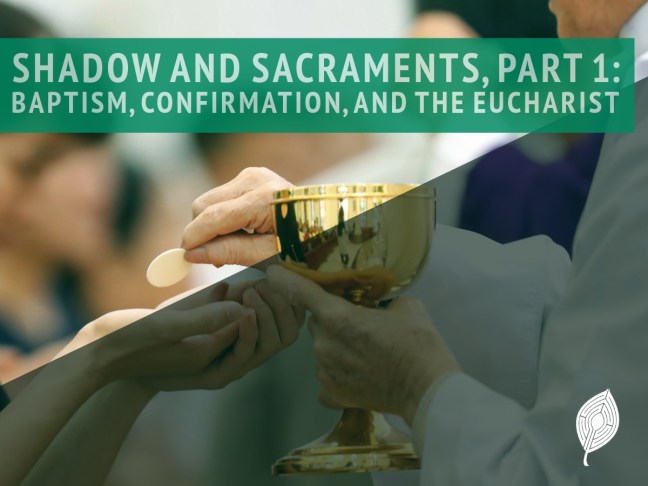
In a sense the Eurcharist, the quintessential Christian sacrament, is another sacrament of belonging. In this ritual meal of consecrated bread and wine, we commune with each other in the community of faith, and with Jesus himself. As Matthew records the institution and ‘founding words’ of the Eucharist at the Last Supper:
While they were eating, Jesus took a loaf of bread, and after blessing it he broke it, gave it to the disciples, and said, ‘Take, eat; this is my body.’ Then he took a cup, and after giving thanks he gave it to them, saying, ‘Drink from it, all of you; for this is my blood of the covenant, which is poured out for many for the forgiveness of sins. (Matthew 26.26-28)
These are pretty shocking words, and perhaps more shocking is that the Church has traditional taken them literally, insisting that in some mysterious way (Christians have never agreed on the ‘how’ of it, and I would insist that the how is completely unimportant), when consecrated, the bread and wine become Christ’s body and blood. By eating and drinking them, we are united to him in the most visceral of ways. Beyond the macabre imagery (which did not do early Christians any favours in getting accepted by Greco-Roman society), this is a very powerful way of articulating and symbolizing our belief that we become one with Christ. And if we take that imagery seriously, it’s a profound ritual. Jung was aware of this and was quite taken with the ritual power of the Eucharist. At one point he wrote (and this is the broader context of a piece I’ve already quoted in this series!):
If you have still not learned [the way of Jesus] from the old holy books, then go there, drink the blood and eat the flesh of him who was mocked and tormented for the sake of your sins, so that you totally become his nature, deny his being-apart-from-you; you should be he himself, not Christians but Christ…. No one can be spared the way of Christ, since this way leads to what is to come. You should all become Christs.” (The Red Book 137)*
The most obvious shadow side of the Eucharist, like any ritual, is that it lose its symbolic power and simply become rote, going through the motions. But the opposite is also oddly true. In some Protestant churches, especially those under the ‘anabaptist’ or ‘evangelical’ labels, they don’t take Jesus’ words literally, but focus on the memorial aspect of Communion. Being hyper-aware of the risk of ritual becoming rote, Communion in these communities can instead become hyper-emotional, with congregants working themselves up into tears as they bring to mind Christ’s death on the cross. There’s nothing wrong with being emotional, but at times (in my experience), the mindset surrounding Communion in these churches promoted a competitive spirit about who ‘felt it’ more, or anxiety about whether someone was feeling it ‘enough’ to participate. A similar thing happens in more sacramental churches when people, out of supposed reverence for the sacrament, refuse to participate in it thinking they aren’t good enough to do so. But first of all, it’s a gift, and second of all, the liturgy does a lot of preparation work for us. If you are baptized and actively participate in the liturgy (which includes praise and thanksgiving, confession of sins, and meditation on the mighty saving works of God), there should really be nothing holding you back.
Another possible aspect of the shadow of the Eucharist is far more controversial, since it refers to an actual practice in some Churches, which is the adoration of the sacrament. The rationale for this practice is simple: If we truly believe the consecrated bread and wine are the body and blood of Jesus, then they legitimately deserve our veneration and worship. But for me, it seems to be an adventure in missing the point. It reminds me of a kid I once knew who was so excited about a new toothbrush (of all things), that he didn’t want to use it. Instead, he decorated it and made a shrine to it in the bathroom. Just as a toothbrush is useless if you don’t brush your teeth with it, the Eucharist is meant to be consumed. The whole point is to embody the life of Jesus within us by eating his flesh and drinking his blood. Looking at it and admiring its holiness doesn’t cut it.
This post is probably long enough. Next time we’ll turn to the other traditional sacraments of the Christian West: marriage, anointing of the sick and dying, ordination, and confession.
 Matthew Root
One thought on “Shadow and the Sacraments, Part 1: Baptism, Confirmation, and the Eucharist”